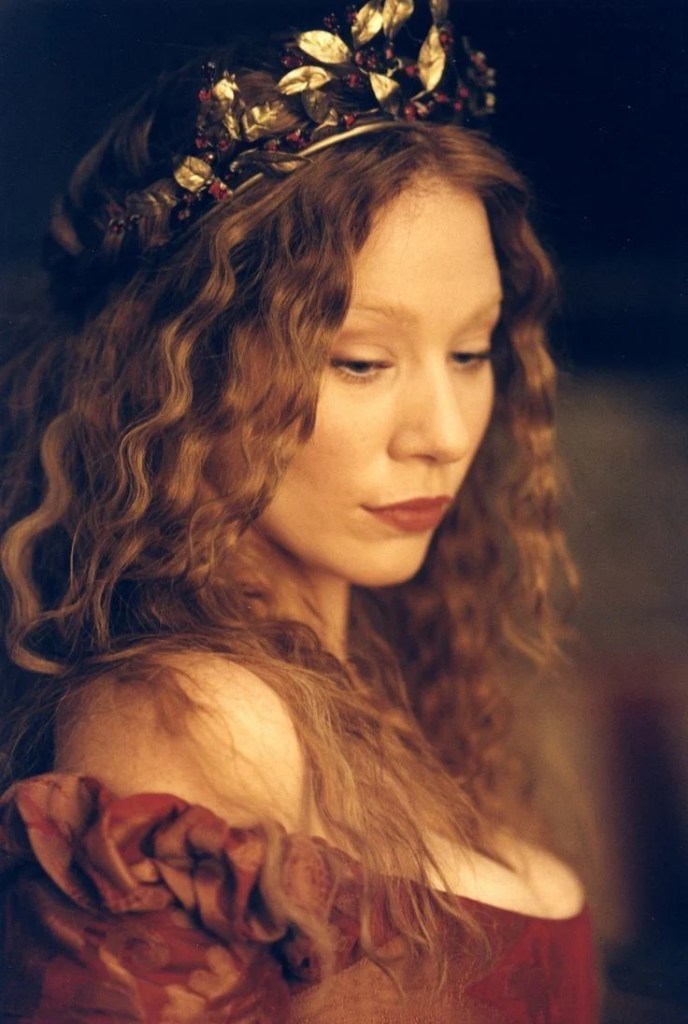
Shakespeare’s Portia visits the puzzle today, identified as “The Merchant of Venice character who favors wordplay.” She has a line in which she comments on “the will of a living daughter curbed by the will of a dead father,” i.e., a play on the word “will.” (The second will refers to a will as a testamentary document.) She is better known for stating that “the quality of mercy is not strained,” which goes pretty far towards explaining why it’s so lumpy.
And she’s the first image I managed to place into the blog! This is Lynn Collins as Portia, quite beautiful. She played Portia in the 2004 movie version, with Al Pacino as Shylock. Portia is also wealthy and very sharp, thus she successfully argued the case against Shylock to save Antonio. (Oops — I forgot to say “spoiler alert.”) The New England School of Law recognized her legal acumen — it was called the Portia Law School when it was established in 1908 as a law school for women only, and it retained that name until 1969. Abigail Adams used Portia as her pen name when she wrote letters to hubby John Adams, who signed his “Lysander,” the handsome young man from Athens in A Midsummer Night’s Dream. I may start signing my notes to Linda like that. (Too late?) Last, the “Portia Hypothesis” holds that women with masculine-sounding names tend to be more successful in the legal profession than those with feminine-sounding names.
Other visitors to the grid today are Manhattan’s first Black elected district attorney, Alvin BRAGG, at 74D. Welcome counselor! He’s right next to YOYO MA at 75D, proving there’s always room for cello. And welcome as well to (Dame) ANNA WINTOUR of Vogue and Conde Nast. She should zhuzh things up a bit. And ERNIE PYLE, WWII correspondent, of whom Harry Truman said: “No man in this war has so well told the story of the American fighting man as American fighting men wanted it told. He deserves the gratitude of all his countrymen.” He was killed by Japanese machine gun fire, and was buried wearing his helmet, between an infantry private and a combat engineer.
But the star of the puzzle was ALAN TURING of “The Imitation Game” and Enigma Machine fame. The Enigma Machine is what the Germans used during the war to encrypt messages, and Turing helped decipher them for the good guys. As a letter in code was typed into the machine, its counterpart appeared above it (or something like that). And in the puzzle eight five-letter answers had to be “decoded” to get a Turing quote. But the code was given to us solvers, and the online version did the decoding for you, by flashing first the answers you entered and then the decoded quote — similar to how the Enigma Machine worked, I guess — you entered one version and then the other appeared. So we didn’t have to solve anything other than the regular puzzle, which was on the easy side. I mean, everyone knows Herbert Hoover’s middle name was CLARK, right?
Turing and the British were building on the groundbreaking (and code-breaking) work of Polish mathematician Marian Rejewski. Here’s a memorial dedicated to Rejewski in the Polish city of Bydgoszcz.

OK, that’s about it for today. I’m going to stare a bit longer at Portia, above, and then go watch the Jets.
 The Wellington Files