A special welcome to new friend Bogie — woof woof! No one can ever replace Susie, but we love you little guy! Nor says Bogie really loves taking walks. What a sweetheart! (Hi Norrie!)

If you read yesterday’s post, please do not confuse the horse with no name with the horse with a clock in its stomach from The Honeymooners. As you may recall, Ralph won the horse with a clock in its stomach in a pinball contest at a local pizza shop but failed to include it in his gross income, under Internal Revenue Code Section 61. It was worth $15. He thought this was the reason he was called in by the IRS. Norton went with him to the meeting — what are friends for? — and when the revenue agent mistook him for Ralph, Norton said: “He’s Kramden. I’m clean.” It turned out Ralph just forgot to sign his return, but he fessed up about the horse with a clock in its stomach, and the agent lauded him for being a good citizen.

Yesterday’s theme was things that can be referred to via the letter K, but don’t start with a K. So from baseball there was the STRIKE OUT. And, “in a salary listing,” THOUSAND. From the periodic table: POTASSIUM, which someone noted has a big tuchas in the center. And, finally, “on a printer cartridge,” BLACK INK.
I wasn’t aware of that last one, but one commenter said: Having worked in publication design for years, I’m super familiar with the print color model CMYK (cyan, magenta, yellow, and black), the basis for almost all color printing for over a century. The reason K stands for black (and not B) is so as not to confuse it with B for blue, which later was used in the RGB (red, green, and blue) color model used in color TVs and monitors. [Note: RGB, in this context, does not refer to the late Supreme Court Justice Ruth Gader Binsburg.]
But later this appeared: I don’t want to be “that guy,” but the black is abbreviated K in CMYK because it stands for “Key,” not to avoid confusion with the B in Blue. In old printing presses, the black plate was the “key plate” that was used to align all three colors, so the inks were always identified as CMYK for this reason.
Okay. Thanks!
In yesterday’s puzzle, 7 down was clued as “Baseball’s Felipe, Matty, Jesus or Moises,” and the answer was ALOU. But one commenter noted they left out Bob Alou. And another said, don’t forget about Cal Alou, the chef who specialized in Caribbean food. Or Boog Alou. Or the liveliest of the bunch: Skip Tom Alou. Quite a family. Here’s an autographed card of Moises Alou from my collection:
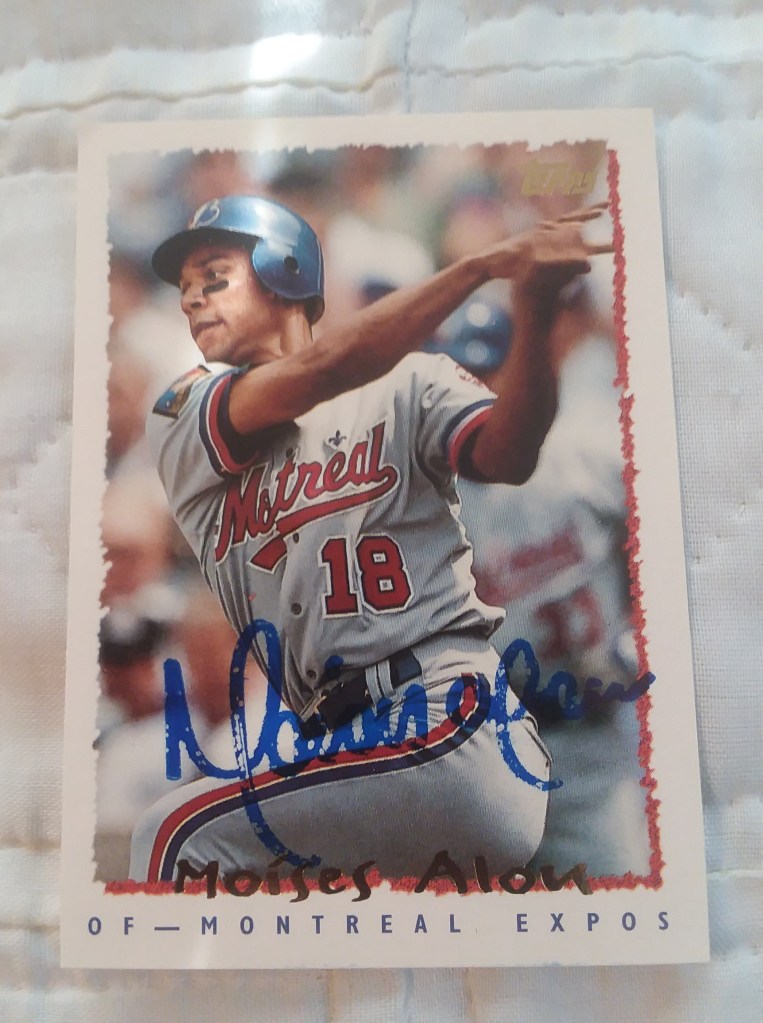
Moises had a heckuva career, with a lifetime batting average of .303 with 2,134 hits, 421 doubles, 332 home runs, and 1,287 runs batted in. Alou is one of the few baseball players who batted without the use of batting gloves. Instead, Moisés revealed that during the baseball season, he’d urinate on his hands to toughen them up. So that’s what he was doing in the outfield! TMI!
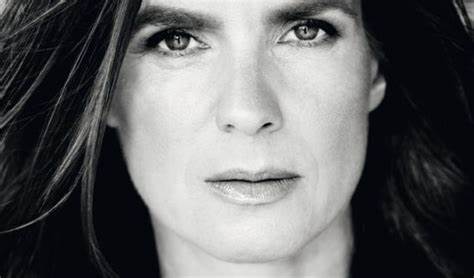
Let’s skate to something more pleasant to round out yesterday’s grid: the lovely Katerina WITT, Olympic figure skating champion, who glided in late, at 60 across. So we start with a dog and end with a Kat.
“Witt’s taste in figure-skating costumes sometimes caused debate. At the 1983 European Championships, she skated her Mozart short program in knee breeches instead of a skirt. Her blue, skirtless feather-trimmed 1988 costume for a showgirl-themed short program was considered too theatrical and sexy, and led to a change in the ISU regulations dubbed the ‘Katarina rule’ which required female skaters to wear more modest clothing; skirts were required to cover the [important parts]. In 1994, skating a Robin Hood-themed program, Witt stated, ‘I wore the Robin Hood – like a man’s costume – because I didn’t want to be accused of seducing the judges this time.’”
Today’s puzzle was all about ANTICI . . . PATION. The first part (ANTICI) was the first across answer, and the second part (PATION) was the last across answer. In between, there was ALMOST THERE, WAIT FOR IT, and NOT QUITE YET.
Commenter Wanderlust noted:
“The theme made me think of the Carly Simon song, of course (written while she was waiting for Cat Stevens to show up for a date, I believe). The ketchup ad with the Carly song is an interesting case of an advertiser emphasizing a flaw in its product. All of us oldsters remember turning the glass bottle upside down, pounding on the base and waiting excruciatingly long for that first ooze of red. The spoiled kids today with their plastic squeeze bottles! They had no idea of the living hell we went through before we could eat the burger! And get off my lawn! “
A later note added the following:
“As for ketchup bottles, I think the modern trend of putting the labels on them upside down to encourage you to stand them on their heads is undermining the moral fiber of our society.”

“Residents of the Sagebrush State” was NEVADANS. When we took our Grand Canyon trip many years ago, I learned that I was mispronouncing “Nevada.” I said the middle syllable like the “a” in “dad.” But the locals pronounce it “ah.” After learning this, I started pronouncing it correctly. But Caity continued to pronounce it with the “a” from “dad.” I said, “Caity, we just learned that the people who live here pronounce it the other way,” and she said “But I don’t live here.”
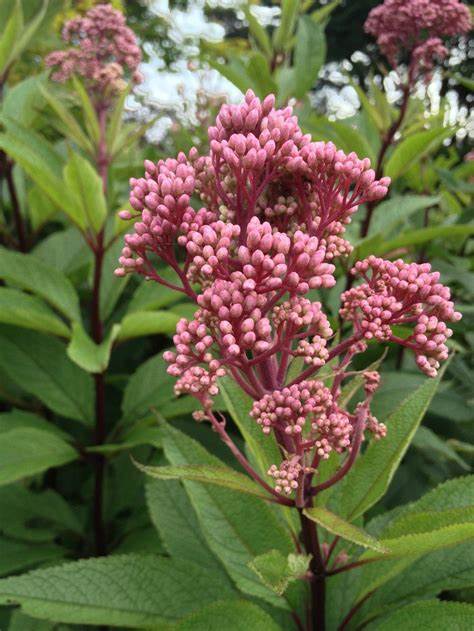
The clue for 48D was “Joe-[blank] weed,” and I had no idea what it was. It turned out to be Joe-PYE weed, and here’s a comment on it:
“Eupatorium purpureum, or Joe-pye weed as most people know it, is far from an unwanted weed to me. This attractive plant produces pale pink-purple flowers that last from midsummer through fall. It’s a great addition to nearly any garden and a must have for wildlife lovers, attracting a multitude of butterflies with its sweet nectar. Growing Joe-pye weed flowers is a wonderful way to bring a little bit of nature to your backyard. What are Joe-Pye Weed Flowers? They were named after a New England man who used the plant medicinally for helping people with typhus fever. In addition to its medicinal properties, both the flowers and seeds have been used in producing pink or red dye for textiles.”
Mollusks made up a mini-theme. First there was NACRE (“Source of iridescence in many mollusks”), and then CONCHS (“Mollusks with iridescence not created by nacre”). Conch can be pronounced either conk or conch. So if you’ve run out of them you can say you’ve “conked out.”

Fashion designer ANNA SUI visited today. Here’s what Wikipedia says about her:
“She was named one of the ‘Top 5 Fashion Icons of the Decade,’ and in 2009 earned the Geoffrey Beene Lifetime Achievement Award from the Council of Fashion Designers of America (CFDA), joining the ranks of Yves Saint Laurent, Giorgio Armani, Ralph Lauren, and Diane von Furstenberg.”
Not too shabby. Here’s one of her outfits on one of my tax students, followed by Anna herself.


Last, a special shout-out to Don up in Newton MA who reported on turkey sightings in light of the Jill Lepore article from a few days ago. Here’s Don’s report:
“We saw turkeys in a neighbor’s yard on our daily walk this morning. (Proof attached below.) We see turkeys in our neighborhood very often. Sometimes as many as 20 together. They’ve wandered through our yard many times. And they frequently stop traffic on Walnut Street for 10 minutes or so as a dozen or more cross the street. We’ve also seen them on the Cape.”
Thanks, Don!

OK everybody — thanks for stopping by. Happy puzzling!
 The Wellington Files