Let’s open with a special shout-out to old friend Bob (and Hi Justine!). Bob was the head librarian at the School of Visual Arts. He started as Assistant Shusher and worked his way up. Bob earned a Masters in Library Science after Brandeis and he kept telling us it was a challenging program. I’d say, How hard can it be? What do you need besides the alphabet?
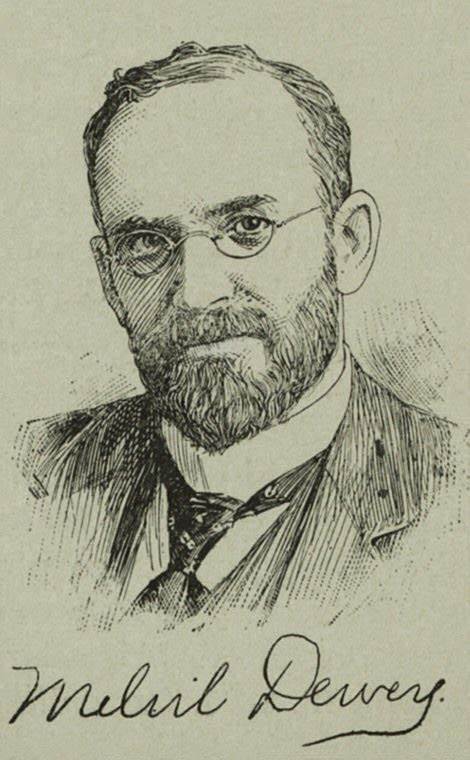
And the reason for the shout-out is it’s the birthday of Melvil Dewey (1851), of the Dewey Decimal system. Dewey put himself through college (Amherst) working in the library and was appalled at how disorganized their “system” was. The system he devised is a series of classifications divided and subdivided into subjects with a decimal number assigned to each book.
As a youth, Dewey advocated spelling reform; he changed his name from “Melville” to “Melvil,” to drop “redundant letters,” and for a time changed his surname to Dui. (That didn’t catch on, you may have noticed.) He was the head librarian at Columbia University and a founding member of the American Library Association. But he resigned in 1905 amid widespread allegations of sexual harassment, racism, and anti-Semitism. Yikes! Bottom line: Not a mensch.
Here’s a poem by Ted Kooser, from Winter Morning Walks (2000):
The sky hangs thin and wet on its clothesline.
A deer of gray vapor steps through the foreground,
under the dripping, lichen-rusted trees.
Halfway across the next field,
the distance (or can that be the future?)
is sealed up in tin like an old barn.
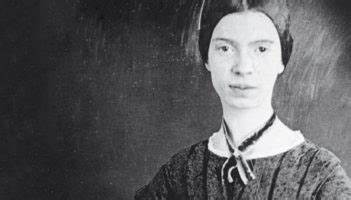
It’s a good day for a poem because it’s Emily Dickinson’s birthday too (1830). She wrote about 1,800 poems but only ten were published in her lifetime. She spent hours in the kitchen with Margaret Maher, the family’s Irish maid, baking breads and cakes, and scribbling poems on chocolate wrappers and the backs of shopping lists. Maher dabbled in poetry herself; they wrote poems back and forth to each other. Dickinson trusted Maher with her poems — literally. She stored them in the trunk that Maher had brought over from Ireland. Maher did not honor’s Dickinson’s request to burn her poems after her death.
When Emily died, her family honored her request to have her coffin carried not by Amherst’s leading citizens, but by six Irish farmworkers — all Dickinson employees. Thomas Kelly, Maher’s brother-in-law, was the chief pallbearer, and they carried her coffin out through the servants’ door.
Here’s a joke freshly stolen from Vermont Lizzie’s 8-year-old friend: How much do Santa’s reindeer cost? Nothing — they’re on the house.
Today’s puzzle had some clever clues:
“Let-them-eat-cake occasion?” Answer: CHEAT DAY (think diet)
“Mug shot subject?” Answer: LATTE ART
“Evidence of one’s hang-ups?” Answer: DIAL TONES
Heard of Leo Baekeland? Father of PLASTICS? Me neither. He was a Belgian chemist, born in 1863. His invention of Bakelite, an inexpensive, nonflammable, and versatile plastic, marked the beginning of the modern plastics industry. He was on the cover of the September 9, 1924 issue of TIME. We had Katherine Ross from The Graduate in owl-chatter recently. You may recall this line from the movie too: “Just one word, Ben: Plastics.”

Time for another adventure in mathematics! Judy, pay attention. The clue for 37 across was “Mathematician Terence who won a Fields Medal at age 31.” Answer TAO. Here’s a (lengthy) comment by TTrimble that I found absorbing despite understanding very little of it. Amazing what these puzzles elicit.
“Terry TAO is an unusually brilliant mathematician. Many consider him the best mathematician working today, with no sign of slowing down. He also has a great talent for collaboration, and has spearheaded a number of “polymath projects” which seek to crush problems through crowd-sourcing. It’s not easy to find problems that submit to such an approach (and to skillfully herd a crowd of mathematical cats), but he finds them. A great example came after the breakthrough of Yitang Zhang in 2013 in the area of number theory.
“In case you haven’t heard of this, I’ll explain. Number theory is full of really hard problems, many dating to antiquity. It’s been known at least since the days of Euclid that there are infinitely many prime numbers. Those Greek mathematicians were also interested in “twin primes”: pairs of primes differing by 2: 3 and 5, 5 and 7, 11 and 13, etc. Are there infinitely many pairs of twin primes? Everyone thinks so, and there are statistical heuristics that suggest so, but we seem to be very far from being able to prove this. The breakthrough result of Zhang (who held a very modest position as a college lecturer), a bolt from the blue, is that there are infinitely many pairs of prime numbers that differ by less than 70 million (to prove the twin prime conjecture, you’d want to replace that 70 million by 3). His proof rocked the mathematics world: although 70 million sounds like a lot, it was a significant toe in the door. And it rocketed Zhang personally, when he was close to 60 years old, from nameless obscurity to a distinguished professorship at UCLA, where Tao himself works. Anyway, Tao and others started a polymath project to refine Zhang’s methods, to see how far they could whittle that number down: Zhang knew 70 million was overkill, but getting any number was the significant thing. Polymath 8, with Terry Tao at the helm, sought to extract maximal juice from Zhang’s (and related) methods, and succeeded in lowering that number from 70 million to 246. He (Tao) is not only an insanely powerful mathematician, but a class act.”
Ouch, my brain hurts. Can we get back to Taylor Swift? Here’s Terry Tao.

I’m sleepy now. See you tomorrow.
 The Wellington Files
One response to “Emily Dickinson’s Funeral”
I loved the math challenge! I am familiar with twin primes, although I had never heard of Terry Tao — but now I have. Thanks!
LikeLike