There’s a less-than-great Steven Wright joke in Saturday’s puzzle: “I spilled spot remover on my dog and now he’s gone. ” (A better line of his is “I’m having amnesia and deja vu at the same time: I think I’ve forgotten this before.”)
The clue for 10D was “Crude meas.” and the answer was BBL — the abbreviation for “barrel” of crude oil. The question arose among the commentariat as to why the second “B” is part of it. This was posted on the issue first:
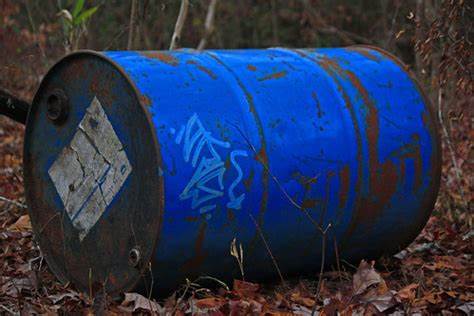
“In the early 1860’s, when oil production began, there was no standard container for oil, so oil and petroleum products were stored and transported in barrels of all different shapes and sizes (beer barrels, fish barrels, molasses barrels, turpentine barrels, etc.). By the early 1870’s, the 42-gallon barrel had been adopted as the standard for oil trade. This was 2 gallons per barrel more than the 40-gallon standard used by many other industries at the time. The extra 2 gallons was to allow for evaporation and leaking during transport (most barrels were made of wood). Standard Oil began manufacturing 42 gallon barrels that were blue to be used for transporting petroleum. The use of a blue barrel, abbreviated ‘bbl’” guaranteed a buyer that this was a 42-gallon barrel.”
However, serious doubt was cast on this via Wikipedia, with proof:
“The ‘b’ may have been doubled originally to indicate the plural (1 bl, 2 bbl), or possibly it was doubled to eliminate any confusion with bl as a symbol for the bale. Some sources assert that ‘bbl’ originated as a symbol for “blue barrels” delivered by Standard Oil in its early days. However, while Ida Tarbell’s 1904 Standard Oil Company history acknowledged the ‘holy blue barrel’, the abbreviation ‘bbl’ had been in use well before the 1859 birth of the U.S. petroleum industry.”
And here are two cites pre-dating 1859:
Niles Weekly Register, June 15, 1816. Supplement.
Page 369.
“23,650 bbls. tar”; “6,015 bbls. flour”; etc
William Cobbett, Porcupine’s Works, Vol. VIII, May 1801. Page 462
“The schooner Columbus, Mason, from St. Vincent’s, for Kennebunk, was boarded by a French privateer, which detained her six hours, and took out of her 60 gallons of rum, a bbl. of sugar, &c.”
So it’s a bit of a mystery, as far as we can tell at the moment. And, of course, who cares anyway?
The Writer’s Almanac informs us that on this date in 1989 the first episode of The Simpsons aired. Yikes! — Sam, who is a big fan, – had just turned one year old. We spent many happy family hours watching that show together.
TWA states:
It has become a point of pride to appear as a guest voice on The Simpsons. The usual pop culture suspects are well represented, but creator Matt Groening often draws from a deep pool of literary glitterati as well. Alumni include David Mamet, James Patterson, Michael Chabon, and Jonathan Franzen. Even the notoriously reclusive Thomas Pynchon has “appeared” twice, but his animated counterpart always wears a paper bag over his head.

Groening has described the Simpsons characters as “creatures of consumption and envy, laziness and opportunity, stubbornness and redemption. Just like the rest of us. Only exaggerated.”
Here’s playwright David Mamet:

There was a funny New Yorker cartoon about a month ago. It was a funeral scene. It was called “Death of a Prankster.” The widow was addressing the people in attendance with her children by her side. She was reading somberly from a card, and saying: In lieu of flowers, please send two dozen anchovy pizzas to Robert Anderson, 19 Foxview Lane . . .
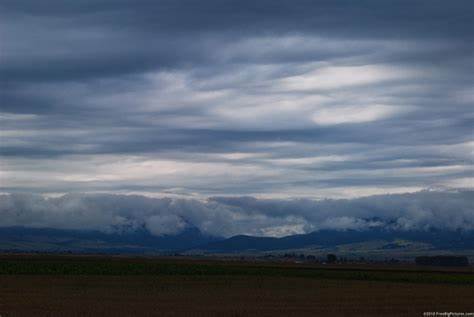
We had cirrus clouds the other day, and today we had STRATI (“overcast clouds”). These are low-level clouds characterized by horizontal layering with a uniform base. More specifically, the term stratus is used to describe flat, hazy, featureless clouds at low altitudes varying in color from dark gray to nearly white.
Here’s another poem by Ted Kooser, from Winter Morning Walks.
All feathered out in clouds,
the wind’s a mockingbird this morning.
Out of its mouth
the piercing whistle of a red-tailed hawk,
the caw of a crow.
No hawk or crow to be seen
from one downy gray side of the sky
to the other.
Ted Kooser won the Pulitzer Prize for poetry in 2005 and served as the Poet Laureate Consultant in Poetry to the Library of Congress for several years. He was diagnosed with cancer in 1998 and started taking a two-mile walk from his home in Nebraska each morning during his recovery from surgery and radiation. He had to stay out of the sun due to skin sensitivity, so he took the walks before dawn.
He grew depressed during the ordeal, and stopped reading and writing. But he started pulling out of it as winter came on and he found himself trying his hand at a poem after one of his walks. He then got into the habit of writing a poem after each walk, pasting it on a postcard, and sending it to a poet-friend Jim Harrison. His book Winter Morning Walks are 100 of those poems.
Several of the poems were put to music by composer Maria Schneider and performed by Dawn Upshaw with the New Jersey Symphony. That’s how I learned about him — I was at one of the performances. Schneider and Upshaw were also recovering from cancer during the project.
I lack the capacity to appreciate any poetry more complex than “Roses are red,” but these seem simple enough even for me.
Thanks for stopping by! Happy Puzzling!
 The Wellington Files