What an unusual turn of events. Back on January 3, 1993, the Houston Oilers took a 35-3 lead over Buffalo early in the third quarter. Stick a fork in them, right? What’s more, Buffalo’s starting QB (Jim Kelly) was out and backup Frank Reich was playing. But Reich led the Bills to a 38-35 win in what was then (and until yesterday) the greatest comeback in NFL history.
Fast-forward to 30 years later: the same Frank Reich began this year as the head coach of the Indianapolis Colts, but he was fired just last month. So yesterday, under new leadership, the Colts pulled out to a 33-0 lead over the Vikings early in the 3rd period. Again — the fork, right? NO! The Vikings rallied for a 39-36 win in overtime, eclipsing the record for the largest comeback by one point. Here’s Frank Reich.

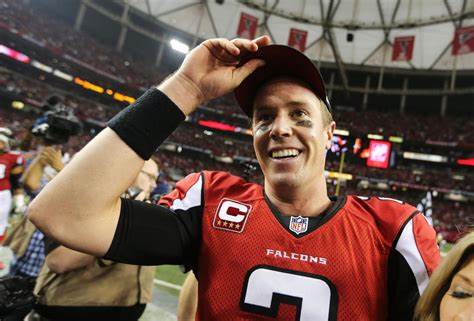
That’s not all. Matt Ryan was the poor Colts QB who fell victim to the Viking comeback yesterday. He was also the losing QB for the largest Super Bowl comeback, when Tom Brady’s Pats stormed back to beat Ryan’s Atlantans in 2017. The Falcons were up 28-3 late in the 3rd quarter in Super Bowl LI, but lost 34-28. Here’s Ryan, in happier times.
So, if Reich were linked to another NFL comeback, it would be The Third Reich, right? Which brings us to a very unusual issue that arose on today’s NYT puzzle. Here’s the grid:
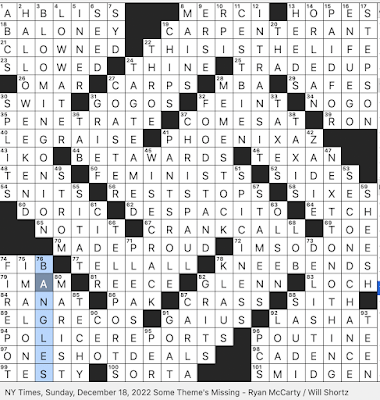
Take a close look at the grid design (squint). Here’s what commenter “egsforbreakfast” wrote. (And he’s generally a sane and interesting voice.)
“I’m a bit surprised that no one (including Will Shortz, Jeff Chen, Rex and others) has noted that squinting at this grid gives you a giant, unambiguous swastika. I’m not saying that it was intentional, but it’s just so inescapable that it’s hard to think about anything else.”
Others agreed with the observation, but “Geezer” said: “Egs — You’re funny and I like your posts but I worry about you.”
“The Joker” added: “When I squint and look at the grid I see people hallucinating.”
Anonymous said: “When I squinted at this puzzle, I saw the Shroud of Turin…”
My view? Well, it is a bit suspicious that the constructor’s name is Anoph Ditler. (No — it’s Ryan McCarty.)
I’m in the “Not a swastika” group. I agree with “Lewis” that’s it’s a “gorgeous swirling hypnotic” grid. He points out that McCarty’s puzzles are known for “stunning” grid designs. My vote is “not guilty.” But it’s right up there for you to see — you decide.
Wait, wait — hold on a sec! The clue for DORIC at 60 across is “Style of column at Berlin’s Brandenburg Gate.” And here’s from Wikipedia: “When the Nazis ascended to power, they used the gate as a party symbol.” Yikes! Now I don’t know what to think. Can’t I do a goddamn crossword puzzle without having to worry about the Nazis??!!

By the way, there was some more input on the BBL/barrel issue discussed at nauseating length in yesterday’s owl chatter. Here’s a note: “Long ago, in the early ‘40s, I asked my Vancouver longshoreman dad about this. He told me it was to differentiate between BALE (BL) and BARREL (BBL).” Sounds good to me.
Nazis aside, there were some neat items in today’s puzzle. At 67A “Joke that goes over the line?” was CRANK CALL. (Get it? — phone line.)
And “Joint accounts?” at 94A was POLICE REPORTS (joint = jail).
Nice clue at 70A for MADE PROUD: “Caused to kvell.”
And I learned that the largest U.S. state capital by population is PHOENIX, AZ. Wow.
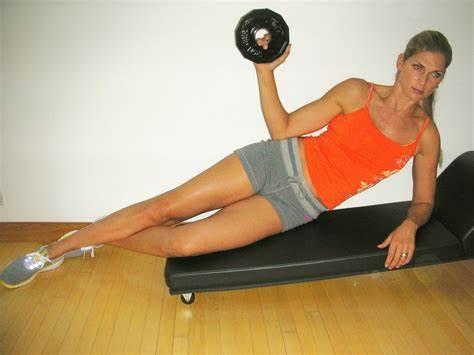
“Volleyball star-turned-model Gabrielle” is REECE (81A). In her book My Foot Is Too Big for the Glass Slipper: A Guide to the Less Than Perfect Life, Reece writes that “to truly be feminine means being soft, receptive, and – look out, here it comes – submissive.” On The Today Show she said that women being submissive in relationships is a sign of strength – not weakness. Her second book: Another Load of Crap, is due out in the Spring.
Here she is at the gym.
At 41D, I learned that the “term for a male opera character played by a woman” is PANTS ROLE. These are more commonly called breeches roles or trousers roles. (Breeches are tight-fitting knee-length pants which were standard male garments when these roles were introduced.)
Most often the character is of a very young man whose part is to be sung by a mezzo-soprano or contralto, hence the need for a woman. The most frequently performed breeches roles are Cherubino (The Marriage of Figaro), Octavian (Der Rosenkavalier), Hansel (Hansel und Gretel) and Orpheus (Orpheus and Euridice).
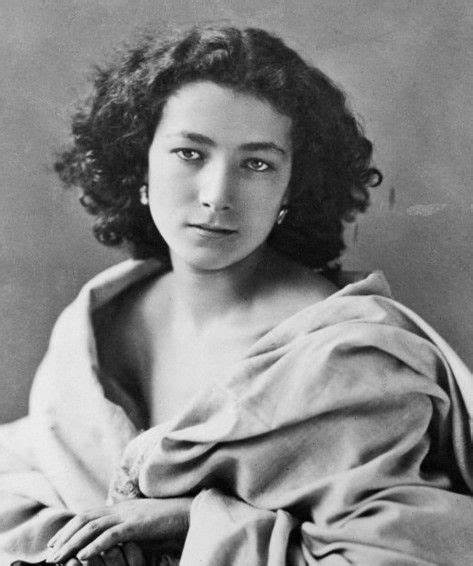
Because stage plays generally have no requirements for vocal range, they do not usually contain breeches roles. But Sarah Bernhardt (below) once played Hamlet as a breeches role.
Some critics thought these roles were just a trick to allow audiences to see women’s legs on stage. (I wouldn’t put it past us.) Here’s a verse suggesting that regarding the famous breeches actress Susanna Mountfort:
You’ll hear with patience a dull scene, to see,
In a contented lazy waggery,
The female Mountford bare above the knee.
Here’s Sarah B. (Not a leg shot, though. Sorry fellas.) I couldn’t find Susanna.
Life in the age of Alzheimers. Here’s a piece from Met Diary today by Patricia Fernandes.
Dear Diary:
We were on a trip to New York and got a restaurant recommendation at the hotel where we were staying. Small, we were told, but the food is good.
When we arrived, we wiggled our way to our table. We were careful not to knock over glasses or bruise our elbows as we settled in after a day of adventures in the city.
After we finished our meal, our waitress returned to the table. “Sorry,” she said to my husband, “I don’t remember what you ordered for dessert.”
He looked at her blankly as he often does in such situations.
“I’m sorry,” he said, “I don’t remember either.”
A woman at the neighboring table piped up.
“He ordered apple pie with ice cream,” she said.
 The Wellington Files