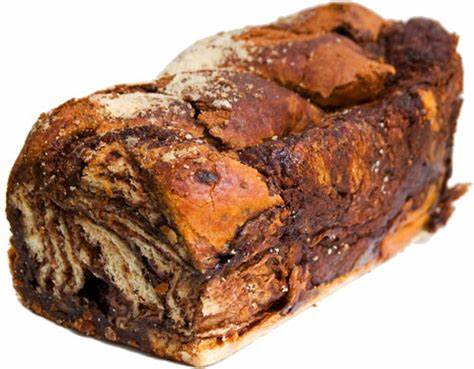
The lavish brunch served up to us by my wonderful Delaware cousins Dayle and Mike this morning included babka. But little did I realize as I bit into a small piece that a raging debate was flaring up in Crossworld over its classification. The clue for BABKA at 20D was “Loaf-shaped cake,” but the question was posed: Is a babka cake or bread? Rex himself notes: Wikipedia calls it a “sweet braided bread,” and specifically states it is not a cake. But Google (Oxford Languages) calls it a loaf-shaped coffee cake and “Spoon University” calls it a dense cake. Authorities can be summoned on either side of the aisle.
Commenter Taylor Slow says: It’s interesting that some people decide whether a baked item is bread or cake based on how it’s served while others decide based on ingredients. I’ve always thought of babka as a sweet bread, because it has the yeasty consistency of bread.
Another note called it a “cake-like bread.”
Airymom said:
I just browsed about a dozen cookbooks compiled by synagogue Sisterhoods. If babka was in the index, then the recipe was in the cakes and pies section. Then I looked in the index of “Spice and Spirit, the Complete Kosher Jewish Cookbook,” a large and comprehensive cookbook which some Jewish women consider the “bible” of cookbooks. If you look up “babka” in the recipe index, it reads, “Babka, see yeast cakes.” In practice, it’s also a cake. If you bake a babka, you serve it for dessert or at Kiddush (collation) after services. No one says, “I think I’ll slice two pieces of babka and make a pbj sandwich.”
And Rebecca said:
I grew up eating BABKA every Saturday morning and consider myself a relative expert on it. The word BABKA comes from the Yiddish word “BUBBE” (or technically “Little Bubbe”) which means “Grandmother.” Traditional BABKA was made from leftover Challah dough that your BUBBE would roll into a long and thin flat dough, spread with chocolate or cinnamon and raisins, and then roll up – for all her grandchildren to eat as sweets. Of course, any BUBBE worth her salt would make sure to make enough Challah dough so that there would be plenty extra. The end product is not all that different from a modern day chocolate danish or cinnamon roll, although instead of being baked as single servings, BABKA is baked as a loaf and the servings are sliced. Cinnamon rolls are formed in almost the exact same way, but they are sliced from the roll into patty shapes before baking. Notably, both cinnamon rolls and danish are made with egg-and-sugar enriched yeasted dough, just like Challah, so they really are the same thing, especially since there are many Challah dough recipes and it would be easy to find the same recipe labeled as Challah dough in one place and Danish dough in another. BABKA is traditionally eaten in the same contexts that one might eat a cinnamon roll or danish. These things are not quite a bread anymore despite having a base of bread dough, but they are somehow acceptable to have for breakfast with a cup of coffee, even though eating a slice of true cake in the same context would not come with the same free pass. So, is BABKA a bread or a cake? It’s a danish. Perhaps this simply semantically passes the buck on the question, because … what is a danish?
Personally, I fall into the cake camp. But I will reserve final judgment until we hear from our friend Joe, whose nickname is Joey Babka! I’ll let you know what he says.
The clue at 49D was “Because of,” and the answer was DUE TO. Innocuous? That’s what I thought. But apparently there is an issue here too.
Mathgent states: I was taught in high school to use “because of” instead of “due to” at all times, but I have heard that “due to” should be used as the beginning of an adverbial phrase and “because of” should be used as the beginning of an adjectival phrase. (Huh? Then someone referred us to the following, which I can follow, but I can’t imagine maintaining the distinction in practice.)
Technically speaking, “due to” should only be used as an adjective and come after a noun. For instance, you could say: The cancellation was due to rain. “Cancellation” is a noun, and “due to” is describing it.
“Because of,” on the other hand, should modify verbs. So you might want to say: The game was canceled because of rain. “Was canceled” is a verb phrase, which makes “because of” the right choice.
Owl chatter has a connection to today’s constructor: Seth Bisen-Hersh. Friends Nancy and Eric (Nancy from Brandeis, and Eric via marriage) have very close friends Wendy and Simon, whom we’ve met, albeit decades ago. And Seth is their son! Mazel Tov, Seth, Wendy, and Simon!
Seth submitted puzzles to the NYT 38 times before having this one accepted. May this be the first of many!

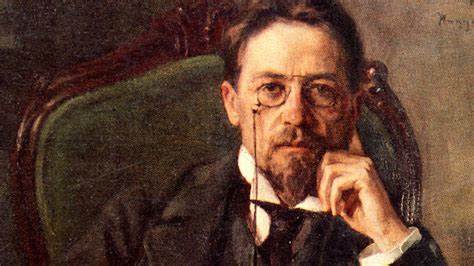
Reaching for a literary figure, Seth didn’t f**k around — he dropped heavy-hitter ANTON Chekhov into his grid at 24D. Chekhov’s big four were The Cherry Orchard, Three Sisters, Uncle Vanya, and The Seagull. Strindberg, Ibsen, and he are often referred to as the seminal figures in the birth of modernism in the theater.
He died of tuberculosis at only 44, and this note appears in Wikipedia: Chekhov’s body was transported to Moscow in a refrigerated railway-car meant for oysters, a detail that offended [the writer] Gorky. Some of the thousands of mourners followed the funeral procession of a General Keller by mistake, to the accompaniment of a military band. Chekhov was buried next to his father at the Novodevichy Cemetery.
Good night everybody — thanks for stopping by!
 The Wellington Files