If you wanted a clue for the name of the constructor of today’s NYTXW, you might use “word with fluid or harm.” It’s Daniel BODILY.
It’s a good puzzle. Remember your PEZ dispensers and candies? The clue for it at 63D says it was originally marketed as a smoking cessation aid. I don’t remember that. In that connection, however, someone noted that the dispensers seem to be like cigarette lighters, which is a little creepy.
The clue for ESCALATOR was cute: “It may have a down side.”
And how about 48D?: “Log feature,” is GNARL. The G is silent, unlike the G in the GNU I ran into somewhere recently. My online dictionary defines gnarl as “a rough, knotty protuberance, especially on a tree,” and offers this nice example of its use: “a blackthorn topped with a two-humped gnarl.”
[Speaking of GNU, I was remiss in not pouncing on it and sharing the absolutely terrific Gnu Song, by Flanders and Swann. If you only click on one owl-chatter song this week, make it this one.]
At 43A, “Step in a mathematical proof” was LEMMA. That’s a word I was always fuzzy on. The dictionary says it’s “a subsidiary or intermediate theorem in an argument or proof.” I think I get it. If you are trying to prove something that says if A, then D, but you have to go from A to B, first, and then B to C, and finally from C to D, you are proving “if A, then D,” and the smaller steps you take to get there are lemmas.
It led to some discussion of mathematics in general among the commentariat. Is HS math useful later in life? Personally, I don’t use it very often, but that doesn’t mean it’s not worth studying. If it’s an exercise that sharpens the mind, it’s worthwhile. The Rabbis don’t study the Talmud to learn the specific laws it describes, but to appreciate the sharpness of the analysis.
I’ll share this comment with you, although I don’t think I agree with it.
“FWIW, I was a very good math student at one time — though it’s hard to remember that now. I took 4 years at Dalton (when only 3 were required) and then took a Calculus elective course my Freshman year at Smith. And while the MIT recruiters never came knocking at my door, my math board scores were pretty high. And yet…
“I don’t remember any math at all and I certainly don’t use it. Whether it’s algebra, geometry, trig or calculus, here’s the way I think about : Math is a house of cards. Take one card away, and all your knowledge collapses. The card can be a single theorem. A single proof. A single equation. A single anything. Because everything in math is built on something else.
“Look, I can forget everything I ever learned about the reign of Charles I or the Treaty of Versailles and still remain absolutely brilliant on the subject of the American Civil War. I can completely forget Hawthorne’s perfectly awful ‘The House of the Seven Gables’ but be able expound convincingly on ‘The Grapes of Wrath.’ And if I were knowledgeable about art (which I’m not) I might be able to talk at length and in detail about Monet and Cezanne while forgetting everything I was taught about Picasso.
“But one dares not forget ANYTHING in the field of mathematics — because if you do, you’re likely to forget EVERYTHING. That’s what’s happened to me. And while I’m deeply sorry about it — I used to LOVE math, after all — there doesn’t seem to be a hell of a lot I can do about it. All the math discussions on this blog are going right over my head.”
But is that true? If you forgot, or never studied, geometry, does that mean you can’t understand algebra? And on the other side of the equation: if your field is literature, and you’ve never heard about Shakespeare, might not your grasp of later literature be compromised?
I think we deserve a treat after that. How about another model, fellas? They seem to be falling all over themselves to get included in owl chatter. Three days ago, we had the poor supermodel who passed away, and today we had another knockout giving the commencement address at Hunter College’s graduation ceremony. I’m not kidding. The speaker was model Emily Ratajkowski, described in the program as a NYT best-selling author, entrepreneur, actress, model, and activist. She has a massive following on Instagram that she parlayed into a successful clothing line, has appeared in the films Gone Girl, and I Feel Pretty, and her collection of essays “My Body” was an instant NYT bestseller. She also created a conceptual art piece that was sold via auction at Christie’s. She advocates for women’s health issues as a spokesperson for Planned Parenthood.
She’s not a Hunter grad. She went to UCLA for just one year. I guess they invited her as an example of an extraordinary success story. She spoke well and didn’t seem like a phony. She seemed truly honored to have been asked. It was nice that Chuck Schumer spoke briefly right before her, and the whole scene had all that regalia all over the place. Emily herself was dressed modestly in an academic gown, which certainly helped keep the drooling to a minimum.
She’s 31. She has a son who will turn two in March. She and her husband are divorcing. Her mom is Jewish and her dad is Catholic. She identifies herself as “Polish-Israeli.” Here’s a photo of her:

Jonathan Raban passed away on Tuesday. He was 80. The name rang a bell because I read (and liked) one of his books a long time ago — about a trip he took down the Mississippi River. He didn’t want to be considered a “travel writer,” which connoted writing travel guides — where you stayed, what you ate. One tribute said his books offered a “view of the world that was both darkly comic and sardonic, delivered in prose that can pierce your heart with its accuracy.”
The obit in The Times includes the following passage from his book “Bad Land: An American Romance,” in which he explored how homesteaders were lured to settle desolate areas in Montana but had their dreams dashed.
He described the derelict houses they left behind:
“Their windows, empty of glass, were full of sky. Strips of ice-blue showed between their rafters. Some had lost their footing and tumbled into their cellars. All were buckled by the drifting tonnage of Montana’s snows, their joists and roof beams warped into violin curves.”

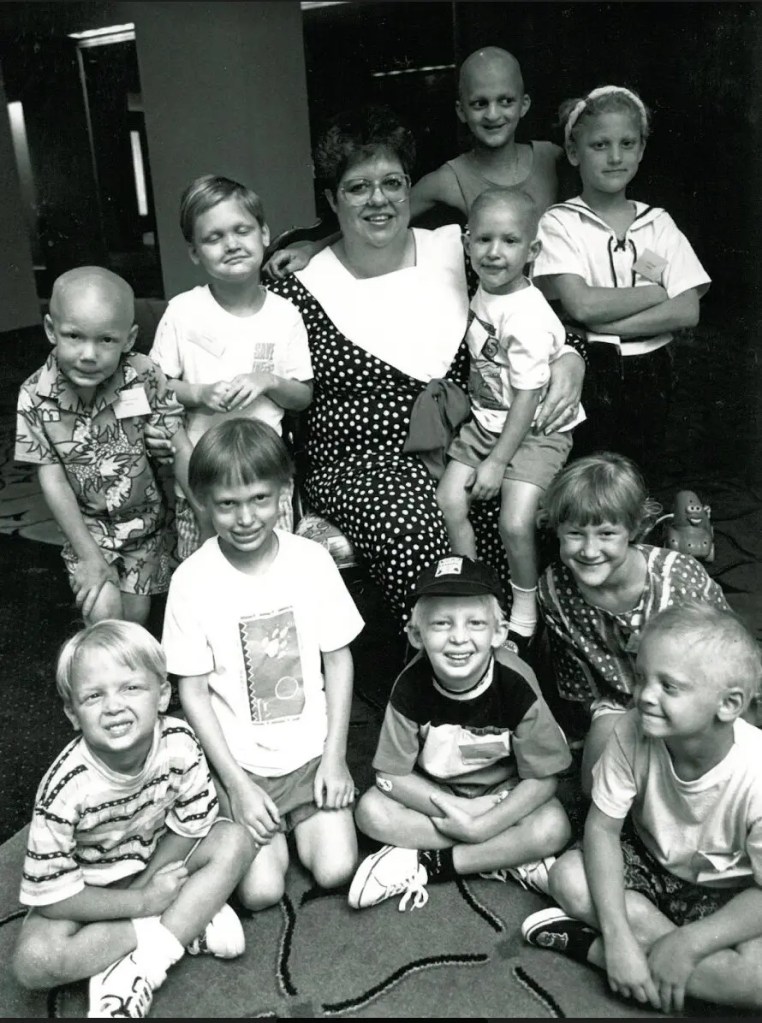
Mary Kaye Richter, who died at age 77 around Thanksgiving last year, suspected there was something off about her son Charley by the time he was a toddler. His skin was dry and scaly, he was very sensitive to warm weather, and he had very little hair and not a single tooth. When she took him to a dentist, x-rays revealed he had no permanent teeth. The diagnosis of hypohidrotic ectodermal dysplasia was very rare — in fact, at the time there were only seven other known cases in the U.S. So research was minimal and support networks did not exist. That was around 43 years ago.
From her farmhouse in Illinois, Mary Kaye got to work. She started a foundation, and soon discovered dozens of other cases and then hundreds. It now serves over 9,200 families worldwide and has raised close to $4 million to fund research at 40 medical facilities. And of course she took care of Charley. For teeth, he got dentures. She came up with an idea that let him play outside with friends in the summertime heat. She’d give him a popsicle when he went out, and when he came back his head would be all blue or red because he’d rub it on himself to keep cool.
Charley is 44 now and says he has lived a good life, thanks to his mom. He got married and has two daughters, although the marriage ended in divorce. And he runs the family farm of 2,000 acres.
Here’s a shot of Mary Kaye with kids she met through her work.
Good night, everybody — see you tomorrow!
 The Wellington Files