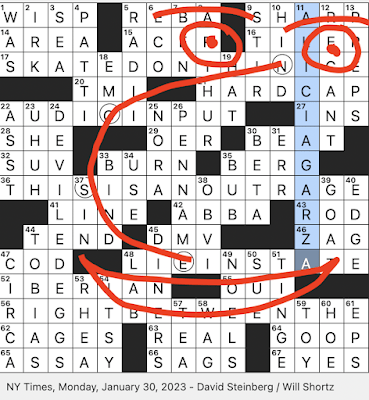
Today’s puzzle was a real hoot, with lots going on. It’s by David Steinberg, a veteran constructor. Well, he’s only 26 years old, but this is his 108th puzzle in The Times. The theme is “RIGHT BETWEEN THE EYES” which is two answers: RIGHT BETWEEN THE at 56A, and EYES two lines down at 67A. Then each of four long answers includes a pair of “I’s” with a different letter sandwiched between them, e.g., SKATED ON THIN ICE has an “N” between the I’s. The four sandwiched letters spell N-O-S-E, which, of course, is “between the eyes.” As a little joke, the word between “between the” and “eyes” is GOOP, — you know, that stuff that is sometimes in your eye when you wake up. Last, if you connect the four letters N-O-S-E, you form a giant nose. Wow!
Always-upbeat commenter Lewis said: David, this being your 108th NYT appearance, did you know that official MLB baseballs have 108 stitches, that there are 108 cards in an UNO deck, and that 108 is a sacred number in Buddhism and Hinduism? So, let today’s puzzle be a special occasion for you — as it was for me. Thank you!
At 48D, “place to wear goggles” was LAB. And the requirement doesn’t apply solely to people! Woof woof!

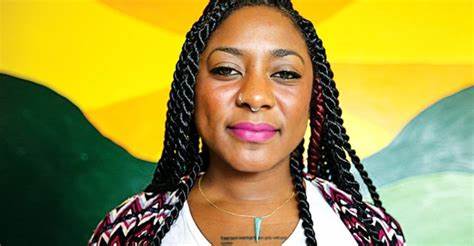
ALICIA GARZA is in the puzzle at 11D, co-founder of Black Lives Matter. She is crossed at 36A by THIS IS AN OUTRAGE. She was born in Oakland CA and is 42. Starting at age 4, she was raised by her mom and her (Jewish) step-father. She grew up as Alicia Schwartz in a mixed-raced and mixed-religion household. Garza identifies as Jewish.
(Jeez! One thing I am learning from owl chatter is that absolutely everyone is Jewish. The co-founder of BLM, Sheena Queen of the Jungle, Tom Verlaine. Or at least Jew-ish, like George Santos and Rod Carew. I’m beginning to think those anti-Semites who say the Jews control everything are right. When I was working at my law firm in Rochester, if someone came to see me when I was out, my partner Pat would tell them I was at a meeting of the International Jewish Bankers Conspiracy.)
Anyway, back to Alicia Garza. She graduated in 2002 from UC San Diego with a degree in anthropology and sociology. In 2004, she came out as queer, but married Malachi Garza in 2008. They ended their relationship in 2021.
A tattoo emblazoned on her chest is comprised of the final lines of June Jordan’s “Poem about My Rights.”
I am not wrong: Wrong is not my name
My name is my own my own my own
and I can’t tell you who the hell set things up like this
but I can tell you that from now on my resistance
my simple and daily and nightly self-determination
may very well cost you your life
Okay, Alicia — easy does it now. I hear ya.
There was an ASPEN TREE in yesterday’s puzzle. Each individual aspen tree can live for 40–150 years above ground, but the root system of the colony is long-lived, in some cases for thousands of years! New trunks are sent up as the older trunks die off above ground. For this reason, an aspen tree colony may be an indicator of ancient woodlands. One such colony in Utah has been estimated to be as old as 80,000 years. Yes, — even older than Joe Biden.
Aspen wood is white and soft, but fairly strong, and has low flammability. So it’s used for making matches and paper. Shredded aspen wood is used for packing and stuffing, sometimes called excelsior.
(The clue for ASPEN TREE was “Main course featuring Egyptian snake meat?” Wait, what? That was the “trick” of the Sunday puzzle. An answer was clued wackily and then you changed the spacing. So this clue led you to ASP ENTREE, which becomes ASPEN TREE when you move the space.)

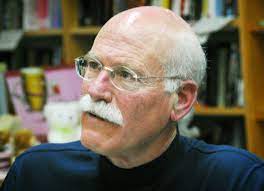
Hi Toby! The writer TOBIAS Wolff was in the puzzle today. He is known for his memoirs, particularly This Boy’s Life and In Pharaoh’s Army. He has written four short story collections and two novels including The Barracks Thief, which won the PEN/Faulkner Award for Fiction. Wolff received a National Medal of Arts from Obama in 2015. He was born in Birmingham AL, is 77, and lives in California with his wife of 47 years. They have three kids. Wolff was raised and identifies as a Catholic, but his paternal grandfather was a Jewish doctor (of course).
I remember reading one of his stories in The New Yorker: “Bullet in the Brain.” It’s terrific and has stayed with me since ’95. Here’s a clip from it, followed by a link to the story in its entirety:
With the line [at the bank] still doubled around the rope, one of the tellers stuck a Position Closed sign in her window and walked to the back of the bank, where she leaned against a desk and began to pass the time with a man shuffling papers. The women in front of Anders broke off their conversation and watched the teller with hatred. “Oh, that’s nice,” one of them said. She turned to Anders and added, confident of his accord, “One of those little human touches that keep us coming back.”
Anders had conceived his own towering hatred of the teller, but he immediately turned it on the presumptuous crybaby in front of him. “Damned unfair,” he said. “Tragic, really. If they’re not chopping off the wrong leg, or bombing your ancestral village, they’re closing their positions.”
She stood her ground. “I didn’t say it was tragic,” she said. “I just think it’s a pretty lousy way to treat your customers.”
“Unforgivable,” Anders said. “Heaven will take note.”
https://www.newyorker.com/magazine/1995/09/25/bullet-in-the-brain
The best moments in class are when a laugh pops out of mid-air. When I cover the topic of Fraud in Contract Law, I start with an example in which an apple seller in Upstate NY sells “Ellen” a bushel of apples. The ones on top look great, but she learns later that there are some that are pretty bad below those. She feels she was deceived. One issue we address is the fact that she wasn’t more careful in checking them herself — she could have looked at the apples below the top level but didn’t.
So one student, a very nice fellow in the back row, raises his hand and says: “Isn’t there a Latin expression, ‘Let the buyer beware?’”
I was quick on my feet that day. “That’s English,” I said.
Thanks for stopping by — see you tomorrow.
 The Wellington Files