The writer Nelson Algren was born on this day back in 1909 in Detroit, and died at age 72 in Sag Harbor, NY. He spent five months in jail for committing the perfect writer’s crime: he stole a typewriter. Because of that experience, his writing focused on the down-and-out, rejects and losers. His novel, A Walk on the Wild Side, contains his three rules for life: “Never play cards with a man called Doc. Never eat at a place called Mom’s. Never sleep with a woman whose troubles are worse than your own.” He married and divorced his first wife twice and his second wife once. He was Simone de Beauvoir’s lover and is featured in her novel The Mandarins.
Algren’s novel The Man with the Golden Arm won the National Book Award. Leonard Cohen used images from it in “The Stranger Song,” from his first album, Songs of Leonard Cohen (1967): “you’ve seen that man before: his golden arm dispatching cards, but now it’s rusted from the elbows to the finger.”
Yesterday I learned something about the plural of the word HERO. When used in the sense of “the hero who saved the damsel,” the plural is HEROES. And that’s the general rule for the word. BUT, when it’s used in the sense of a HERO sandwich, the plural is HEROS. “Ralph and Sally took two tuna salad HEROS with them on the trip.”
The puzzle today made use of the expression “dead as a doornail.” It was used famously by Dickens in A Christmas Carol, below. But it stems from a time when the metal in a nail was valuable, so it was common for nails to be stolen out of whatever they were hammered into. So builders would hammer a nail through a door and then, on the other side, hammer that pointy part flat against the inside of the door. That way, the nail could not be pulled out and was deemed “dead.” Here’s Dickens:
“Mind! I don’t mean to say that I know, of my own knowledge, what there is particularly dead about a door-nail. I might have been inclined, myself, to regard a coffin-nail as the deadest piece of ironmongery in the trade. But the wisdom of our ancestors is in the simile; and my unhallowed hands shall not disturb it, or the Country’s done for. You will therefore permit me to repeat, emphatically, that Marley was as dead as a door-nail.”
Before I had grandchildren, and when my kids had grown up, my memory of what a 5-year-old or a 7-year-old is like was hazy. Who can remember what your kids were like at specific ages? But now when I hear about a 7-year old, I can picture him or her, because my Zoey is seven. Similarly, I can picture a string of younger ages because Leon is 5 and a half, Rafi 4, Isaac 2 and a half, and little Mo out in Michigan is almost one and a half. At the upper extreme, Lianna is thirteen and a half. All gorgeous and wonderful, kinahora.
So when I read that yesterday’s school shooting in Nashville killed three nine-year-olds, I could picture them as a little older than ZoZo. A substitute teacher was also killed, as was a janitor, and the head of the school. It would have been a lot worse if not for what seems like quick and effective police work. The police received a call at 10:13, and they were on the scene, saw the shooter, and killed the shooter by 10:27. Since the shooter was using assault rifles, the threat of many more deaths per minute of delay was real.
Nashville Police Chief Drake said the shooter identified as transgender, and officials used “she” and “her” to refer to the attacker. But according to a social media post and a LinkedIn profile, the shooter appeared to identify as male in recent months.
Representative Andrew Ogles (R-TN), who represents Nashville, said he was “utterly heartbroken” by the shooting, and offered “thoughts and prayers to the families of those lost.”
In 2021, Ogles, his wife, and two of his three children held guns as they posed for a Christmas card with a caption that read: “The very atmosphere of firearms anywhere and everywhere restrains evil interference—they deserve a place of honor with all that’s good.”

This is the poem of the day today from The Poetry Foundation. It’s called The Sound of Music and it’s by Kathryn Nuernberger.
When I tell you I love
the song “Edelweiss”
you have to understand
that even though I too
am a sophisticate
who scorns musicals,
I was once a little girl
who stood in my grand-
father’s living room
singing, Cuckoo!
Cuckoo! while he sipped
his scotch and laughed
at my preciosity.
And when I sing the lyrics
in your ear—Small and
bright, clean and white,
you look happy to meet me
—you have to understand
my grandfather only ever
had one friend, a jeweler
who also drank scotch,
and left his $10,000 Rolex
to my grandfather, who
wore it even though
it turned his wrist green,
wore it to the funeral,
where the daughter sang
in her ethereal voice. Blossom
of snow may you bloom
and grow, bloom and grow
forever. She couldn’t take
her eyes off the casket.
You have to understand that
my grandfather kept spinning
that heavy gold around
his wrist, and when he raised
his voice to join in, he cried
to sing it. Edelweiss, edelweiss,
bless my homeland forever.
Bobbi Ercoline passed away on March 18 in Pine Bush, NY. She was 73. She and her husband, then-boyfriend, Nick Ercoline, became the quintessential symbols of hippiedom when a photo of them embracing amid the scene at Woodstock in 1969 became the photo on the Woodstock 3-LP set. Here’s the shot:
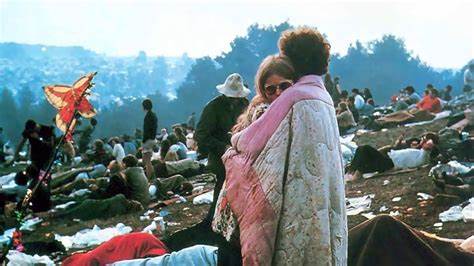
In fact, they were not hippies. They were both observant Roman Catholics. Bobbi was working as a bank clerk, and Nick was working in construction and bartending, putting himself through college. Their friend Corky Corcoran, who was in the photo sleeping nearby, had just returned from serving in Viet Nam with the Marines. (Bobbi’s sister Cindy later married one of Corcoran’s brothers.)
They did not plan to attend the festival originally, put off by the steep ($18) ticket price. But when all the hoopla was reported about the first day, they decided to go the morning of Day 2. They drove as close as they could get, ditched the car, and proceeded on foot for the last few miles. Bobbi found that blanket on the walk. They also “picked up” Herbie along the way, who was on a bad acid trip. Herbie supplied the large plastic butterfly you can see in the upper left of the photo, attached to the wooden staff.
The photo was taken by a freelance photographer for the Magnum agency, Burk Uzzle. He made use of advice from the founder of the agency, Henri Cartier-Bresson, who had told him to study the detailed compositions of the Quattrocento painters of Renaissance Italy.
“I walk up and I know the curvature of the hill has to work with the curvature of the heads,” he recalled. “And there’s the flag, it’s going to have to be there, and just enough of the people.”
When the album came out, with the photo right on the cover, Bobbi had to fess up to her mom that she missed church that day — it outed her!
The couple married in 1971, and had two kids. Bobbi became a school nurse, and Nick a union carpenter and a construction inspector.
Alex Traub, who wrote Bobbi’s obit for the NYT, ended it with this paragraph:
“The Ercolines became frequent interview subjects for historians of Woodstock, and they often spoke about their marriage as a symbol of its lasting influence and an example of peace and love in action. Every morning when they woke up and every night before they went to bed, they kissed and held each other for about a minute — just as they had on a grassy hill in the summer of 1969.”
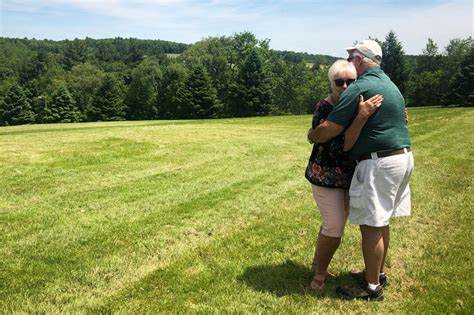
In addition to Nick, Bobbi is survived by their sons Matthew and Luke; a brother, John; a sister, Cindy Corcoran; four grandchildren; and the rest of us, attendees and non-attendees alike, half a million strong.
 The Wellington Files