Albert Von Tilzer was born on March 29, 1878 in Indianapolis. His family name was originally Gumbinsky (they were Polish-Jewish immigrants), but even when it was changed to Gumm he eschewed it. (Sorry, couldn’t resist.) So he took his mom’s maiden name, Tilzer, and added Von to make it seem classier. He was a songwriter, pounding out tunes by the hundreds, such as: “My Cutie’s Due at Two-to-Two,” “Put on Your Slippers and Fill Up Your Pipe, You’re Not Going Bye-Bye Tonight,” “Oh How She Could Yacki-Hacki, Wicki-Wacki, Woo,” “Au Revoir But Not Good Bye, Soldier Boy,” “Chili Bean,” “I Used to Love You But It’s All Over Now,” and, of course, “The Moon Has His Eye On You.”
But none of those made Albert’s place in history. For that we have to go back to 1908 and take a subway ride with Jack Norworth, who was also a songwriter. Norworth saw a sign that said “Baseball today — Polo Grounds.” It got him thinking about a girl who was asked out on a date and said yes, but only if the fella took her to the ballgame. Here are the original lyrics he came up with:
Katie Casey was baseball mad,
Had the fever and had it bad.
Just to root for the home town crew,
Ev’ry sou
Katie blew.
On a Saturday her young beau
Called to see if she’d like to go
To see a show, but Miss Kate said “No,
I’ll tell you what you can do:”
Take me out to the ball game,
Take me out with the crowd;
Buy me some peanuts and Cracker Jack,
I don’t care if I never get back.
Let me root, root, root for the home team,
If they don’t win, it’s a shame.
For it’s one, two, three strikes, you’re out,
At the old ball game.
There was a second stanza before the famous chorus was repeated:
Katie Casey saw all the games,
Knew the players by their first names.
Told the umpire he was wrong,
All along,
Good and strong.
When the score was just two to two,
Katie Casey knew what to do,
Just to cheer up the boys she knew,
She made the gang sing this song:
Norworth took the lyrics to Von Tilzer who put them to the tune we all know. Neither Tilzer nor Norworth had attended a baseball game before writing the song, and they only attended their first games decades later. The first time the song was sung at a game was in 1934 in LA at a high school game, but it was also sung in St. Louis at the 4th game of the World Series that year between Detroit and St. Louis. In 1927, Norworth revised the lyrics, but the chorus wasn’t changed.
In the 1935 Marx Brothers’ film A Night at the Opera, in one of the more unusual uses of the song, composer Herbert Stothart arranged for a full pit orchestra to segue seamlessly from the overture of Il Trovatore into the chorus of “Take Me Out to the Ball Game.”
In 1955, in an episode of I Love Lucy guest starring Harpo Marx, Harpo performed a harp rendition of the song.
In 1994, radio station WJMP, broadcasting to the Akron, Ohio market, played the song continuously during the Major League Baseball players’ strike of 1994 as a protest.
In 1995 in the ER Season 2 episode “Hell and High Water,” the character Doug Ross tells a child to keep singing the song to keep himself conscious.
The 2001 children’s book “Take Me Out of the Bathtub and other Silly Dilly Songs” by Alan Katz and David Catrow, recast the end of the chorus as “I used one, two, three bars of soap. Take me out…I’m clean!” in its title number.
In the series Homeland, Nicholas Brody teaches the song to Isa Nazir to help him learn English.
In 2001, Nike aired a commercial featuring a diverse group of Major League players singing lines of the song in their native languages. The players and languages featured were Ken Griffey Jr. (American English), Alex Rodriguez (Caribbean Spanish), Chan Ho Park (Korean), Kazuhiro Sasaki (Japanese), Graeme Lloyd (Australian English), Éric Gagné (Québécois French), Andruw Jones (Dutch), John Franco (Italian), Iván Rodríguez (Caribbean Spanish), and Mark McGwire (American English). C’mon, man — you couldn’t get Max Fried to sing it in Hebrew? Well, he was only 7 years old.
Tilzer died in LA at age 78 in October of 1956. “Take Me Out to the Ballgame” is listed at #8 in Songs of the Century.
Here’s Harpo’s version. It’s beautiful.
Today’s poem from The Writer’s Almanac is by Dorianne Laux.
Girl in the Doorway
She is twelve now, the door to her room
closed, telephone cord trailing the hallway
in tight curls. I stand at the dryer, listening
through the thin wall between us, her voice
rising and falling as she describes her new life.
Static flies in brief blue stars from her socks,
her hairbrush in the morning. Her silver braces
shine inside the velvet case of her mouth.
Her grades rise and fall, her friends call
or they don’t, her dog chews her new shoes
to a canvas pulp. Some days she opens her door
and musk rises from the long crease in her bed,
fills the dim hall. She grabs a denim coat
and drags the floor. Dust swirls in gold eddies
behind her. She walks through the house, a goddess,
each window pulsing with summer. Outside,
the boys wait for her teeth to straighten.
They have a vibrant patience.
When she steps onto the front porch, sun shimmies
through the tips of her hair, the V of her legs,
fans out like wings under her arms
as she raises them and waves. Goodbye, Goodbye.
Then she turns to go, folds up
all that light in her arms like a blanket
and takes it with her.
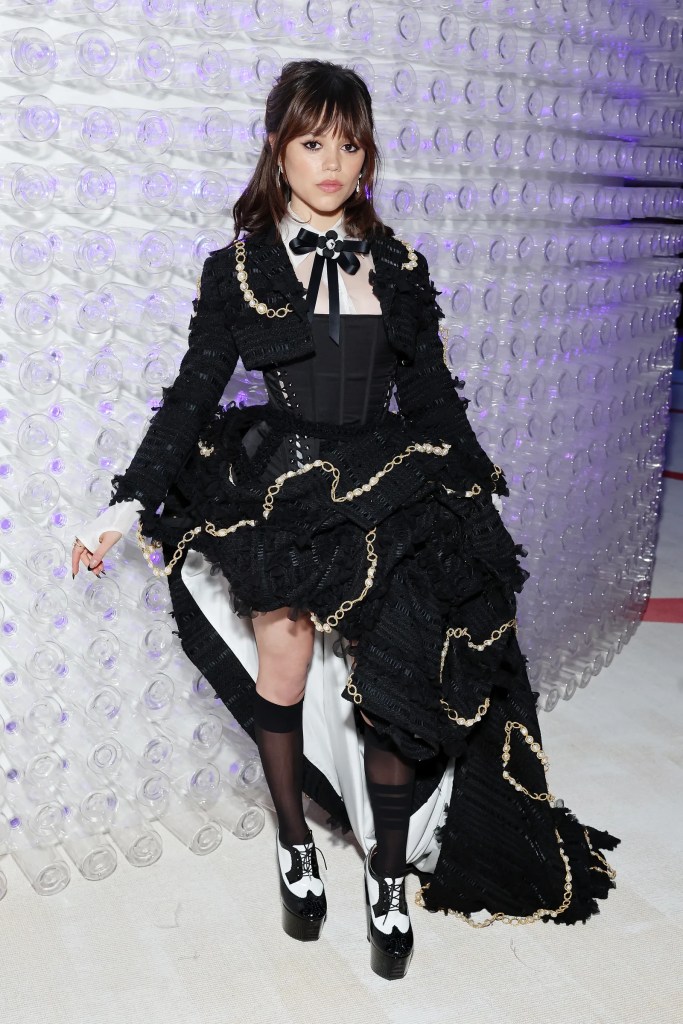
In today’s comments on the puzzle, Weezie said she liked its “contemporary/pop culture bent.” It includes Lady Gaga and Dua Lipa, for example. She noted the coincidence of its appearing the day after the posh Met Gala in NY. Then she confessed to being “obsessed with Jenna Ortega’s look.” We sent our photographer Phil to check it out. Yup. Good shot, Philly. It’s Jenna at the Gala. Matadorial.
There are some other nice pairings in the puzzle: MT RAINIER and SUMATRA, two gorgeous sites; CABANA and HUT; AMOROUS right next to ROM-COMS; BURRATA and BURRITOS; and the sexy DOMINATRIX with MADAMS and CUFFS (!) — pretty hot for the NYT. Constructor Aimee Lucido put a nice grid together.
Burrata is an Italian cheese made from cow or buffalo milk combining mozzarella and cream. The outer surface is solid cheese and the inner part is cream mixed with bits of mozz. It dates back to around 1900, but only became more widely available in the 1950’s. Here, try some.

And here’s a shot of Sumatra. You may have had some coffee from the island. There’s a strong Starbucks blend that features it.

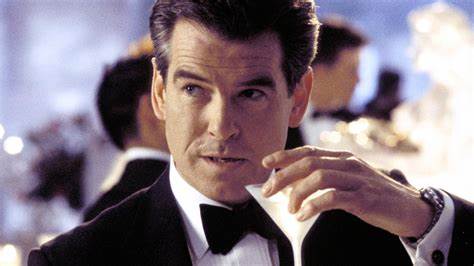
The puzzle’s theme today was based on James Bond’s famous drink order: “Vodka martini, shaken not stirred.” But several commenters came down hard:
First, for a guy who’s supposed to be classy and sophisticated, he orders a completely blasphemous cocktail. For starters, real martinis use gin, not vodka. Vodka is a cheap booze, lacking nuance. Second, never ever shake a martini. It over dilutes, creates ice shards and the drink loses complexity during the tasting. The very request would indicate a person lacking knowledge of potent potables, and not in line with our Mr. Bond.
Next, shaken, not stirred, will get you cold water with a dash of gin and dry vermouth. The reason you stir it with a special spoon is so not to chip the ice. James is ordering a weak martini and being snooty about it.
And, finally, Ian Fleming was a fine writer, but he created a character who didn’t know what a martini is. It is 3 parts GIN, 1 part dry vermouth, optional bitters – STIRRED with ice (to minimize air bubbles so the end product is a lovely crystal clear), served in a cocktail glass with a garnish of seeded green olive(s).
Hrrrrumph!
Question from Joaquin: If James Bond sleeps through an earthquake, can you say he was shaken but not stirred?
Enough nonsense for now. More tomorrow.
 The Wellington Files