If you need a clue for EMILY in your puzzle, there are various directions to choose from. Poetry? There’s Emily Dickinson, of course. Hotties? There’s Emily Ratajkowski, the model/actress/writer/entrepreneur who spoke at Hunter’s graduation last year.

Phil!! Did you wake her up? We’ve spoken to you about that! You’re going to get in hot water someday. Sorry Emily! Go back to sleep. Phil will come back later and give you time to get ready.
Or you can really class it up by going with Emily Greene Balch, as today’s constructors did. Balch was born on Jan. 8, 1867 and died one day after her 94th birthday. She was awarded the 1946 Nobel Peace Prize for her work with the Women’s International League for Peace and Freedom (WILPF), to which she donated her prize money. Although she was a long-time pacifist, she did not criticize the Allied war effort in WWII. She was an Economics professor at Wellesley College for 23 years and never married.
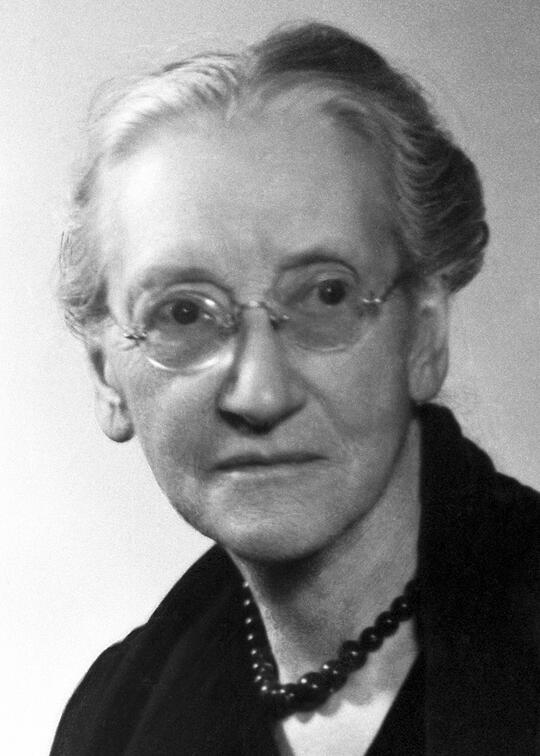
Emily’s corner in the puzzle (NW) was pretty dramatic. Right next to her at 3D came the “International Day of Peace month,” which is SEP. But over at 1D was AT WAR, darkly clued with “Like much of Europe beginning in 1939.” And 26D was WWII, clued with “JoJo Rabbit setting,” and ELIE Wiesel was at 58D.
Anthony Lane, the movie critic for The New Yorker, is often very funny. Here’s how his review of “Master Gardener” starts: As career moves go, the path from neo-Nazism to horticulture has not, perhaps, received the attention it deserves.
In the same column, he also reviews “You Hurt My Feelings,” where the main plot revolves around a married couple. The wife has written a novel that she overhears the husband saying he doesn’t like. Ouch! Lane writes: Delusions of creativity are always funny, because they rely on such a spectacular lack of self-knowledge.
I like that phrase “delusions of creativity.” It pretty much sums up the force behind Owl Chatter, no?
Oooh, Emily R. is out of the shower, and she threw something on and is ready for you now, Phil. Let’s see what you got.

Wow — gorgeous! Thanks, guys.
Two writers were born on this date. First, Raymond Carver, back in 1938, in Clatskanie, OR. Never heard of it? It’s a bit southwest of Inglis. In 1957, he married his 16-year-old girlfriend Maryann Burk right out of high school (Carver was 19), and took a series of low-paying jobs. They had two kids. Working as a night janitor in a hospital, he wrote stories of the working poor: his people. But 20 years later, in 1977, he fell in love with Tess Gallagher, a poet, and divorced Maryanne. This is what it says on his tombstone (from his poem, “Late Fragment”):
And did you get what
you wanted from this life, even so?
I did.
And what did you want?
To call myself beloved, to feel myself
beloved on the earth.
Here’s Tess.

The second one is novelist and essayist Jamaica Kincaid, born in Antigua in 1949. Since she was a girl, she was less favored by her mom than her two brothers, and she took refuge in books. (She was able to read at age 3.) She read every sentence of Moby Dick twice because she couldn’t believe how beautiful it was. As a writer, The Talk of the Town columns she wrote for The New Yorker were greatly admired. She was married for over 20 years to Allen Shawn, son of William Shawn, editor of The New Yorker, and brother of actor Wallace Shawn. They have 2 kids: Harold and Annie.
Henry Lewis Gates, Jr., said of her writing:
“She never feels the necessity of claiming the existence of a black world or a female sensibility. She assumes them both. I think it’s a distinct departure that she’s making, and I think that more and more black American writers will assume their world the way that she does. So that we can get beyond the large theme of racism and get to the deeper themes of how black people love and cry and live and die. Which, after all, is what art is all about.”
Kincaid converted to Judaism in 2005. Mazel Tov, JK!

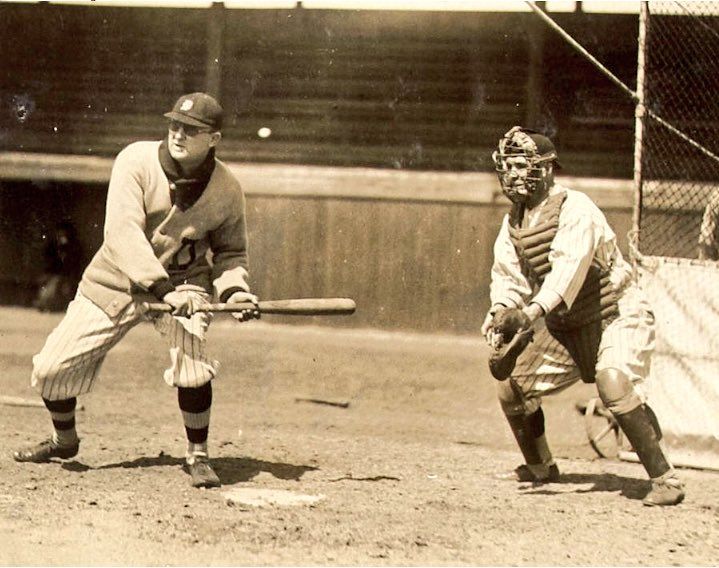
I learned something new in baseball yesterday. I was watching the Nats playing San Diego, and the Padres had runners on first and second. The batter bunted, and the Nats’ third baseman, Jeimer Candelario, pounced on the ball and threw it to second, to cut down the middle runner. So the lead runner advanced from second to third, and the batter made it to first.
What I learned was, in this case, the batter does not get credit for a sacrifice bunt. He needs to advance both runners to get credit. Did you know that?
Here’s Ty Cobb doing it. Is he wearing a scarf and a sweater? Was it chilly?
See you tomorrow!
 The Wellington Files