So Abie runs into Max and Max says, “Oh my goodness — how did you get that black eye?” Abie says: “Bernstein gave it to me. He came up to me yesterday and said: ‘This is what you get for calling my wife an ugly pig,’ and he punched me!” Max says, “That’s terrible, but why are you laughing?,” and Abie says: “The joke’s on him – it wasn’t me!“
Owl Chatter’s favorite poet, Ted Kooser, has a poem in today’s Writer’s Almanac. It’s not from Winter Morning Walks, but I was familiar with it nonetheless. He wrote it in May, 1999. It’s from Delights & Shadows, and it’s called “Father.”
Today you would be ninety-seven
if you had lived, and we would all be
miserable, you and your children,
driving from clinic to clinic,
an ancient, fearful hypochondriac
and his fretful son and daughter,
asking directions, trying to read
the complicated, fading map of cures.
But with your dignity intact
you have been gone for twenty years,
and I am glad for all of us, although
I miss you every day — the heartbeat
under your necktie, the hand cupped
on the back of my neck, Old Spice
in the air, your voice delighted with stories.
On this day each year you loved to relate
that at the moment of your birth
your mother glanced out the window
and saw lilacs in bloom. Well, today
lilacs are blooming in side yards
all over Iowa, still welcoming you.

North Dakotan writer Louise Erdrich was born on this day in 1954. She is an enrolled member of the Turtle Mountain Band of Chippewa Indians, a tribe of the Ojibwe people, and her books feature Native American characters and settings. Her mom was a Chippewa woman, and her maternal grandfather was a tribal chairman. In 2012 her novel The Round House won the National Book award, and in 2021, she won a Pulitzer Prize for The Night Watchman.
She was part of the first class of women admitted to Dartmouth in 1972 and earned her BA in English there. She went on to Johns Hopkins for her MA.
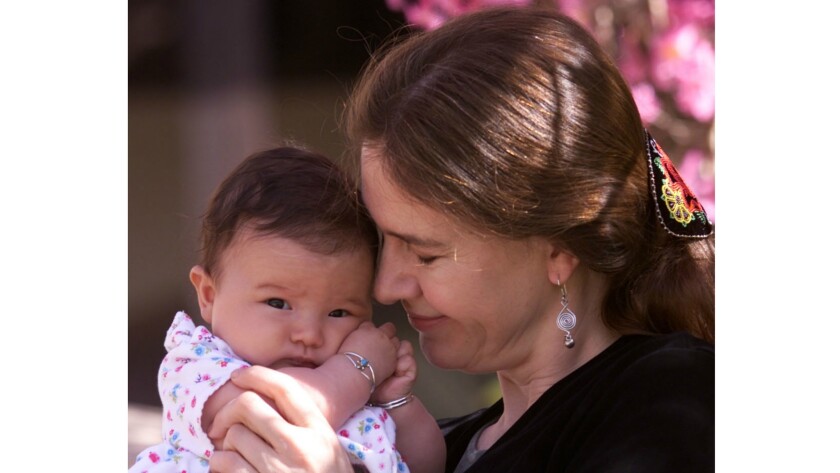
Here she is, below, with her baby Animikii Kiniins Erdrich in 2001. Her English name is Azure and she was born when Erdrich was 47. Animikii is a giant mythological thunder-bird common to the northern and western tribes. The beating of their immense wings causes thunder, which is sometimes mistaken for flatulence. [No it isn’t.] Erdrich had three children with her husband before they divorced: Persia, Pallas, and Aza Marion. Azure’s dad was a Native American healer and teacher.
In case you missed Tucker Carlson’s return to the airwaves (via Twitter) yesterday (a 10-minute video), the highlights included an expression of sympathy for Putin and mocking of Owl Chatter fave Zelensky. We were also told that UFOs and extraterrestrial life are “actually real.”
Did the charges read “Assault with Coffee and Donuts?” And why was a story about a “Gay Riot” on the front page of the NYT Food section today, of all places?
Let’s hearken back to May 1959, Los Angeles. Cops were routinely harassing gays and trans people at Cooper Do-nuts in the seedy gay area known as The Run. They finally had enough. Drag queens, hustlers and other customers pushed back, barraging officers with hot coffee and half-eaten crullers. Outnumbered, the police fled. Amazing. Author John Rechy recalls seeing coffee cups fly. Unfortunately, the cops returned with backup and arrests were made.
The uprising, occurring ten years before Stonewall, is part of LA gay lore, and the City Council is set to approve the installation of a street sign commemorating a Cooper Do-nuts shop for its historic role.
But now the very occurrence of the event is being called into question. There is no mention of it in the media back when it was said to have happened, even the underground tabloids that cover gay life. Research shows there was no Cooper Do-nut shop at the location! But Rechy, a leading source of the story, explained it was a different donut shop that people called “Coopers” because Coopers was synonymous with donuts back then.
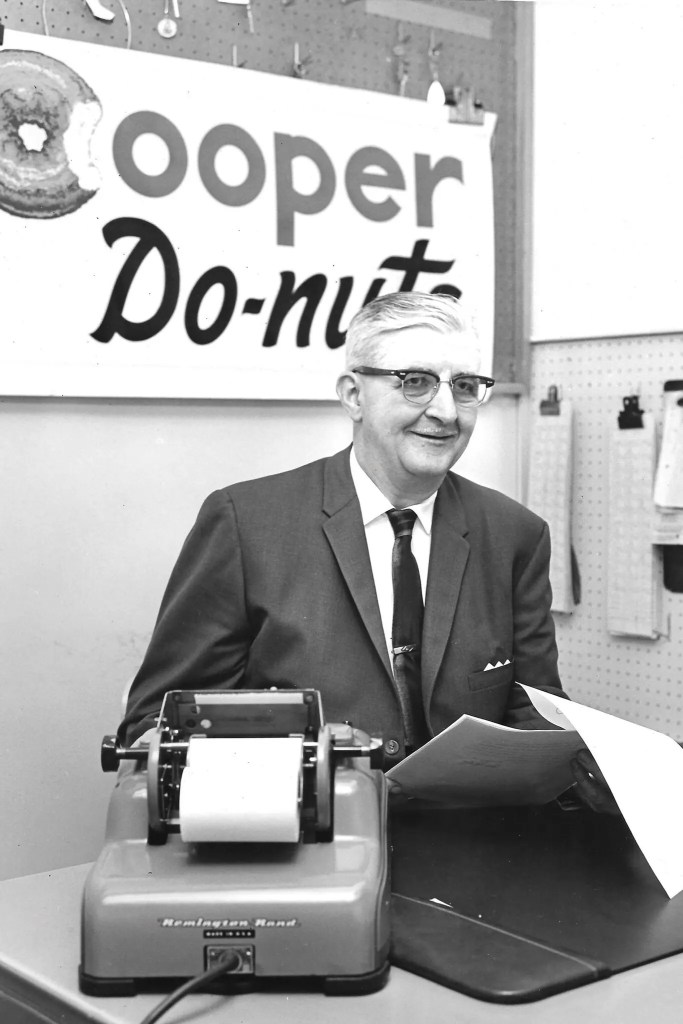
Whether or not the incident occurred, Keith Evans, whose grandfather ran the shops, says the commemoration is not out of place because the shops were a friendly and supportive haven for the gay and trans communities. Many gays were offered jobs. Here are Keith and wife Jacquie, and then Grandpa Jack Evans. (Note how the C in Cooper is formed.)

Nancy Valverde, an activist who is also being honored, said she and her lesbian friends “always felt accepted” at Cooper Do-nuts during an era when it was dangerous to be openly gay. After classes at a barber school, she would walk to a Cooper Do-nut shop for a glazed doughnut, her favorite. “The minute we got a dime for cutting a head of hair, we’d go there and enjoy each other’s company,” said Ms. Valverde, who is 91 and in hospice. “Once we were together, people could be themselves.”
So let’s believe the uprising occurred. What’s the harm? And that somewhere, every once in a while, in the middle of the night, in the dark recesses of LAPD’s institutional subconscious, some young recruit is having a bad dream and yelling “Put down that donut! I’m warning you!“

Back to Dowd’s words, how about sillage? Sounds to me like some slop pigs would eat, but that’s way wrong. It’s the degree to which a perfume’s fragrance lingers in the air. You might say it’s the scent detected in the wake of the woman wearing it when she passes by. It comes from the French term for wake.

And then there’s remembrancer. It’s someone who has the job of reminding people of something, or more broadly, a chronicler. Here’s how it might be used:
Remind me to take my medication in the morning.
No way — I’m not your f*cking remembrancer.
Or:
Who was that on the phone?
It was Dr. Peterson’s remembrancer: I have an appointment tomorrow to have some unsightly moles removed from my tuchas.
OK.
See you tomorrow!
 The Wellington Files
One response to “The Cooper Do-nuts Uprising”
Today, June 7, would have been Hank’s 73rd birthday. Ted Kooser’s poem “Father” is so poignant and your sharing it today is perfect.
LikeLike