Did you forget to send a card? Me too. It’s Bertha von Suttner’s birthday today. She may not put you on her sh*tlist, though — she’s been dead for over 100 years. She was a novelist and pacifist and was the second woman to win a Nobel prize — for Peace. (The first was Marie Curie for Physics.) What’s neat, though, is she knew Alfred Nobel personally, and it was her influence on him that convinced him to leave money in his will for the creation of the Peace Prize.
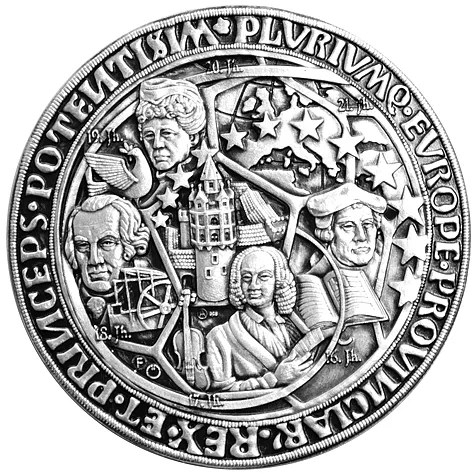
Von Suttner is depicted on the Europe Taler, along with Martin Luther, Vivaldi, and James Watt. It’s the largest silver-medal coin in the world, issued in 2008, i.e., it is awarded in some competitions to the silver medal winner.
I sent a selection to Frank Bruni for his “For the love of sentences” feature. It’s from Charles Blow’s Op-Ed piece in yesterday’s NYT.
“These [anti-gay, anti-trans] politicians play to a segment of the population that sees any divergence from its primitive ideals as deviant. So they build boxes. But for too many people, particularly young people, those boxes can become caskets. . . “
Blow goes on to note that, according to the CDC, one in five gay, lesbian, or bisexual high school students attempted suicide in the past year. Those are actual attempts, not just reports that they considered it. So, e.g., (check me on this, Judy), if a HS has a gay club with 20 members, statistically, four will have tried to kill themselves in the past year. Lianna has two good friends who are trans. They are wonderful young people and do not deserve to be the target of political and legislative attacks.
In the puzzle today 58A was “Like some Brie,” and the answer was RUNNY. The question arose as to why Brie was capitalized. Commenter bocamp shared the following from ChatGPT:
“The capitalization of ‘Brie’ cheese is a matter of grammar and style conventions. In English, proper nouns, which are names of specific people, places, or things, are typically capitalized. ‘Brie’ in ‘Brie cheese’ refers to a specific type of cheese that originated in the Brie region of France. Since it is named after the region, ‘Brie’ is considered a proper noun and is capitalized.
“Capitalizing ‘Brie’ helps distinguish it as a specific cheese variety and emphasizes its connection to the region from which it comes. It follows the same convention as other proper nouns, such as ‘Camembert cheese’ or ‘Cheddar cheese.’ By capitalizing the name, it also adheres to grammatical rules for written English.
“Capitalization conventions may vary in different languages or writing styles. Specific style guides or publications may choose to deviate from the general rules. However, in standard English, capitalizing “Brie” when referring to the cheese is the accepted practice.”
But Joe DePinto chimed in with:
“You don’t really have to capitalize cheeses that were named for locations if you are referring to them in a generic way. Almost no one capitalizes ‘cheddar,’ which is named for a village in England. The name comes to symbolize the taste, texture, look, etc., much more than where it’s actually from. Your runny brie cheese may not have been produced in the region of Brie or even in France.”
Today’s constructor, Robyn Weintraub, is widely loved and respected in Crossworld. Here are some of her very clever clues:
17A: “Animals that all share the same ‘birthday’ (January 1).” The answer is RACEHORSES. I think I may have heard this before. Whenever a racehorse is born during the year, it is considered one year old on the following Jan. 1. Setting a standard birth date for racehorses makes it easy to determine its acceptability for races based on age.
25A: “Game you can’t stand to win.” ANS: MUSICAL CHAIRS. (Get it?)
56A: “Alternative to an elbow.” ANS: PSST (Get it?)
57A: How about this one? — “Contronym that means moving quickly or not moving at all.” A contronym is a word that means both itself and its opposite. The answer is FAST. To “hold fast” means to not move at all. Another example is to sanction. It means both to allow and to censure.
And how about this lively cluing for some simple boring words:
“Glum drops,” for TEARS.
“65%, e.g.,” for MOST
“Some queens but not kings,” for BEES.
Here’s Robyn!

Ted – can you help me close tonight? This is from Winter Morning Walks.
An old moon, lying akilter
among a few pale stars,
and so quiet on the road
I can hear every bone in my body
hefting some part of me
over its shoulder. Behind me,
my shadow stifles a cough
as it tries to keep up,
for I have set out fast and hard
against this silence,
filling my lungs with hope
on this, my granddaughter’s
birthday, her first, and the day
of my quarterly cancer tests.
Thanks, Buddy. See you all tomorrow!
 The Wellington Files