Professor Owen Gingerich, who taught astronomy and the history of science at Harvard for 37 years, thought Pluto should not have been deplanetized (my word). He considered its demotion a “linguistic catastrophe.” Prof. Gingerich died in Belmont, MA, on May 28th. He was 93.
His view on the matter was significant because in 2006 he was chosen to lead a committee of the International Astronomical Union charged with recommending whether Pluto should remain a planet. Gingerich’s position did not carry the day. Pluto is now a “dwarf planet.”
When Gingerich was 9, his dad bought him a book that included instructions for making a telescope using a mailing tube and lenses from a local optician. The eyepiece was a dime-store magnifying glass. It worked well enough for him to see the rings of Saturn easily. “So it was probably slightly better than Galileo’s telescope,” Gingerich said.
From all accounts, he was a wonderful and lively professor. He sometimes taught dressed as a 16th-century Latin-speaking scholar. He sometimes shot himself out of the classroom on the power of a fire extinguisher to prove one of Newton’s laws. One year, when his signature course, The Astronomical Perspective, was under-enrolled, he hired a plane to fly a banner over the campus that said: “Sci A-17. M, W, F. Try it!”
One of the major pursuits of his life was triggered by Arthur Koestler’s contention (in 1959) that Copernicus’s book on the Earth revolving around the sun (De Revolutionibus) was not widely read in its time. Eleven years later, Gingerich ran across a copy of it in Edinburgh that was heavily annotated, thus indicating that at least one person read it. Over the next 30 years, he travelled hundreds of thousands of miles to examine 600 Renaissance-era copies. It resulted in Gingerich’s 2004 book, “The Book Nobody Read: Chasing the Revolutions of Nicolaus Copernicus.” It established that the Copernicus book was widely read, and showed how word of its theories spread and evolved.
He also wrote two books on his belief that religion and science need not be at odds. Here’s what he looked like 50 years ago.
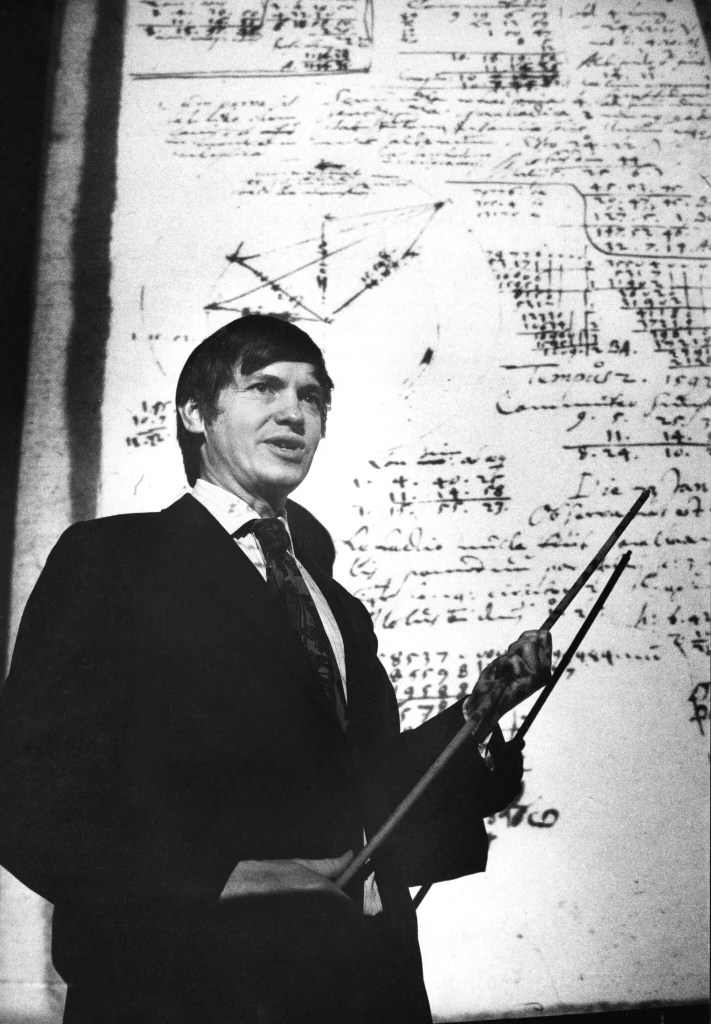
Professor Gingerich is survived by his wife, three sons, three grandchildren, and one great-grandchild, all of whom would say, Wherever he is up there now, he probably knows his way around.
From the “Monday is too easy camp,” I started off by posting: “Completed the puzzle on paper today with the grid and clues face down. Definitely more difficult. Took me forever to get GLBSWEZZY and MRKLLDRB.”
My co-conspirator, JM, chimed in with: “From a blindfold-solving perspective, this is the toughest Monday puzzle in memory. I’ve spent over an hour on it so far and still don’t have a single answer. Maybe it’s because I used a double blindfold this time and couldn’t see any clues. However, I haven’t given up and will try again later after I figure out some new peeking techniques.”
Picked Nit of the Day: The clue at 28D was “Buck ___, first Black coach in Major League Baseball,” and the answer was ONEIL.
Commenter Evan said: “The clue on Buck O’Neil is a problem. There was no (capital M, L, B) Major League Baseball at the time (it only came into use in the 1980’s and was generally not capitalized in the NYT until the leagues merged at the end of the 20th century). The phrase ‘major league’ was only applied to baseball as an adjective at that time, which properly (and now widely acknowledged) applied to the Negro Leagues as well.”
C’mon, man — it’s a crossword puzzle for cryin’ out loud, not a doctoral thesis.
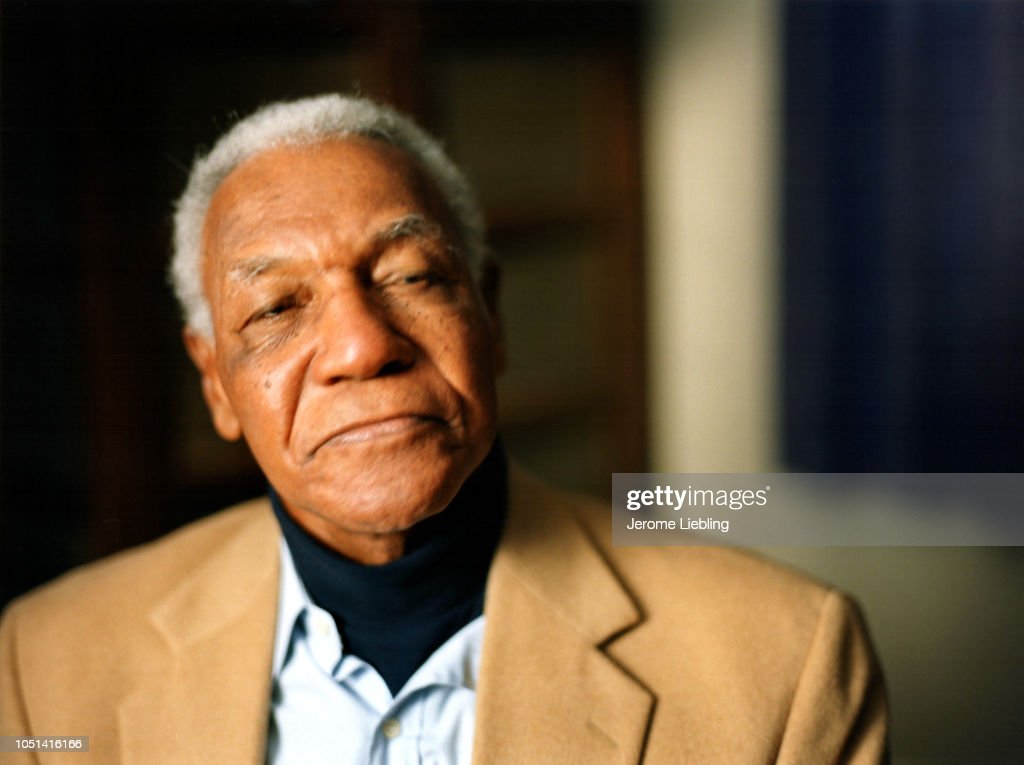
Here’s Buck:
Anne Frank would have been 94 today had she lived. It’s her birthday. Of course, she was killed by the Nazis at Bergen-Belsen when she was only 14.

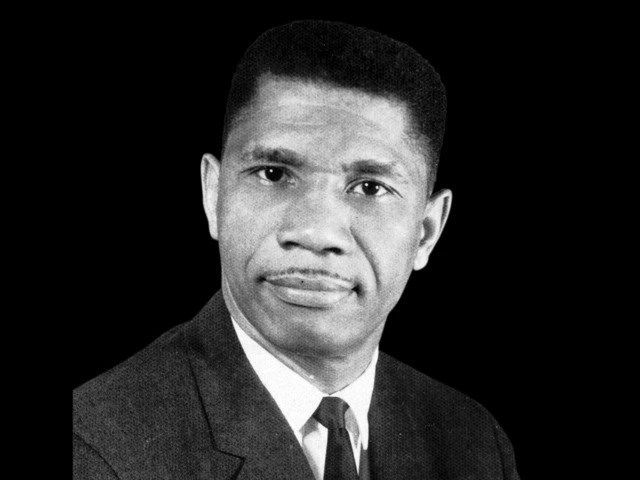
Today is also the anniversary of the murder of Medgar Evers, in 1963, in the driveway of his home in Jackson, Mississippi. He was 37. He served in the U.S. Army and participated in the Allied invasion in Europe. He was shot in the back at point blank range by a KKK member named Byron De La Beckwith. Evers was rushed to the hospital and was initially refused care because he was Black. He didn’t survive. He was buried in Arlington National Cemetery with full military honors. Two trials of De La Beckwith ended in hung juries, but he was convicted in 1994 at the age of 74 by a jury consisting of 8 Blacks and 4 whites and died in prison.
See you tomorrow.
 The Wellington Files