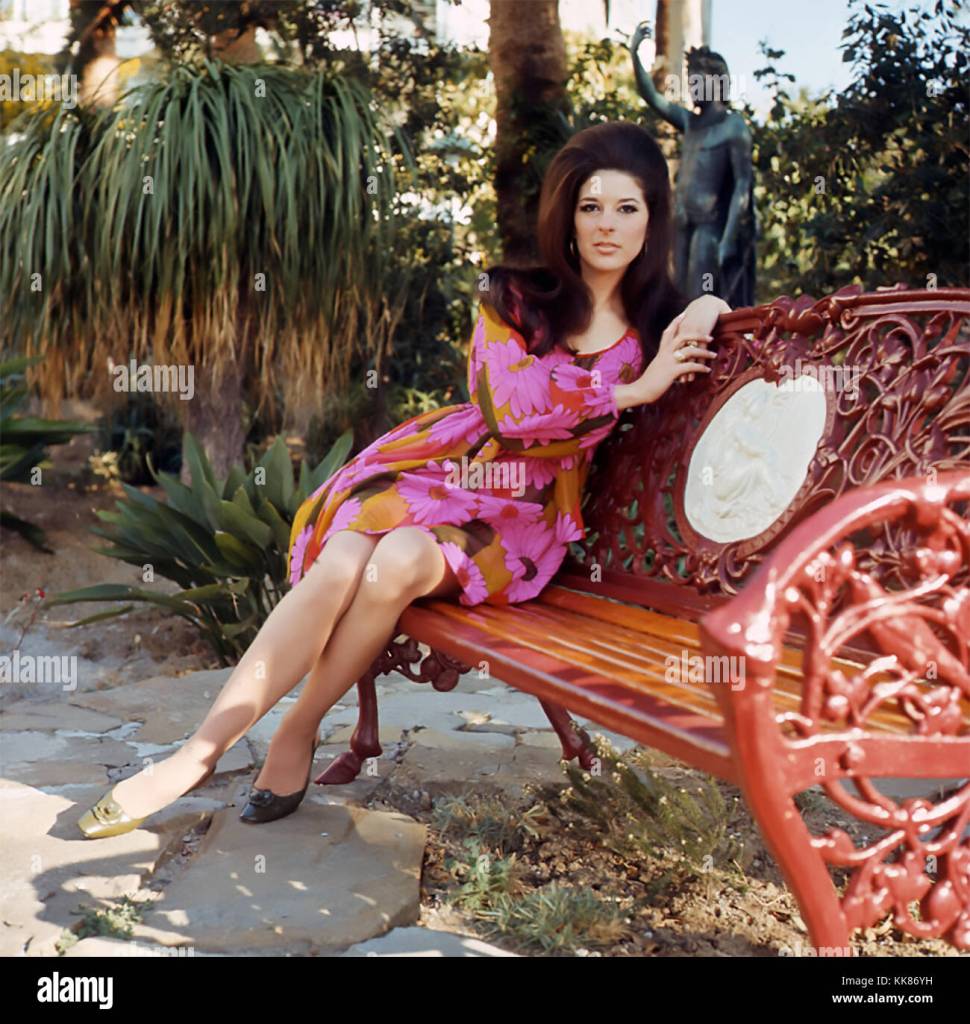
Who among us is not painfully aware of Billie Joe McAllister’s death by suicide; of his famous and fateful leap from the Tallahatchie Bridge? “It was the third of June, another sleepy, dusty Delta day.” BJ must have been the unluckiest guy in the world: according to Leflore County records, 40 to 50 other men jumped off that 20-foot high bridge and not one of them died. The county established a fine of $180 per jump. Even in 1969 dollars, it seems like a bargain, although maybe not in Mississippi. The bridge was destroyed by a fire set by vandals in 1972 and has been rebuilt. It crosses the Tallahatchie River at Money, MS, ten miles north of Greenwood. It sure meant money for Bobbie Gentry, who is 80 years old now, with a net worth estimated at $110 million. The very first clue in the puzzle today, for the word ODE, referenced the famous song. Here’s a nice photo of her. Jeez Louise! – what size shoe does she wear — 28?
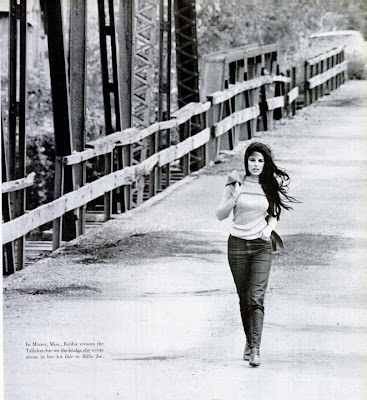
Here she is crossing that bridge (when she got to it).
As you may recall, Billie Joe and his girlfriend threw something off the bridge, but the song does not say what it was. It raised quite a fuss. Was it a baby? (God forbid!) A wedding ring? Given the era, some suggested a draft card or LSD. Gentry says she knows what it was but she never told anyone — not even her mom. She says it doesn’t matter — it’s not important. The point of the song was the nonchalance which which the family treated the horrific news. In an interview Gentry called the song “a study in unconscious cruelty.” Gentry, it should be said, was not a brainless country-western star. She majored in Philosophy at UCLA before transferring to the LA Conservatory of Music, where she studied composition, music theory and arranging. Here’s a live version of the Ode to Billie Joe:
Bob Dylan, on his Basement Tapes, wrote and sang a parody of it called Clothes Line Saga. The event bandied about in his ballad, as the laundry is discussed, is the Vice President going mad. It’s worth a listen — you’ve wasted so much time on this already — what’s a few more minutes?
The Taylor Swift phenomenon has more than spilled over into the mainstream — at least as Owl Chatter taps into it, — it’s a deluge. We discussed the New Yorker review recently. Today, TS was the subject of a glowing lead story on the editorial page of the Times.
It’s a guest essay by Suzanne Garfinkle-Crowell, a psychiatrist in private practice and the founding director of the Academy for Medicine and the Humanities at Mount Sinai. Clearly a moron and a hack.
Many of her patients are adolescent girls and young women and, as the tour was approaching, they were having trouble calming down. Garfinkle-Crowell was already a casual fan, but, she says, “I couldn’t really understand why this artist and this tour were so powerful — and so disruptive. So I started listening. And listening more. And then I went to the show with my daughter. And now I, too, cannot calm down. Swiftmania is a very different kind of high from what I experienced listening to music as a teenager — a high that is worth the pain. It’s not just the plethora of songs to discover, but the nonstop Swiftie culture itself — a party that is raging all day and all night.”
“’What would Taylor Swift do?’ is a refrain among certain patients in my practice. Teenagers suffer for many reasons. One is being fragile and in formation — a human construction site. Ms. Swift articulates not only the treachery of bullying but also the cruelty just shy of it that is even more pervasive: meanness, exclusion, intermittent ghosting. She says: Borrow my strength; embrace your pain; make something beautiful with it — and then you can shake it off.”
Most importantly, Garfinkle-Crowell goes on to highlight the same aspect that the New Yorker reviewer did – the community Swift engenders. She writes:
“What is singular about this artist, in this time, is the access she has created to a cohesive community, particularly for the pandemic generation, whose social connections grew tragically elusive. Whatever you are upset about, the poet laureate of this generation has got a song somewhere describing that precise feeling. She is not going to solve whatever problem you are having, but she is going to sit with you in it until the passage of time does its work: Look at her now. You may dress up as a “1989” party girl, but it’s understood by everyone here that you are also heartbroken and rageful and forgiving and brave.
She goes on,
“We will all eventually calm down, but for now, I am leaning into this fever dream, this restlessness and sleeplessness and decline in focus on anything else. Sometimes it’s good to let yourself be disrupted, to be a little less productive, to stay stay stay in an enchanted place as long as you can. Especially when there is someone new in your life who shows you colors you can’t see with anyone else.
“My patients have their own dedicated professional to listen to them for 45 minutes a week. But few teenagers have access to this kind of support. It’s confusing to be human and to be female, and I’m glad, both for my patients in their midnights and for their populous, shimmering community, that they have someone so articulate, so generous and so endlessly present to talk to.”

Here’s a poem from The Writer’s Almanac about a summer job before starting college. It’s called “Patty’s Charcoal Drive-In,” and it’s by Barbara Crooker.
First job. In tight black shorts
and a white bowling shirt, red lipstick
and bouncing ponytail, I present
each overflowing tray as if it were a banquet.
I’m sixteen and college-bound;
this job’s temporary as the summer sun,
but right now it’s the boundaries of my life.
After the first few nights of mixed orders
and missing cars, the work goes easily.
I take out the silver trays and hook them to the windows,
inhale the mingled smells of seared meat patties,
salty ketchup, rich sweet malteds.
The lure of grease drifts through the thick night air.
And it’s always summer at Patty’s Charcoal Drive-In—
carloads of blonde-and-tan girls
pull up next to red convertibles,
boys in black tee shirts and slick hair.
Everyone knows what they want.
And I wait on them, hoping for tips,
loose pieces of silver
flung carelessly as the stars.
Doo-wop music streams from the jukebox,
and each night repeats itself,
faithful as a steady date.
Towards 10 p.m., traffic dwindles.
We police the lot, pick up wrappers.
The dark pours down, sticky as Coke,
but the light from the kitchen
gleams like a beacon.
A breeze comes up, chasing papers
in the far corners of the darkened lot,
as if suddenly a cold wind had started to blow
straight at me from the future—
I read that in a Doris Lessing book—
but right now, purse fat with tips,
the moon sitting like a cheeseburger
on a flat black grill,
this is enough.
Your order please.

More nonsense tomorrow. Thanks for dropping in.
 The Wellington Files