I wanted to strangle this woman on the subway today. A bunch of us were waiting on the platform for the train. It arrived and the doors opened, and she got on first and just stood there — blocking the way! Hello? Remember us? The ten other people you were standing with, like, four seconds ago? Did it not occur to you there was a good chance we wanted to get on the train too?
So we walked around her. There is no sense confronting these assholes, or even saying something like “I’m sorry — I didn’t know you are the only person on the planet.” You have to assume (1) they are lunatics, and (2) they have guns.
Hrummmph!

I entered the New Yorker cartoon contest a few weeks ago and found out today that I wasn’t a finalist. Here’s the cartoon at issue:

My entry was: “No, I’m fine with your mom’s visit. Why do you ask?”
I like one of the three finalists: “You don’t have to say ‘Excuse me’ every single time.”
I concede defeat.
That issue (July 24) also contains a review of the production of Hamlet that is being put on in Central Park this summer, starring Ato Blankson-Wood. The review is respectable but not glowing. The description of one scene, though, caught my eye. It’s the scene, fairly early, where the ghost of Hamlet’s dad appears to Hamlet, and tells him of his murder. Here’s how the reviewer Vinson Cunningham describes it.
“Instead of using another actor to fill the father’s figure, Leon [the director] shows Hamlet being possessed by his dead father—Blankson-Wood mouths the ghost’s portentous speech. His slinky physicality suddenly becomes regal and strange. His eyes roll back into his head. Fire might as well be spouting from the tips of his fingers. That’s another unexpected thing about grief, how it coaxes you into an attempt at becoming the other, taking on their tics and savoring how they used to talk, fishing a ring out of their jewelry box and stuffing it onto your finger—all evidence of a great hope that, by embodying those details, you might permanently save them.”
[Wow.]

Solea Pfeiffer portrays Ophelia “soulfully,” according to Cunningham. Break a leg, Oph!

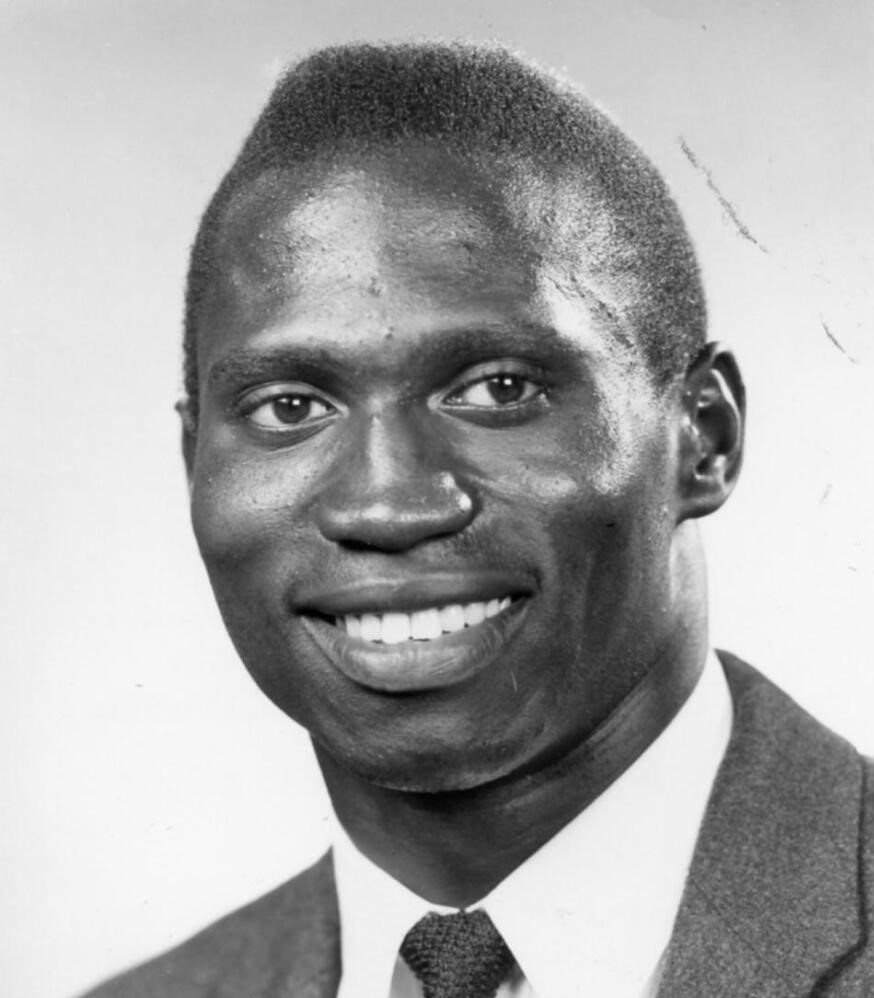
Cornelius (C. R.) Roberts died at age 87 in a care facility in Norwalk, CT on July 11. He was a “leapling,” born on Feb. 29, 1936 in Tupelo, MS. His mom felt they had to get out of racist Mississippi and told his dad: “Get our son out of Mississippi or they’re going to kill him.” So they moved to California. C.R. scored 65 touchdowns for his high school team as a running back and was recruited by USC, where he also excelled.
Thus was set the stage for the extraordinary game in 1956 when USC went down to Texas to play the Longhorns. There were three Black players on USC, and Texas was having none of it. They told USC “the coloreds couldn’t play.” Fearing violence, the USC coaches suggested Roberts stay behind. But C.R. said he’d rather quit the team than stay home. Now get this — his teammates stood by him — they said (and I paraphrase) “F*ck that sh*t — if C.R. ain’t going, we ain’t going.”
Negotiations were worked out for the entire team to play. Then, the hotel in Texas explained that the Blacks couldn’t stay there and made arrangements for them at a YMCA. USC said: “F*ck you very much,” and found a hotel where they could all stay.
Be all that as it may, as game-time approached, tensions were sky high and C.R. found himself wondering if he’d make it out alive. He had received death threats and thought he might be taken out by a shotgun blast from the stands. The hatred was pouring down from the crowd — the N word and whatever else they had.
But C.R. could run, and he ran. A 73-yard touchdown run in the second quarter was followed by a 50-yard TD run. He scored again on a 74-yard run in the third and finished with 251 yards, a USC record that stood for 19 years. Chances are he would’ve broken 300, but the coaches pulled him shortly after his last TD, fearing for his safety. Final score: USC 44 Texas 20. The LA Times described Roberts as an “explosive bolt of searing speed.”
Roberts played pro ball for 6 years: two in Canada and four with the 49ers, a modest career. He had earned a business degree at USC and ran several businesses after football. His two marriages ended in divorce. He is survived by three children and four grandchildren, none of whom roots for Texas. Throughout his lifetime, the Texas game and the emotions it stirred up remained vivid. In an interview he gave the LA Times years later he said: “I didn’t give a damn who we played. We were going to beat them. Everybody had a chip on their shoulder. We played our best game.”
C.R. is a first-ballot inductee into the Owl Chatter Hall of Fame. Rest in peace, Roberts.
In the puzzle today, 4D was “Big _____ (serious favor)” and the answer was ASK, with ask serving as a noun. It ran right up LMS’s alley.
“Loved the clue for ASK, forcing its nounness, a big thumb in the eye to the language police. Y’all seem to hate watching a shift occur in real time. But since language is one ever-shifting, ever-morphing wonder, anything that comes out of our mouths these days is the result of shifts from Old to Middle to Modern English. APRON was originally napron, but we started dividing a napron to an apron, et voilà! (See also umpire and adder.) A similar mis-dividing is occurring right now, right under our feet, and we’re creating a new word. An other is shifting to a nother in “That’s a whole nother story,” and the word has reached the Holy Grail of wordship: it’s in the dictionary. (See also notch, nickname, and newt.)”
And Judy — did you see your old pal EULER was in the grid today, clued with “Pioneer in calculus notation.” I learned (from Rex) it’s pronounced OILER. Whew, amazing I haven’t made a fool of myself all these years. (On that.) Rex was reminded that he criticized a constructor way back in ’06 for using EULER, whom Rex referred to as “obscure” only to be lambasted for his math ignorance. A comment today chipped in with:
“As a mathematician I definitely don’t think of EULER as obscure. He’s arguably one of the three greatest mathematicians in the last millennium, along with Newton and Gauss. If you work with almost any kind of mathematics beyond arithmetic you run into some formula, theorem, or method named after him. Even the constant e is named for Euler.”
And kitshef added: “There is another slightly famous EULER, Carl, who will be known to birders thanks to the Euler’s flycatcher. That ‘Euler’ is pronounced ‘yoo-lur’.’” [And it’s a bird, not a swatter.]

That’s a nice image to end on. See you tomorrow (unless I can’t broadcast from Baltimore).
 The Wellington Files