The anagramatically great Greta Garbo (born Greta Lovisa Gustafsson), was born on this date in Stockholm, Sweden, in 1905. Her mom worked in a jam factory and her dad was a laborer, and together they produced “the most beautiful woman who ever lived,” according to The Guinness Book of World Records in 1954. Here’s how critic Kenneth Tynan put it: “What when drunk one sees in other women, one sees in Garbo sober.” When she kissed actor John Gilbert with an open mouth in Flesh and the Devil, the movie was banned in some places for “moral turpitude,” but ticket sales soared.

Her silent films were very popular, with her playing the mysterious femme fatale. Then, in 1930, sixteen minutes into the film Anna Christie, people first heard her husky voice: “Gimme a whiskey, ginger ale on the side, and don’t be stingy, baby,” a line I’ve used myself numerous times, to no effect. The headlines screamed “Garbo Talks!,” and she became an international star. She is still regarded as one of the greatest screen actresses of all time. Director Clarence Brown, who made seven of her pictures, said, “Garbo has something behind the eyes that you couldn’t see until you photographed it in close-up. You could see thought. If she had to look at one person with jealousy, and another with love, she didn’t have to change her expression. You could see it in her eyes as she looked from one to the other. And nobody else has been able to do that on screen.”
Garbo made 28 films and retired at age 35. She became famously reclusive, was often depressed, and may have been bipolar, although she had many friends, socialized, and traveled. In 1951 she became a U.S. citizen, and in 1953 she bought a seven-room apartment at 450 East 52nd Street in NYC where she lived for the rest of her life. Her buzzer was identified by a solitary G. She walked eleven miles a day in the city in white clothes and sunglasses, and “Garbo watching” became sort of a sport.

Remember Gilbert from that hot kiss, above? Well, he was her most serious romance. He proposed to her numerous times and she accepted occasionally but backed out at the last minute. “I was in love with him,” she said. “But I froze. I was afraid he would tell me what to do and boss me.” In later years, Garbo said of Gilbert, “I can’t remember what I ever saw in him.” She never married and had no children. But she had romantic relationships with both men and women, including Leopold Stokowski and Erich Maria Remarque.
She was a dinner guest at the Kennedy White House, nine days before he was killed. She died herself of renal failure and pneumonia in a NYC hospital on April 15, 1990 at the age of 84. She left her estate of $72 million (in 2002 dollars) to her niece. Garbo was cremated in Manhattan, and her ashes were interred nine years later at Skogskyrkogården Cemetery (pronounced exactly as it’s spelled), just south of her native Stockholm.
Happy Birthday, G. You came a long way from your mom’s jam factory.
To hell with the war, let’s party! According to a front-page story in today’s NYT, over 35,000 Hasidim made their annual pilgrimage to Uman in central Ukraine this week, where Rebbe Nachman of Breslove died in 1810, a great-grandson of the man widely considered the founder of Hasidism. It is also the site of terrible Nazi atrocities: 1,000 Jewish children were gunned down there and thrown into a pit.

The tradition of the pilgrimage goes back 200 years and there’s no way a small matter like a Russian invasion could put a crimp in it. The pilgrimage remains pious, but it is also wild. The Breslovers, as followers are called, are known for exuberant worship. Maybe a little too exuberant: dozens have been arrested in Uman in past years for drug possession, drunkenness and brawling. But Breslovers are also known for being open-minded. Men in black hats and sidelocks prayed next to men in T-shirts and tattoos. Most come from Israel, with the second biggest contingent from the US. With Ukraine’s airspace closed, most made overland trips from Poland, Moldova, Hungary or Romania that were long, exhausting, and expensive.
President Zelensky didn’t stop by Uman this week but a small contingent of Ukrainian Jews joined the festivities, which have fueled a bustling economy. Entire 10-story buildings are hired out, taxi drivers get dream fares and vendors do a brisk trade in T-shirts, books, amulets and other Breslov merch.
Sadly, our dear Yevgeny can no longer score any catering gigs in Uman, since he was brutally murdered. His pierogis were to die for (perhaps not the best choice of words). Dig in, everybody!

An extraordinary oyster farmer, Jules Melancon, died on August 31 at his home in Cut Off, Louisiana, 25 miles south of New Orleans. (English and Cajun French were spoken at home.) He was only 65 and his father and mother both survived him.
Most of his life he farmed oysters the old-fashioned way, dredging the shallow, brackish waters of the lower Mississippi River Delta, as captain of his own boat, My Melanie, named after his wife. Times were good and he was able to sell 400 bags of oysters a day at $15 a bag. But he just about gave up the business when the oyster population started taking hits from rising sea levels, pollution and erosion, and then from Katrina and the massive Deepwater Horizon oil spill which coated the Louisiana coast with millions of gallons of crude. No question — it all combined to put the Oy in oyster.
Then Melancon learned from a friend about a new type of oyster farming being tested by Auburn U. researchers. They were growing immature oysters (“spats”) from pinhead-size seeds in drums on land. When they grew to the size of a quarter, they were transferred to cages suspended in shallow water. Instead of taking five years to reach full size, they could be exposed to a rich flow of nutrients and become big, meaty, and delicious in just ten months. Plus the shells looked gorgeous on a raw bar. He was a pioneer in the field, and was back in business, although not as lucratively as before.
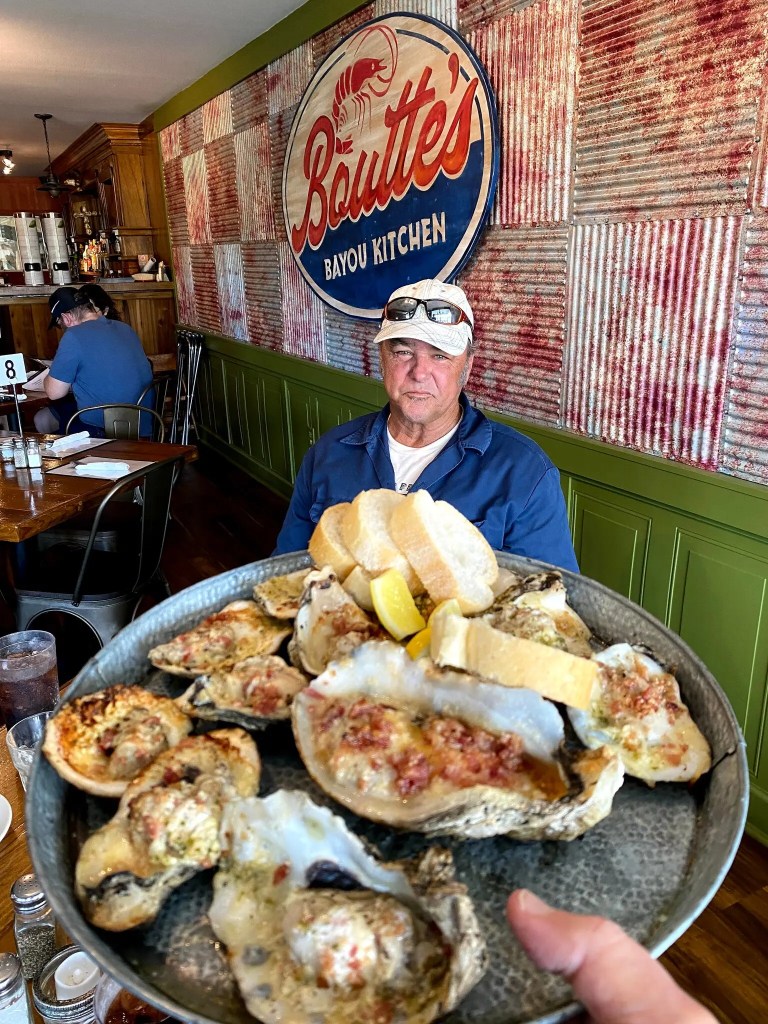
Along with his mom and dad, he is survived by his wife Melanie, four sisters, and 500 pounds of raw oysters, fresh and delicious like you wouldn’t believe. Here he is — Phil tracked him down to a joint in Lafitte, Louisiana. They both ate well that night.
Rest in peace, Buddy.
Good night everybody! See you tomorrow.
 The Wellington Files