Was Chandler your favorite? Of the guys, he was mine, and I’m sad that he passed away at only age 54. He struggled terribly with drugs. At one point he was taking 55 Vicodin a day. He credited having the role in the show and the support of his castmates (his “Friends”) with saving him.
Matthew Perry was born in Williamstown, MA, where we hang out every July 4th, but raised in Ottawa. He went to school with Justin Trudeau, and his mom was Pierre Trudeau’s press secretary. Justin issued a statement honoring his memory.
Take care, Chandler. Thanks for all the good work, and for so many laughs. Hope you find peace.

This story, by Evelyn Saphier, is from today’s Met Diary.
I am remembering with nostalgia a bakery on East Ninth Street near First Avenue that I used to frequent in the 1970s.
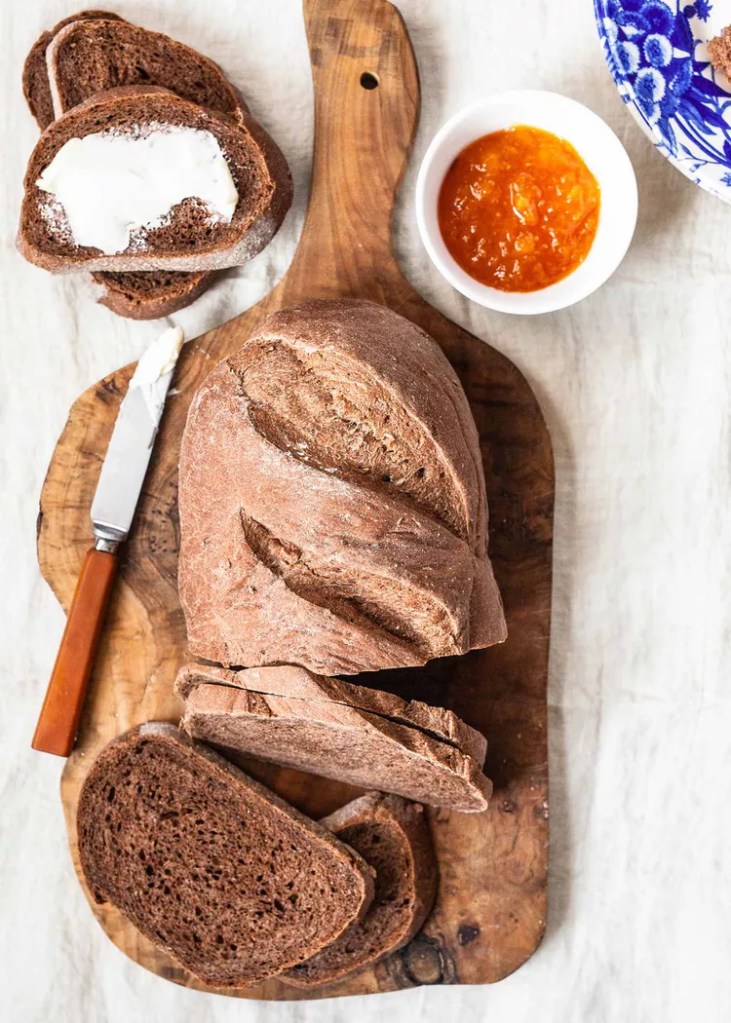
It was run by two brothers who sold bread by the pound in loaves they stored in large drawers.
“Hello, dear,” they would say when I entered. “If you eat this bread, you can live forever! You never need to eat anything else!”
They would cut a slice from a loaf, put it in my hand and direct me to taste it on the spot to make their point. There were lots of rye and dark pumpernickel loaves.
One brother began to lose his memory, and it was touching to see the other care for him as they carried on the business.
Eventually, the brothers died, and I heard on the news that one had secretly built up a small fortune that he passed on to a nephew.
To this day, I think I could live forever if I could have that bread again.
If a group of lions is called a pride, what is a group of ferrets called? Well, I learned from today’s puzzle at 16D it’s called a “business.” A business of ferrets.
I also learned that the “HODGE conjecture” is one of math’s Millennium Prize Problems. Having never heard of it, I sought out some info in Wikipedia. Note that this discussion starts with the phrase “in simple terms.”
In simple terms, the Hodge conjecture asserts that the basic topological information like the number of holes in certain geometric spaces, complex algebraic varieties, can be understood by studying the possible nice shapes sitting inside those spaces, which look like zero sets of polynomial equations. The latter objects can be studied using algebra and the calculus of analytic functions, and this allows one to indirectly understand the broad shape and structure of often higher-dimensional spaces which can not be otherwise easily visualized.
Okay, thanks!

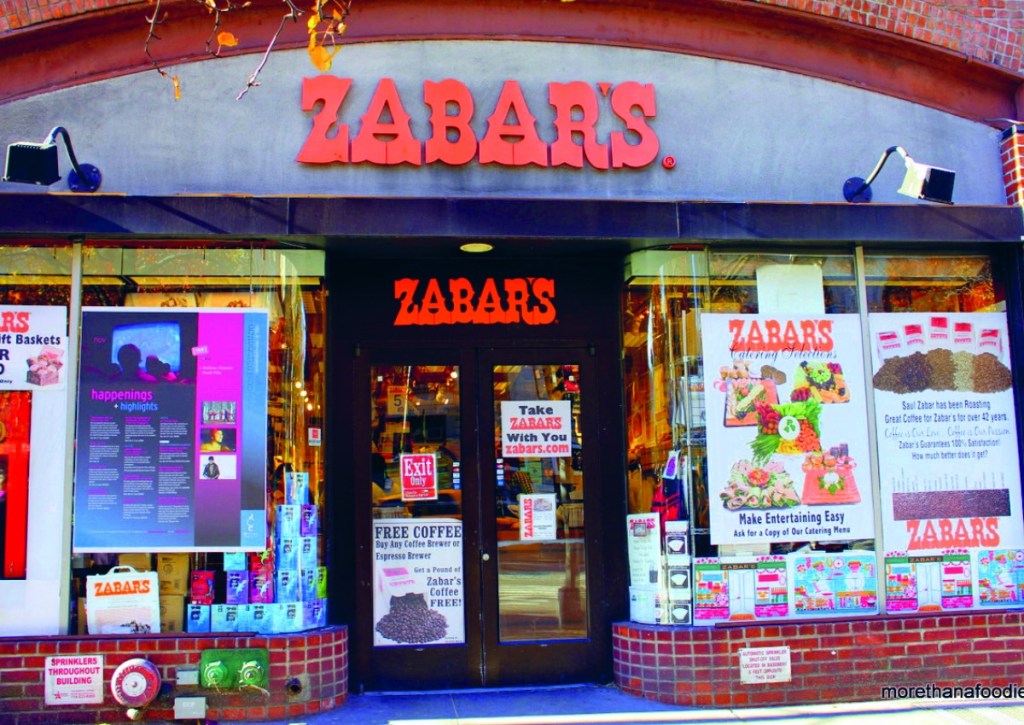
The clue at 11D was “Famed NYC deli” and the answer was ZABAR’S. It led me to post the following story on Rex’s blog. Some of you have already heard it, and some of you were at the wedding!
To me, “deli” means The Carnegie or Katz’s, but I guess technically Zabar’s qualifies. When my wife and I got married nearly 40 years ago (to each other), we broke up the reception into two pieces: A more formal sit-down lunch with the families, and then, at night, a looser party with our friends.
Part of the food for the latter was lox from Zabar’s. The bagels were from our favorite bagel place in Brooklyn. We figured we’d need about 100 which, translated into bagelspeak, is 8 dozen. So we went to the bagel place a week ahead of time to see if there was anything special we had to do for an order that large. (My wife still laughs at this.)
I approached the counter like I was a big macher to let them know I would be ordering “8 dozen bagels” in a week, but I must have been a little nervous because what I said was: “Next Sunday I’m going to be needing 8 bagels — is there anything special I should do in advance?” I had left out the word “dozen.” He looked at me for a few seconds before saying “It won’t be a problem.” (Fortunately, my wife cleared things up, as she has continued to do for close to 40 years, kinahora.)
In the puzzle today, “Philadelphia special,” was CREAM CHEESE. But, get this — it was actually invented in Chester NY by a dairyman named William Lawrence in 1872. In 1880 he took on a partner and they adopted the name “Philadelphia” because that region had a reputation for high-quality dairy farms and creamier cheese products. Good move.
In 2019, an advertisement for it in England that portrayed an absent-minded father was banned under a British law that forbade gender stereotyping on TV advertisements. Owl Chatter was able to obtain a copy.
The Z in Zabar’s was also the Z in ZEBRAFISH, clued with “Striped minnow used in drug development.” Let’s take a look at one.

Rex poster Barbara S., after noting that it’s National Cat Day today (meow), shared this info from the website yourgenome.org, explaining why Z-fish are so useful in drug trials:
* Zebrafish have a similar genetic structure to humans. They share 70% of genes with us.
* 84% of genes known to be associated with human disease have a zebrafish counterpart.
* As a vertebrate, the zebrafish has the same major organs and tissues as humans. Their muscle, blood, kidney and eyes share many features with human systems.
I’ll never look at a herring the same way again.
Here’s an interesting linguistic matter that arose. At 15D the clue for the simple word ATE was “Did a great job, in Gen Z lingo.” So, apparently, if Tom does a great job, you can say he ATE. But that usage is not original to Gen Z — it was appropriated from AAVE. What’s AAVE, you may ask? It’s Black English (African American Vernacular English).
AAVE can be traced all the way back to slavery and has been used by Black people for centuries. It’s a big issue as to whether some phrases are AAVE or just “Twitter slang.” As one article in a student paper put it, “If we look at AAVE as just slang, then there isn’t a problem with people adopting and using it. But it’s so much more than that. It’s an actual dialect that people use to communicate. When a non-Black person uses it, with no regard to where and from whom it actually came, that’s just a form of cultural appropriation. I understand that like every other dialect or language, people do have access to it, but what non-Black people in Generation Z could do is at least learn the history behind it and respect AAVE before they use it.”
Rex poster Seth asks:
How long after a slang term is coined can a clue stop having to recognize the origin of the word and can just call it “slang?” There are tons of words that appear in crosswords now that originated in AAVE, but it’s been so long that no one would think to clue it in reference to AAVE — it’s just common slang now. (For example: dig meaning appreciate, crib meaning house, lit meaning exciting, bae meaning significant other, etc.) Granted, ATE is very new slang, so maybe it’s new enough that recognizing it comes from AAVE is appropriate. But at some point slang stops being attributed to its origins, and just becomes generalized slang.
In some cases, a “culture clash” involving something as seemingly harmless as language or pronunciation can have real-world consequences.
It’s the birthday of Harriet Powers today (1837) — quiltmaker and folk artist. She was born into slavery and emancipated after the Civil War. She married and had nine children before her husband abandoned the family. She survived as a seamstress.
Through her quilts, she recorded legends and biblical tales of patience and divine justice. Only two have survived: Her Bible quilt of 1886 which she sold for $5 in the aftermath of the war now hangs in the Smithsonian. (She asked for $10 but the buyer bargained.) Her Pictorial quilt of 1888 is displayed in the Museum of Fine Arts in Boston. Powers’ work is considered among the finest examples of Southern quilting from the 19th century.
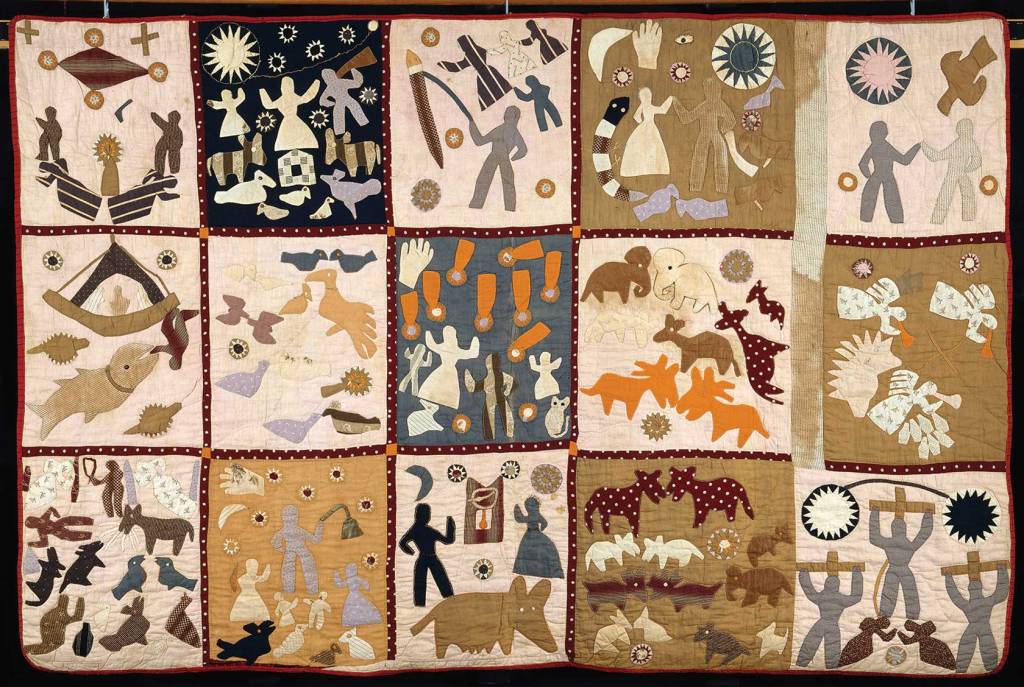
In 1992 the Smithsonian hired a Chinese company to make reproductions of the Bible Quilt, along with several other quilts, and it aroused much controversy. The quilting and arts communities were extremely upset. And you don’t want those thugs coming after you, believe me.
They claimed that it was disrespectful to make money off the Bible Quilt and similar works without exploring who might own the familial rights to the works and who could receive some of the royalties from reproductions.
Many felt so passionately about this cause that they canceled their Smithsonian memberships, contacted their congressmen, signed petitions, and protested on the National Mall. The Smithsonian greatly altered its policies as a result. So there.
No need to bring up today’s Jets game. Too painful. Oy. No, wait!! There was a miracle overtime win after we went to press!! All is forgiven, Zach! You da man!
See you tomorrow.
 The Wellington Files