When Isaac Bashevis Singer was asked if he believed in free will, he said “We must believe in free will — We have no choice.” That’s pretty much the conclusion of a review in The New Yorker of 11/13/23 by Nikhil Krishnan (NK) called “Make Me,” of a book by Robert M. Sapolsky, “Determined: A Science of Life Without Free Will.”
Apparently (did you know this?), science has come down on the side of determinism, i.e., everything is pre-determined, so there is no free will. Sapolsky is so convinced that all the disciplines, including history, negate the presence of free will that he says: “there’s not a single crack of daylight to shoehorn in free will.”
That means it makes no sense to blame anyone for anything, or to reward anyone for anything either. It’s called “causal determinism.” As NK writes: “If science tells us to be determinists, and determinism is incompatible with freedom, shouldn’t we give up on judging people for doing what they were destined to do?”
Sapolsky is exasperated that so many “sophisticates” are skeptical about free will skepticism. As NK puts it, “determinism, they tend to hold, is compatible with freedom, and therefore with moral responsibility, and therefore with blame, gratitude, and so on. The term for that happy reconciliation is ‘compatibilism.’ A compatibilist agrees that our actions are determined but denies that this truth casts doubt on anything of significance about human practices.”
Sapolsky mockingly claims their arguments boil down to three sentences:
a. Wow, there’ve been all these cool advances in neuroscience, all reinforcing the conclusion that ours is a deterministic world.
b. Some of those findings challenge our notions of agency, moral responsibility, and deservedness so deeply that one must conclude that there is no free will.
c. Nah, it still exists.
The problem is, even Sapolsky himself can’t make peace with his world view: “he admits to being a normal guy with normal guy feelings. ‘It’s been a moral imperative for me to view humans without judgment or the belief that anyone deserves anything special, to live without a capacity for hatred or entitlement,’ he writes. ‘And I just can’t do it.’ He’s in permanent misalignment with his theory of the world.”
His whole book comes down to what Singer said in one sentence: We have to believe in free will — we have no choice.
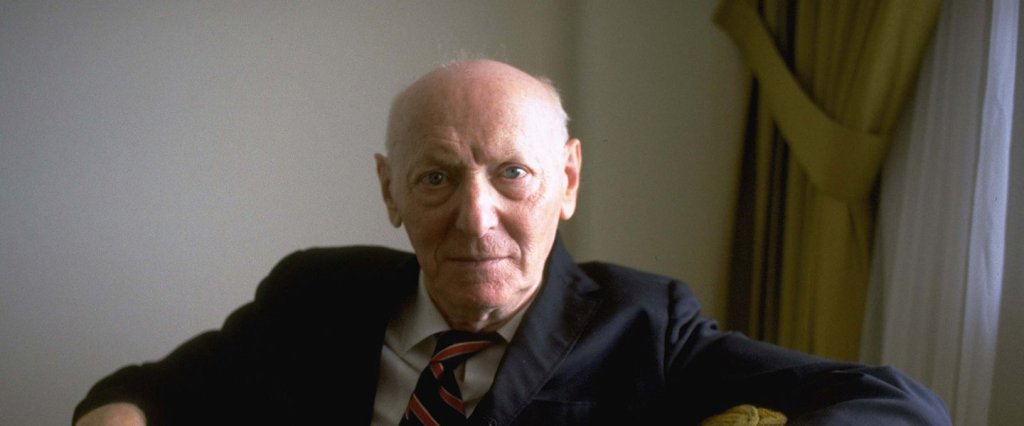
I went to hear Singer speak once. There was a question period at the end, and a woman got up and raved about how wonderful he was — she read all of his books, they were all outstanding and they changed her life, and so on and so on. When she finally came to a stop, Singer had a gleam in his very blue eyes and said: “Madam — you failed to pose a question — but I’ll forgive you.”
We attended a concert by the New Jersey Symphony in Morristown yesterday. When I checked the program ahead of time, I saw that Joshua Bell was slated to be both performing (Mendelssohn’s Violin Concerto), and conducting! How could he do both simultaneously?, I wondered. Phil said he saw it done on an assignment several years ago and it was pretty amazing. I’ll say! Here’s how JB did it yesterday:
When we took our seats, we noticed an unusual bench sort of thing in the center of the stage, angled downward towards the audience. When Bell came on stage (to very warm applause) he smiled and bowed and then lay down on his back on that contraption, — legs up and head downward. It was then that I noticed he wasn’t wearing shoes or socks!! He nodded at the concertmaster (the first violinist), who then proceeded to place a baton between the big toe and the next toe of Bell’s right foot. Bell then lowered his violin down onto his shoulder and began to play while conducting the orchestra with his feet!!
It was extraordinary – who wouldn’t be moved by those gorgeous Mendelssohn strains?! The only problem that arose — and it was momentary — was at a particularly lively moment when Bell lost his balance and tumbled off the bench, with his violin shooting off in one direction and the bow in the other. But it either happened in an earlier performance too or they rehearsed for it because he was back on the bench and in position within a second or two — he’s incredibly dexterous. I don’t think the folks in the back of the hall even knew what happened — and the orchestra didn’t miss a beat.
The ovation at the end was very appreciative, and the audience was buzzing during the whole intermission. Amusingly, we were sitting way up close so I could see off stage that Bell was having trouble finding his shoes. I think some of the cellists may have hidden them as a little good-natured prank; I could hear JB saying: “C’mon fellas — really — it’s cold out here.”
Photos were not allowed during the performance, but Phil managed to snare this shot of Maestro Bell before it started.

I neglected to show you how beautifully yesterday’s grid was constructed. Note the elegance of the symmetry. (Puzzles are required to be symmetrical.)
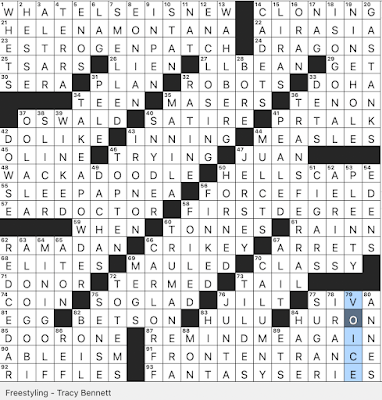
At 62D the answer was RED CEDAR (“Evergreen tree with fragrant bark”).
Rex poster Pete shared this with us (from which I learned the words dioecious and monoecious).
I came to praise the glory of RED CEDARs, or at least Eastern RED CEDARs. There are a lot of them in the park where I frequently walk my dogs, and this fall they were just full of berries, except they’re not berries, but we’ll call them berries because they’re technically juniper berries, just not juniper juniper berries, if you know what I mean. Trees full of green leaves looking more teal than green because the berries are as plentiful as the leaves. About half are that way, because most are dioecious, i.e. there are male and female Eastern RED CEDARS. There are also a small percentage of Eastern RED CEDARS that are monoecious, both male and female, because sex is not binary and is confusing as hell so we should all just keep our mouths shut about it and respect each tree for what it is. The production of seeds also takes three years, year one flowers appear on the ‘female’ trees and are pollinated, year two little bulbs form on the trees, year three they mature to the ripe berries. At the end of year three, they get swarmed by birds, and the seeds get distributed, complete with fertilizer. Such is the circle of life.

Yesterday, 66D was “Carmina Burana composer,” who is, of course, CARL ORFF. Here’s a good way to use it in a sentence: “Once it was clear that the bank robbers had left New Jersey, the Jersey state troopers decided to Carl Orff the search.”
So when I found out the dog could talk, I asked him who composed Carmina Burana and he said “Orff, Orff.” Correct!
Gosh, there must be a million of those — those two just came to me Orff the top of my head. I’ll take a little time Orff and see what I can come up with later.
(Phil was Orff somewhere, so I got this photo Orff the internet.)

At 20A today, the clue was “Make history at the Olympics, say,” and the answer was SET A NEW RECORD. It set Orff a bit of a flurry.
First, pbc noted: SETANEWRECORD is a pet peeve among professional copy editors. It’s not possible to set an old record, so any editor who’s paying attention will delete the ‘new’ and turn the phrase into, ‘set a record.’ The editor will then turn to colleagues and mock the sloppiness of the writer.
But Joe Dipinto disagreed: SET A NEW RECORD is fine, it acknowledges that there was a previous record quantified for the thing. Especially apropos when a famously long-held record gets broken, such as Hank Aaron’s surpassing Babe Ruth’s home run total.
And CT2Napa disagreed differently:
From OED: new. Not previously existing; now made or brought into existence for the first time. So a RECORD that didn’t exist before and is now made or brought into existence for the first time would seem to be a NEW RECORD.
(But that wouldn’t apply very Orfften.)
Does this woman, Sheynnis Palacios, look like a revolutionary to you?
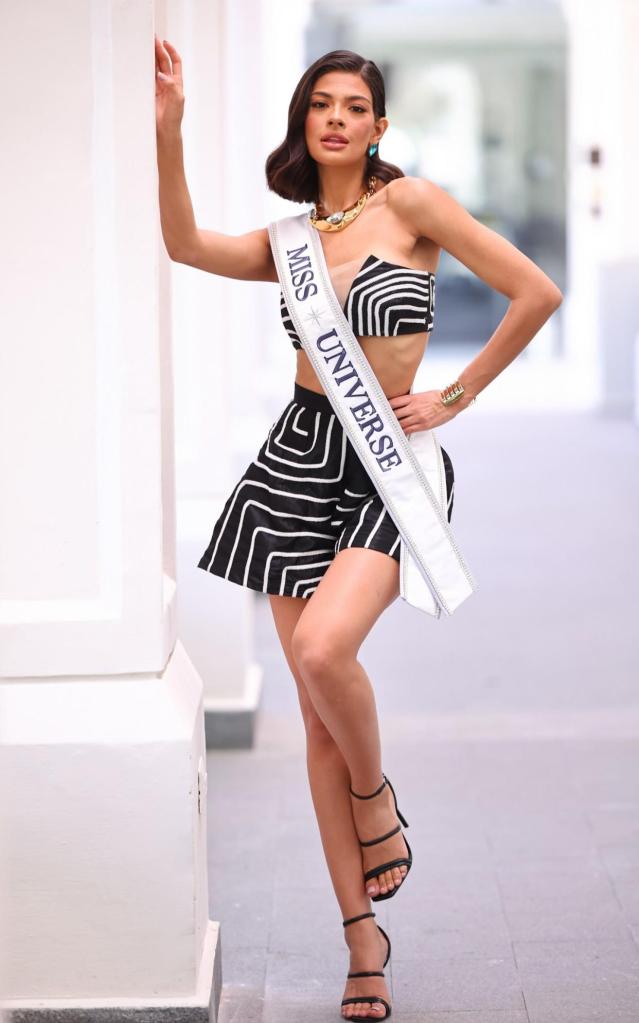
Well, she does to President Ortega of Nicaragua, and it’s probably a good thing that she’s out of the country for the time being. Here’s the deal. First of all, she won the Miss Universe contest this year, a first for Nicaragua. Hard to make a case against her deserving it, amirite?
Anyway, where were we? Oh, yeah, so photos of her attending anti-government rallies in 2018 surfaced. Ortega, the authoritarian leader, accused the pageant director, Karen Celebertti, of conspiring against him by engineering an anti-government Miss U win . She’s been charged with crimes (although she’s in Mexico at the moment), and her husband and son have been detained.
At protest rallies, which have since been declared illegal, protesters wave blue and white flags, instead of Ortega’s red and black. Some have interpreted Ms. Palacios’s white dress/blue cape combo, below, as referencing the protests. Owl Chatter is with you, ladies. Hoping for the best.

That’s a pretty smile to go Orff with tonight. See you tomorrow! — thanks for stopping by.
 The Wellington Files