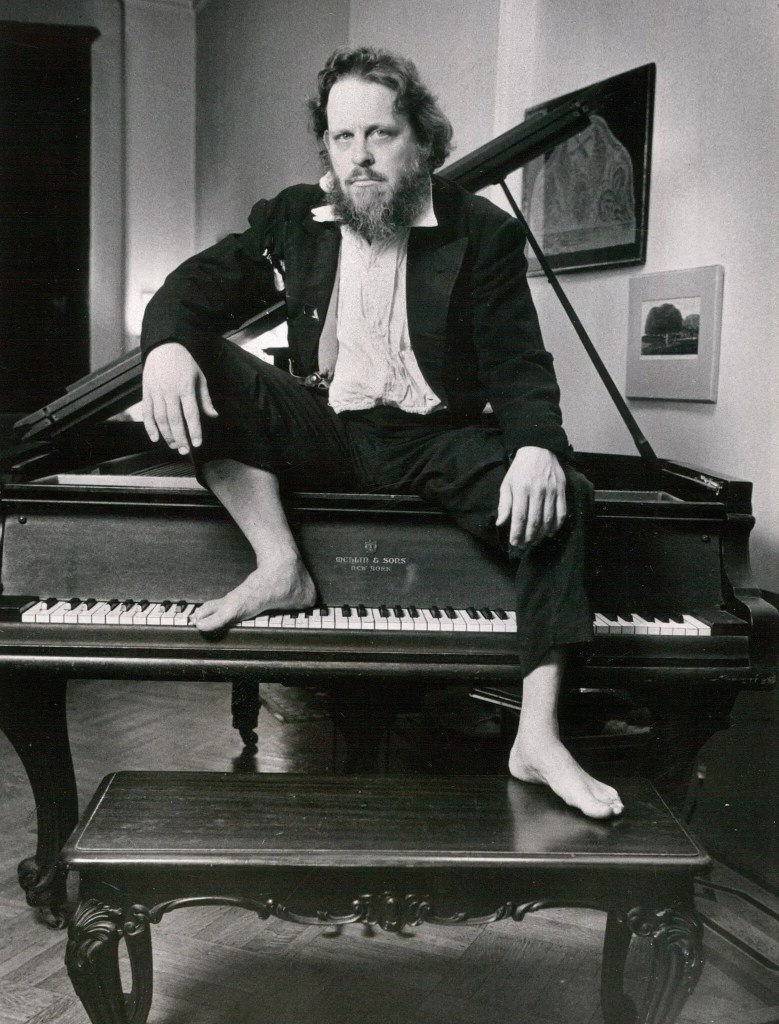
Peter Schickele died at age 88 on Tuesday at his home in Bearsville, near Woodstock, NY. A serious composer and musician, he is better known as the “discoverer” of P.D.Q. Bach (1807-1742), the 21st of J.S. Bach’s 20 children, also described as “the youngest and oddest of Bach’s 20-odd children.”
Works attributed to P. D. Q. Bach often use instruments not normally used in orchestras, such as the bagpipes, slide whistle, kazoo, and fictional instruments such as the pastaphone (made of uncooked manicotti), tromboon (see below), hardart, lasso d’amore, and left-handed sewer flute.
During his Soused (or Brown-Bag) Period, P. D. Q. Bach wrote a Concerto for Horn and Hardart, a Pervertimento for Bicycle, Bagpipes, and Balloons, a Serenude, a Schleptet in E-flat major, Hansel and Gretel and Ted and Alice, an opera in one unnatural act, The Art of the Ground Round, and a Grand Serenade for an Awful Lot of Winds and Percussion. He also wrote The Short-Tempered Clavier, The No-No Nonette, and The Unbegun Symphony. He wrote pieces to be performed by a “bargain-counter tenor” and an “off-coloratura soprano.”
The tromboon is an actual musical instrument developed by Schickele. He called it “a hybrid – that’s the nicer word – constructed from parts of a bassoon and a trombone; it has all the disadvantages of both.”

For his live performances, he often made a wild entrance. In his early years, he slid down a rope suspended from the first balcony; on at least one occasion he ran down the aisle, vast suitcase in hand, as if delayed at the airport; on another he entered, pursued by a gorilla. In his later years, when declining health forced him to enter in a wheelchair, audience members mistakenly took it for part of the act.
Schickele was born in Ames, Iowa, and went to high school in Fargo, ND. He dubbed himself Professor of Musical Pathology at the University of Southern North Dakota at Hoople, ND. He is survived by his wife, their daughter, Karla, a singer, songwriter and bassist, their son, Matthew, a composer, and two grandsons, all of whom enjoy a good tune on the tromboon from time to time.
I had the great pleasure of hearing Peter Schickele on NPR now and then. He was a uniquely brilliant and funny man.
Ed Poe was born on this date in 1809 in Boston, although he is most associated with Baltimore. He’s the reason their pro football team is the Ravens. Poe died in Baltimore. He was only 40.

Poe spent periods of his life in poverty during which he’d write anything for a buck, e.g., a how-to guide on collecting sea shells.
Ever hang out at a bat-mitzvah drooling over the bat-mitzvah girl’s friends and classmates? Me neither. But Eddie was 26 when he married his cousin Virginia who was only 13! Yikes! They remained married for 11 years until, sadly, her death from TB did them part.

Poe “invented” the detective novel, says no less an authority than A. C. Doyle. Thus, the award for best mystery is the “Edgar.”
Between 1949 and 2009, a bottle of cognac and three roses were left at Poe’s original grave marker every January 19 by an unknown visitor affectionately referred to as the “Poe Toaster.” It may have been Sam Porpora, a historian at the Westminster Church in Baltimore. He claimed he started the tradition to raise money and enhance the profile of the church, but this hasn’t been verified. The Poe Toaster’s last appearance was on January 19, 2009, Poe’s 200th birthday. Research conducted by Owl Chatter has established that there is no connection between the Poe Toaster and Post Toasties.

The puzzle today triggered a rant from Rex right off the bat. The clue at 1A was: “Bladderball players, historically,” and the answer was ELIS. It’s a game that used to be played at Yale. Here’s the rant:
“I cannot adequately express how much I do not care about and am not curious about the lore and practice and general behavior of YALIES, who have, historically, been overrepresented in the crossword, compared to other institutions of higher learning, to an absolutely absurd degree. YALIE YALIES ELI ELIS ELIHU OLDELI BOOLA LUX (et Veritas) and on and on, seemingly. So … Bladderball? I have no &^$%ing clue. I assume it’s something embarrassing like Quidditch. The name itself is something someone should’ve changed a long time ago. I know and admire and even love many people who have attended Yale, but dear god please stop making me know things about Yale.”
Here’s the scoop. Bladderball is a variant of pushball, and has its roots in mob football. It was originally a competition between The Yale Banner, the Yale Daily News, the campus humor magazine, and the campus radio station.
Bladderball was conceived by Yale student Philip Zeidman, owner of a six-foot leather exercise ball, as a preliminary event before the Yale-Dartmouth football game in 1954, according to Yale bladderball historian Sarah Hammond. Hammond traces the name “bladderball” back to a rugby-like game played by Yale students on the New Haven Green in the first half of the 19th century, featuring an inflated animal bladder.
Once each year, at 11 a.m. the Saturday before the Yale-Dartmouth game, the inflatable six-foot ball was rolled through Yale’s Phelps Gate onto Old Campus, where a throng of Yale students waited. At the sound of a whistle, teams from each residential college and various extracurricular organizations would fight for possession of the ball. Teams were allowed to use any means at their disposal to seize control.
In the absence of any scoring system, victory consisted of fervent declarations of victory by each team. Listeners to the Yale radio station would invariably learn that the station team had won a mighty victory, while readers of the Yale print media were invariably informed that each particular publication had bested all other teams handily, by scores often ranging into the thousands of points.
In the 60s, the game started spilling out onto the streets of New Haven, resulting in traffic tie-ups and various unfortunate incidents, which finally led Yale Prez Bart Giamatti (later the Baseball Commish) to ban it in 1982. The game reappeared surreptitiously in 2009 and 2011, but the cops quickly came and ended it. An attempted revival in 2014 was scotched by the cops who had received advanced word.

At 17A the clue was “World capital since 1971,” and the answer was DOHA. Here’s Rex again:
“I had no idea its capital status was so young. Admittedly, I don’t think a lot about DOHA. In fact, it’s possible I wouldn’t think about it at all, or even know of its existence, were it not for crosswords. This is true of much of the world. Is OSLO even real?”
At 42D, as anyone who has seen The Little Mermaid knows, “Domain of the god Triton,” is the SEA. It led Son Volt to share this song by the Waterboys.
Phil got the scoop for us on Taylor and Travis’s first tiff when he snapped a few exclusive pics of the star for OC. It started with a bad loss for the Chiefs on Christmas. It put Trav in a very sour mood and — unacceptable! — he snapped at her. (“No shit!” Phil said. ”Shit,” she replied.) The only snapping she wants to hear is our Philly snapping some pix. Travis apologized but it left a scar. Rule #1: Don’t be snappin’ at the Princess. No way. No how.
Taylor also opened up to Phil about her relationship with some members of Travis’s family — there’s some coldness between her and Trav’s brother and his wife. The brothers are close, so that doesn’t help. There’s also tension about scheduling time for them to see each other — they both have massive career commitments (duh). Taylor told Phil she’s been bending over backwards to accommodate Travis’s schedule and it sounds like she may be pulling back a bit. We’ll keep you posted. Phil stays in pretty close touch with Tay.
Wow — nice shot, buddy.

See you tomorrow everybody! Thanks for popping in!
 The Wellington Files
One response to “Bladderball”
I had a record of PDQ Bach’s greatest flops. In the category of never-laughed-so-hard, the recording features an aria—quite a long one. The soprano hits a very high note at the end of side one, and the flip side begins with her on the same note for another couple of minutes. Rest in peace, Mr. Schickle. You gave us joy and frankly injected a little humor into the stuffy world of classical music.
LikeLike