Look at this shayna punim. What a beautiful young man:
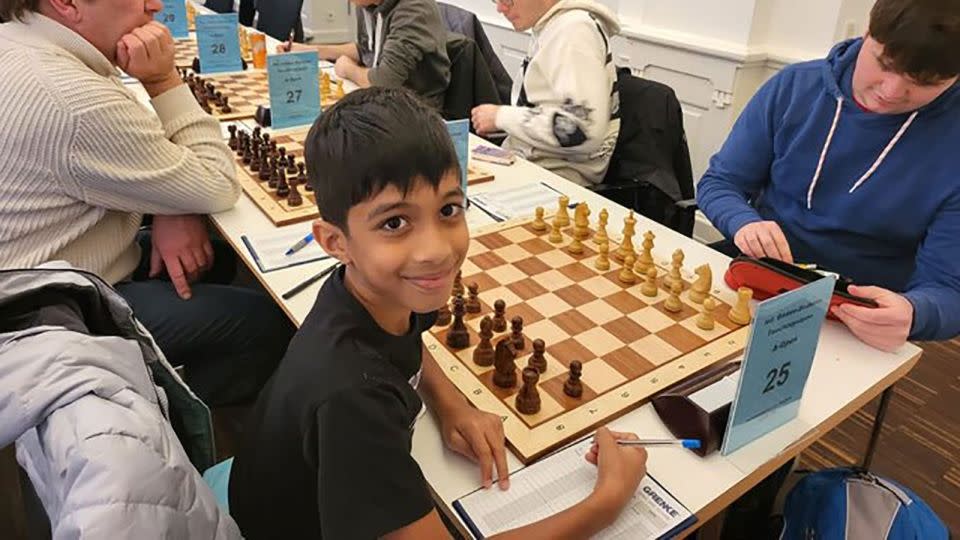
He’s from India, is 8 and a half years old, and just became the youngest person ever to defeat a chess grandmaster in a tournament. His name is Ashwath Kaushik. He beat Poland’s Jacek Stopa, 37, in round four of the Burgdorfer Stadthaus Open in Switzerland. Ashwath went on to finish 12th in the tourney.
Ashwath’s father says neither he nor his wife have a history of playing chess and it was a surprise to see his son, who he says practices around seven hours a day, become such a talented player. “It’s surreal as there isn’t really any sports tradition in our families. Every day is a new discovery, and we sometimes stumble in search of the right pathway for him.”
Well, you’ve got something special there, buddy. Take good care of him.
At 36A today, the clue was “Effect of secondhand pot smoke,” and the answer was CONTACT HIGH. I thought that meant you were in a room where so much pot smoking was going on that you inhaled enough pot to get high even though you never took a puff. And that’s what the clue/answer implies.
But a comment on Rex’s blog today says that thinking (and thus the clue) “is dead wrong. The whole thing about a CONTACT HIGH is that you get it without ingesting or inhaling anything other than the good mood of your companions. My friend Dana doesn’t touch the stuff but when she gets around people who are high she gets all giggly and laughs at the same stupid jokes as anyone else. If you get high from second hand pot smoke, that’s just called ‘high.’”
Wikipedia agrees: “The term is sometimes incorrectly used to describe the high experienced by a person who has inhaled secondhand marijuana smoke.”
[Ed’s note: Where else can you get vital information like this. I ask you.]

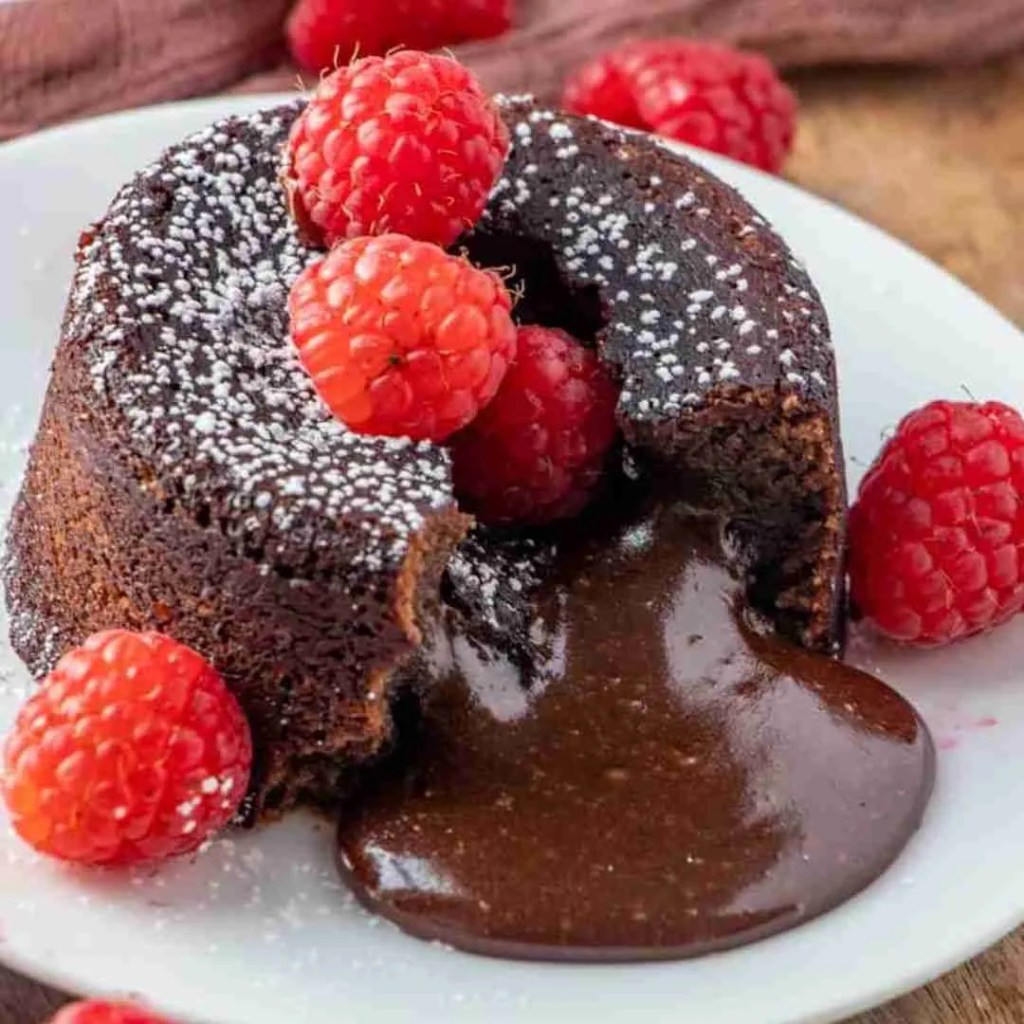
The puzzle’s theme today was things that are, in a sense, HALF BAKED. CONTACT HIGH was one of them. The others were WILD IDEA, LAVA CAKE, and BIKINI TAN. I agree with Rex, who thought it was a little off.
egs noted: Being a pessimist by nature, I always see something that’s HALFBAKED as half raw. But I think this puzzle was well done.
And several folks reminded us of the line from The Graduate. Ben (Dustin Hoffman) is told that his plan to marry Elaine seems half baked. And he replies: No, it’s fully baked.
There were a lot of names in the puzzle. Two were Shakespearian: OSRIC (from Hamlet) and TIMON (of Athens). Also ASLAN (hero of Narnia), Mel TORME, CARL JUNG, ANDY (from Toy Story), author Ted CHIANG, ELIE Wiesel, MAD MAX, and STAN (clued with “uber fan”).
I knew them except for ASLAN and CHIANG, but the crosses worked for me so I didn’t have a problem.
Some people blame the constructor when there are too many names they don’t know — “crappy puzzle — who ever heard of Mel Torme?” But almost always, I consider it a failing of my own — my cultural reach should be broader. As Lewis noted yesterday, it’s okay to have a tough name if the crosses are fair. Sometimes, I’ll concede, the name is just too off — e.g., yesterday’s Adrian Fenty, ex-mayor of DC. I can see crying foul over him.
Commenter Mike expounded on this today, a bit testily:
I was surprised by all the complaints about names and quaint old vocabulary. I mean, it’s a crossword puzzle. You’d think there would be some appreciation for language per se, and an interest in expressions from the past (MOOLA, lah-di-DAH, NERTS). As for names, I mean, it’s the New York Times, where literature, arts, and fashion are right up there with politics, economics, and world events. Until recently, I suppose, its readers would have been expected to know “TIMON of Athens” and LAERTES/OSRIC at a very minimum. ASLAN is a crossword staple and C.L. Lewis and the Chronicles of Narnia are epochal. Mel TORME stands beside Sinatra, Bennett, Ella, and Billie among classic voices of the American songbook. MAD MAX??? That movie—which I saw when it was first run in 1979—put Mel Gibson on the map and virtually invented the dystopian genre in contemporary film. Oh, and the term STAN was in an Eminem song, and is thought to be a portmanteau of “stalker” and “fan.” There’s a Pet Shop Boys song called “The Night I Fell in Love” in which a gay fan goes home with a pop star after meeting him backstage after a concert, and the star at one point says in jest, “Hey, man! Your name isn’t Stan, is it?”
Ilya Kaminsky was born in Odessa, Ukraine, in 1977, so he’s 46. When he was 16 his family was granted asylum by the U.S. on the grounds of anti-Semitism in Ukraine. His poetry has won many awards. In 2019, the BBC named Kaminsky among “12 Artists who changed the world.” He teaches at Princeton now.
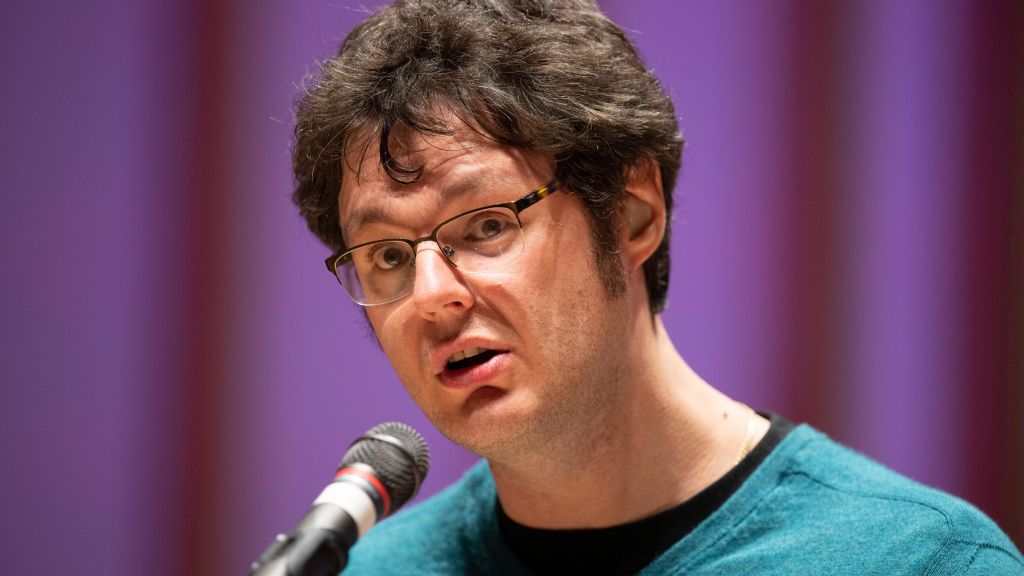
His poem “We Live Happily During the War” was The Poetry Foundation’s poem of the day today.
And when they bombed other people’s houses, we
protested
but not enough, we opposed them but not
enough. I was
in my bed, around my bed America
was falling: invisible house by invisible house by invisible house.
I took a chair outside and watched the sun.
In the sixth month
of a disastrous reign in the house of money
in the street of money in the city of money in the country of money,
our great country of money, we (forgive us)
lived happily during the war.
***********
In an interview, he said this about Odessa: Odessa architecture is scaled down, “human sized,” and there was an opera house before there was potable water. Odessa loves art, and it loves to party. In the summer, huge cages of watermelons sit on every corner. You break them on the sidewalk and eat them with friends. The city has an especial affinity for literature. There are more monuments to writers than in any other city I have ever visited. When they ran out of writers, they began putting up monuments for fictional characters.
The most important holiday in Odessa isn’t Christmas, it is April 1, April Fool’s Day, which we call Humorina. Thousands of people come to the street and celebrate what they call the day of kind humor. All of Ukraine has a sense of humor – think of the man who offered to tow the Russian tank which had run out of gas back to Russia. Humor is part of our resilience.
He was asked what he heard from people back there. (This was when the war had just started.) He told about “this conversation I’ll never forget with an older friend from Odessa. After I asked him for any way I could help him, he responded: ‘Putins come and go. If you want to help, send us some poems and essays. We are starting a new literary magazine.’ In the first days of war. Imagine.”

See you tomorrow!
 The Wellington Files