Today’s puzzle is a “modern reimagining” of Frost’s famous poem (which I was barely skin-of-my-teeth familiar with). I thought it was fairly cute/clever. But Rex’s rant was so heartfelt (and funny) that I am going to go whole hog with it. First, here’s the (real) Frost poem:
Whose woods these are I think I know.
His house is in the village though;
He will not see me stopping here
To watch his woods fill up with snow.
My little horse must think it queer
To stop without a farmhouse near
Between the woods and frozen lake
The darkest evening of the year.
He gives his harness bells a shake
To ask if there is some mistake.
The only other sound’s the sweep
Of easy wind and downy flake.
The woods are lovely, dark and deep,
But I have promises to keep,
And miles to go before I sleep,
And miles to go before I sleep.
OK, and here’s the “modern reimagining” which fills four complete lines in the puzzle: 15 letters across for each line:
I KNOW WHOSE WOODS
THESE ARE. MY HORSE
IS RESTLESS. I HAVE
A LOT TO DO. GIDDYUP!
Get it? It’s kinda cute IMO. I guess the idea is to “unpoem” the poem.
Rex killed it with unusual fervor. The poor constructor (Joe O’Neill) must be searching for Saddam Hussein’s hiding hole right about now.
Here’s Rex:
Well, this puzzle *is* exceptional, in that it’s easily the worst puzzle I’ve done this year. Imagine writing a puzzle that (a) assumes the vast majority of solvers will know this damn poem well enough to paraphrase the whole thing, (b) has such a terrible, off-the-mark sense of what “modern” means (or what paraphrase entails), and (c) makes zero reference to “sleep” in a poem where the speaker, famously, repeats the need for sleep at the poem’s conclusion.
There are four stanzas to the poem, but we get three … sentences? Or four lines, I guess, if this is supposed to be “modern” poetry, with each line a “line,” and rhyme and meter not a factor. Anyway, two whole stanzas about the horse condensed to “MY HORSE / IS RESTLESS.” Brilliant. If this is “modern,” why are you even on a horse in the first place?! Use the GPS on your ATV, you idiot. This puzzle manages to be an insult both to poetry and to puzzles. Guessing at the phrasing of the “modern” version was torture, in the sense of (occasionally) “hard,” but primarily in the sense of “actually physically painful to accomplish because the ‘poem’ was so completely tin-eared.”
He goes on:
I liked one thing about this … or at least respected one thing, and that’s the final GIDDYUP! It’s so stupid, so Not a part of the original poem, so unexpected and goofy, that I have to give it at least a golf clap. The rest of the poem was so punishing that the GIDDYUP! at the end actually managed to alleviate a bit of the pain.
Commenter Kenji wrote:
“We read and discussed a number of Frost poems in a course I took, under the guidance to look always beyond Frost’s seeming pastoral, down-home gloss for the haunting, darker angle. Ever since, I’ve seen the ‘lovely, dark, and deep’ woods of this one as reflecting a relatively young person’s (possibly first) contemplation of mortality, and, kinda Hamlet-like, early death by one’s own hand.”
I re-read the Frost poem from this perspective and got more out of it. Sleep = death. I can see it.
The best early comment was from Anony-mouse (who was anticipating Lewis’s take on the puzzle — Lewis always finds the positive, as a counter to Rex):
[Grabs popcorn] 🍿 [Waits for Lewis]
To no surprise, when Lewis chimed in, he loved it. Many folks agreed with Rex, but several came to the puzzle’s defense, including me. It generated an unusual amount of interest — there are 193 comments. That’s about triple the usual amount.
Here’s a defense I found reasonable. Then I’ll end the discussion with Commenter Nancy’s poem.
I’m a high school English teacher, love Frost, really enjoyed the puzzle. I think if it had been clued as “banal reimagining of a Frost poem” or “limited” or “unpoetic,” it would have irritated people who know the poem less. My sense was that the superficiality of it was the point, which is why it amused me. I spend all day listening to students complain about the “pointless” complexity of language, imagery and meaning in literature, so this felt like a spoof of that attitude. It made me laugh, and I liked trying to figure out exactly how pedestrian each line would be as I filled it in from the downs. The “giddyup” at the end was a great payoff.
Nancy’s poem:
What have you done to Robert Frost?
His words are jumbled — tempest-tossed!
They make no sense; they leave us lost!
What have you done to Robert Frost?
He doesn’t need improving, Joe!
“Stopping by Woods” has grace and flow,
So why you’ve done this, I don’t know —
He doesn’t need improving, Joe!
He can’t protest because he’s dead.
So I’m complaining in his stead.
The words he wrote, the words he bled
Are not your words to take and shred.
So stick to what you know the best:
The “SMOOVE”s and “U”s and all the rest.
And make your silly nonsense cease,
And let poor Robert rest in peace!
One of the funniest men in America died on Tuesday: Richard Lewis, at age 76, in his home in LA, from a heart attack. Years ago, he cracked me up with a Bill Skowron joke. Who does that? Skowron was the Yankee first-baseman when I was growing up and first became a fan. Nickname Moose. He was my favorite Yankee because I played first base too. He kept his hair short and heavily gelled.
So years later I’m watching Richard Lewis being interviewed, and the topic of Mickey Mantle’s restaurant came up — Mickey had recently opened it in Manhattan. And Lewis said: “Yes, I ate there. It’s very good. I had the Bill Skowron salad, you know, with the vaseline.”
Fell out of my chair.
One of my great comedy disappointments occurred when I settled into my couch to watch Lewis interviewed by Bob Costas. After three sentences, Costas was so paralyzed by laughter that he couldn’t go on. He couldn’t do the interview. They didn’t do it.
Some of his bits were about the something “from hell.” The waiter from hell; the doctor from hell, etc. The Yale Book of Quotations credits Lewis as the source of “the [blank] from hell” expression.
He was a regular on Larry David’s “Curb Your Enthusiasm” and appeared on David Letterman’s show 48 times. He was born in Brooklyn three days ahead of Larry David in the same hospital. But he grew up in Englewood NJ. His dad owned a kosher catering business, and his mom acted in community theater, specializing in the Jewish mother characters in Neil Simon plays. That must’ve been easy.
He graduated from Ohio State with a degree in marketing and was phumphing around on the edges of comedy back in NJ after graduating. He was in a deli one day with friend and mentor David Brenner, complaining about his life (voo den?).
As Lewis told the story, “Brenner said, ‘What do you need to be a comic full time?’” “I said a thousand dollars. He whipped out a check and gave it to me. I quit my job and I’ve never looked back.”
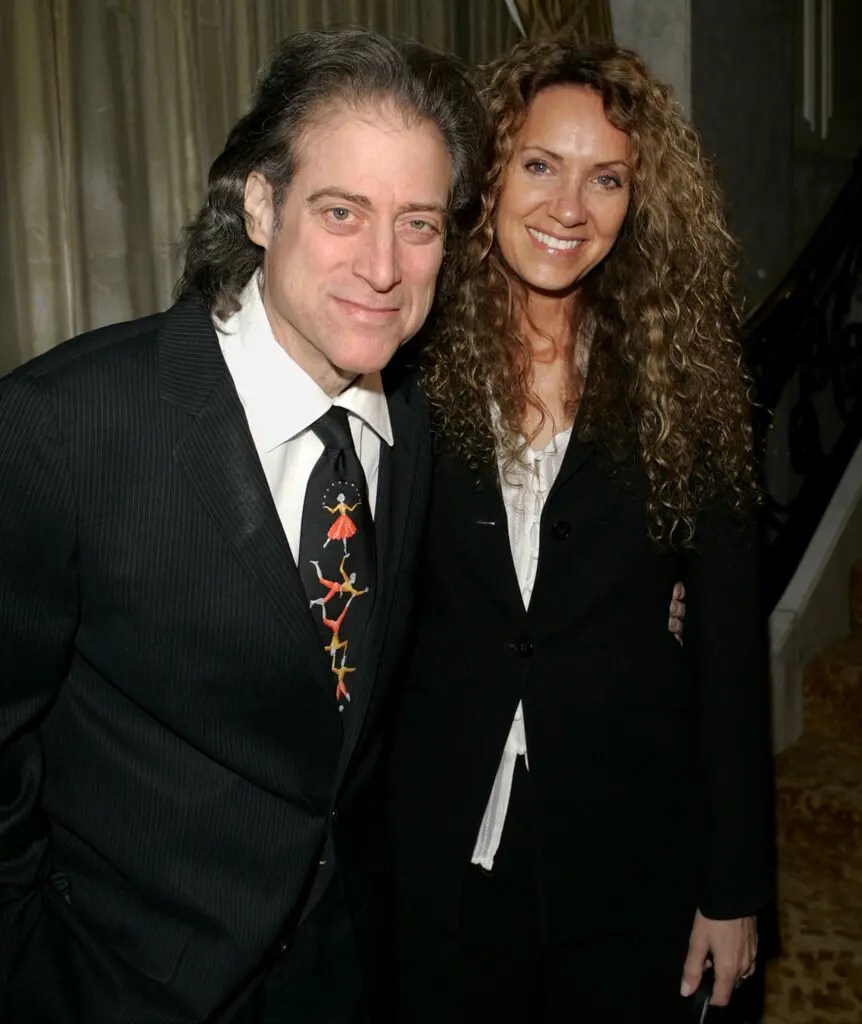
He avoided long-term relationships for many years, but then met Joyce Lapinsky who worked in music publishing. They dated for years and when they considered marrying, Lewis brought her to meet his psychiatrist. “This is as good as it gets,” the shrink told him. They married in 2005.
Lewis is survived by his wife Joyce and his brother Robert, both of whom, I have absolutely no doubt, spent most of their time laughing.
Rest in peace, Richard. I’m glad you enjoyed the salad.
The Oregon State Lady Beavers were down by 12 to Colorado with only seven minutes to go in the PAC-12 tourney. Not looking very good. But a flurry of made shots and stellar defense brought the game to a dead heat by the time the buzzer sounded. Oh, baby. First overtime – still tied. Second overtime was the ticket. 85-79 OSU! Brava, ladies. On to the semi-finals tomorrow!

See you tomorrow!
 The Wellington Files