Ever wonder what it would be like to be a dog? Me neither. This poem is by Richard Shelton. It was in today’s Writer’s Almanac and is called “If I Were a Dog.”
I would trot down this road sniffing
on one side and then the other
peeing a little here and there
wherever I felt the urge
having a good time what the hell
saving some because it’s a long road
but since I’m not a dog
I walk straight down the road
trying to get home before dark
if I were a dog and I had a master
who beat me I would run away
and go hungry and sniff around
until I found a master who loved me
I could tell by his smell and I
would lick his face so he knew
or maybe it would be a woman
I would protect her we could go
everywhere together even down this
dark road and I wouldn’t run from side
to side sniffing I would always
be protecting her and I would stop
to pee only once in awhile
sometimes in the afternoon we could
go to the park and she would throw
a stick I would bring it back to her
each time I put the stick at her feet
I would say this is my heart
and she would say I will make it fly
but you must bring it back to me
I would always bring it back to her
and to no other if I were a dog
It was on this date in 1834 that Whistler’s mother gave birth to Whistler in Lowell MA: James Abbott McNeill Whistler. His famous painting, Whistler’s Mother, below, was not called that. Its title was Arrangement in Grey and Black No. 1, but what are you going to do? — it’s a painting of his mother so people call it what it is. Her name was Anna Matilda McNeill Whistler. Get this — she was only a stand-in, or, I guess, a sit-in. The model Whistler arranged to sit for him failed to show up, so it was “Mom!! Help!!”
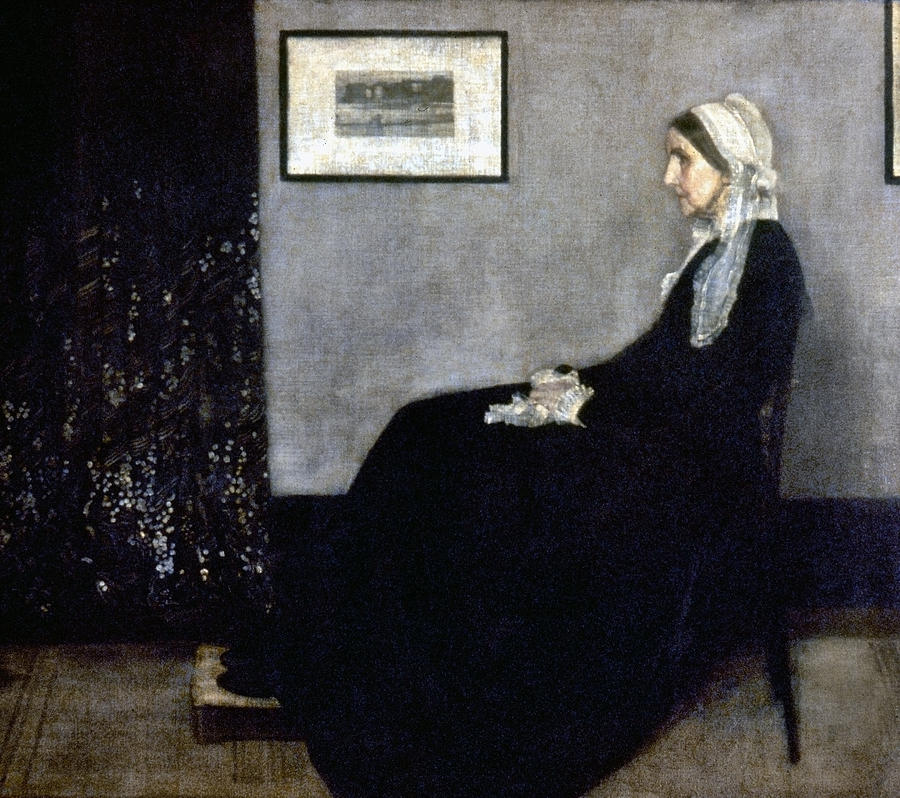
When he was finished painting her, they switched places and she painted this portrait of him.
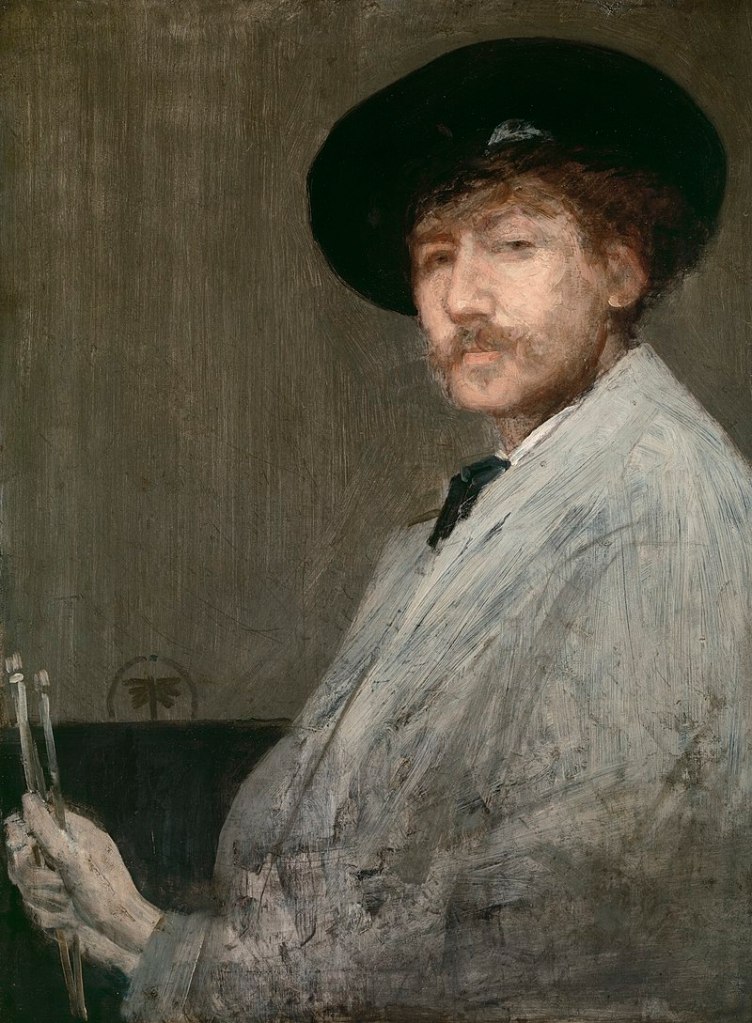
(No she didn’t — that’s a self-portrait Whistler painted himself of himself himself.)
In 1877, the critic John Ruskin wrote this about Whistler’s painting Nocturne in Black and Gold: The Falling Rocket: “I have seen, and heard, much of Cockney impudence before now; but never expected to hear a coxcomb ask two hundred guineas for flinging a pot of paint in the public’s face.”
Whistler sued for libel. Here is Ruskin’s attorney Holker cross-examining the artist:
Holker: “What is the subject of Nocturne in Black and Gold: The Falling Rocket?”
Whistler: “It is a night piece and represents the fireworks at Cremorne Gardens.”
Holker: “Not a view of Cremorne?”
Whistler: “If it were A View of Cremorne it would certainly bring about nothing but disappointment on the part of the beholders. It is an artistic arrangement. That is why I call it a nocturne.“
Holker: “Did it take you much time to paint the Nocturne in Black and Gold? How soon did you knock it off?”
Whistler: “Oh, I ‘knock one off’ possibly in a couple of days – one day to do the work and another to finish it …” [the painting measures 24 3/4 x 18 3/8 inches]
Holker: “The labour of two days is that for which you ask two hundred guineas?”
Whistler: “No, I ask it for the knowledge I have gained in the work of a lifetime.”
Whistler won the case but was awarded only a farthing in damages. It may not have seemed much at the time, but adjusting for inflation and the exchange rate, it’s the equivalent of 800 billion dollars today, give or take a quarter.
We’re broadcasting tonight from our luxurious suite in The D. Hotel in Holyoke MA, in reasonable proximity to Yidstock, the annual klezmer festival at the Yiddish Book Center in Amherst. Opening night featured the Klezmatics, the only klezmer band to win a Grammy, and they did not disappoint. The pre-show announcement was in Yiddish, followed by English. We were told to take note of the emergency exits but reassured that nothing bad will happen. We were also told not to video the performance. “We’ve put people in jail for far less,” they warned. Aaron Lansky whose brainchild the Center is, said there were many people to thank for organizing the festival — “It takes a shtetl.”
I can’t do justice to how wonderful the show was. I’m sharing a song of the Klezmatics off of Youtube to give you a small sense of what klezmer sounds like, but they played a wide variety of songs, including three Woody Guthrie songs that were very appropriate to our time. The performance as a whole reminded me how important music is. How it is not only part of our identity, it shapes us.
Enjoy the tune. We’ll report more on the rest of the festival in the coming days.
Thanks for stopping in! See you soon.
 The Wellington Files
One response to “The Klezmatics”
great dog poem…I have been out of touch for two weeks and trying to catch up on The Wellington Files!!
LikeLike