The first game of the World Series was disappointing (wrenching, actually) to me as a Yankee fan, but was such a damn good game it’s hard to be too upset.
Jazz Chisholm Jr., the Yankee third-bagger, stole the show, as far as I was concerned, well, at least until Freddie Freeman stole everything at the very end. Jazz made a spectacular play on a hot shot to him when he was playing in to cut off a runner on third from scoring. And in the tenth inning he stole second and third before scoring the lead run on an infield hit. Black lightening. Here’s The Jazzman. So glad he’s in NY.

Little things made such a difference. LA shortstop Tommy Edman dove and stretched as far as he could and needed every inch to stop a grounder up the middle from escaping the infield. It saved a run. In the other direction, Yankee second-baseman Torres couldn’t handle the bounce on the throw from Soto in right when Ohtani doubled off the wall. (Catch the fucking ball, Torres!!) It skipped away towards the mound that was vacated by the pitcher backing up third. Oh no! Ohtani darted alertly to third and scored a moment later on Mookie Betts’s searing drive to deep center. Two plays that made a difference of two runs in LA’s favor.
With Judge still in his post-season funk, the Dodger lineup deeper than New York’s, and Yankee ace Cole “wasted,” the Dodgers are in the catbird seat. But anything can happen.

Today’s award for best clue for a boring word went easily to the clue at 10A: “Freshly pressed grapes before fermentation.” Answer: MUST.

At 27D, the clue was “Vessel that hasn’t crossed the Canadian border since 1993.” You have to think of a cup as the vessel. Then you have to realize a Canadian team has not won the Stanley Cup since ’93. Hence the answer STANLEY CUP. Rex took the occasion to share this exquisite song with us. How in the world have I not heard of Nadia Reid before?
Novelist Anne Tyler was born on this date in Minneapolis in 1941. Most of her novels are set in Baltimore where she’s lived since 1967, but she lived in a Quaker commune in the mountains of North Carolina when she was little and attended a one-room school for all the children who lived on the mountain. There weren’t a lot of books so she read Little Women 22 times. If you’ve read any of her books, she looks exactly how you would imagine she looks.

This poem by Robyn Sarah is called “Nursery, 11 p.m.”
Asleep, the two of you,
daughter and son, in separate cribs,
what does it matter to you
that I stand watching you now,
I, the mother who did not smile all day,
who yelled, Go away, get out, leave me alone
when the soup-pot tipped over on the stove,
the mother who burned the muffins
and hustled bedtime, tight-lipped.
You are far away,
beyond reach of whispered
amends. Yet your calm
breathing seems to forgive,
unwinding
into the air to mesh
like lace, knitting together
the holes in the dark.
It makes of this dark
one whole covering
to shawl around me.
How warm it is, I think,
how much softer
than my deserving.
Taylor popped up again in the puzzle today, smack in the middle at 30D: TAY: “When doubled, a pop nickname.” Rex shared this little XW history with us:
One of the weirdest things about TAY, as a crossword answer, is its mysterious 11-year disappearance. The TAY is a Scottish river, and it appeared in pre-Will-Shortz era puzzles with reasonable regularity, but once Shortz took over, it just vanished. Then, suddenly, eleven years later, in 2004, it came back, and has since appeared eighteen times as the Scottish river. The first appearance of this more current pop star clue was just this year back in June, so the TAY-TAY frame of reference is solely a Joel Fagliano post-Shortz-era phenomenon.
Here are the two Tays.


Gordon McGoochan of the DMC (UK) writes: This is our cutlery drawer, there are 4 teaspoons, 14 spoons, 10 knives and 39 forks. Only two people live in this house and I have no idea how this happened. Also, I have never bought a piece of cutlery in my life.
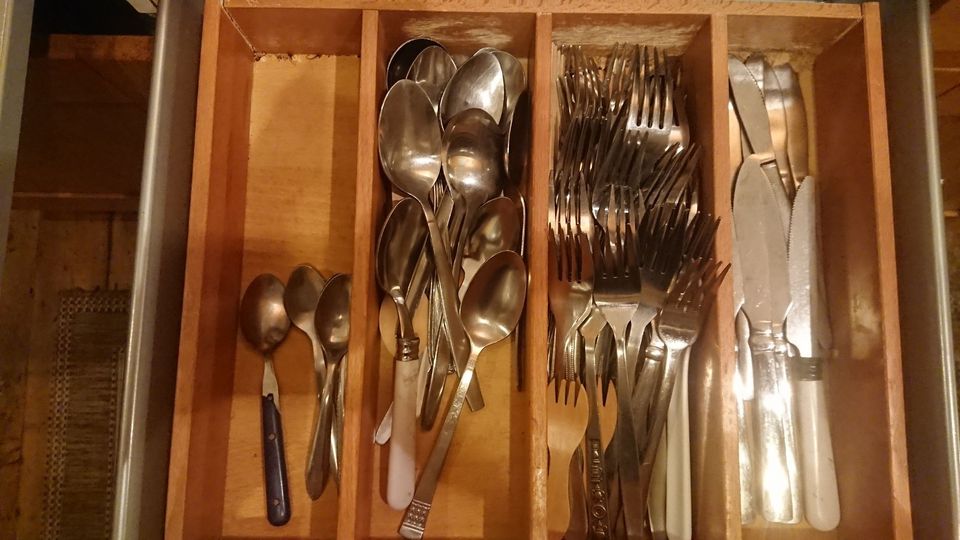
Nick Wallis: They’re in the wrong order: It should be from left to right, knife, fork, spoon, tea spoon.
Debbie Mackay: Teaspoons are with your missing socks.
Robin Lawrenson: I have just counted 42 mugs/teacups in our kitchen, and yes, just two of us; I have never bought one either.
Paul Mandel: Teaspoons are mysterious things, like socks. They do disappear. Where and how, no clue. I recently had to top up with a dozen.
Paul Mandel also cited a study that appeared in The BMJ (British Medical Journal):
Introduction
In January 2004 the authors found their tearoom bereft of teaspoons. Although a flunky (MSCL) was rapidly dispatched to purchase a new batch, these replacements in turn disappeared within a few months. Exasperated by our consequent inability to stir in our sugar and to accurately dispense instant coffee, we decided to respond in time-honoured epidemiologists’ fashion and measure the phenomenon.
A search of the medical and other scientific literature through Google, Google Scholar, and Medline using the keywords “teaspoon”, “spoon”, “workplace”, “loss” and “attrition” revealed nothing about the phenomenon of teaspoon loss. Lacking any guidance from previous researchers, we set out to answer the age old question “Where have all the bloody teaspoons gone?” We aimed to determine the overall rate of loss of teaspoons and the half life of teaspoons in our institute, whether teaspoons placed in communal tearooms were lost at a different rate from teaspoons placed in individual tearooms, and whether better quality teaspoons would be more attractive to spoon shifters or be more highly valued and respected and therefore move and disappear more slowly.
Abstract
Objectives To determine the overall rate of loss of workplace teaspoons and whether attrition and displacement are correlated with the relative value of the teaspoons or type of tearoom.
Design Longitudinal cohort study.
Setting Research institute employing about 140 people.
Subjects 70 discreetly numbered teaspoons placed in tearooms around the institute and observed weekly over five months.
Main outcome measures Incidence of teaspoon loss per 100 teaspoon years and teaspoon half life.
Results 56 (80%) of the 70 teaspoons disappeared during the study. The half life of the teaspoons was 81 days. The half life of teaspoons in communal tearooms (42 days) was significantly shorter than for those in rooms associated with particular research groups (77 days). The rate of loss was not influenced by the teaspoons’ value. The incidence of teaspoon loss over the period of observation was 360.62 per 100 teaspoon years. At this rate, an estimated 250 teaspoons would need to be purchased annually to maintain a practical institute-wide population of 70 teaspoons.
Conclusions The loss of workplace teaspoons was rapid, showing that their availability, and hence office culture in general, is constantly threatened.
OMG, if that’s not enough nonsense for you for the day, I give up.
See you tomorrow Chatterheads!
 The Wellington Files