Isaac Bashevis Singer was probably born 120 years ago this week in Poland. There’s some question about his birthdate since he may have made one up to avoid the draft. (Was it that easy?) He wrote in Yiddish on a Yiddish typewriter, and then translated his writings into English himself. On Yiddish being a dying language, he said, Yiddish has been dying for 100 years and I’m confident it will go on dying for another 100 years. Upon being asked if he believed in free will, he famously said “We must believe in it — we have no choice.”
When Singer received the Nobel Prize in 1978, he delivered part of his acceptance speech in Yiddish, and said, “Yiddish has not yet said its last word. It contains treasures that have not yet been revealed to the eyes of the world.”
There is a collection of Yiddish typewriters in the Yiddish Book Center in Amherst MA which Linda and I saw last July when we were up for the Klezmer festival, Yidstock. Here’s one. It must work from right to left.
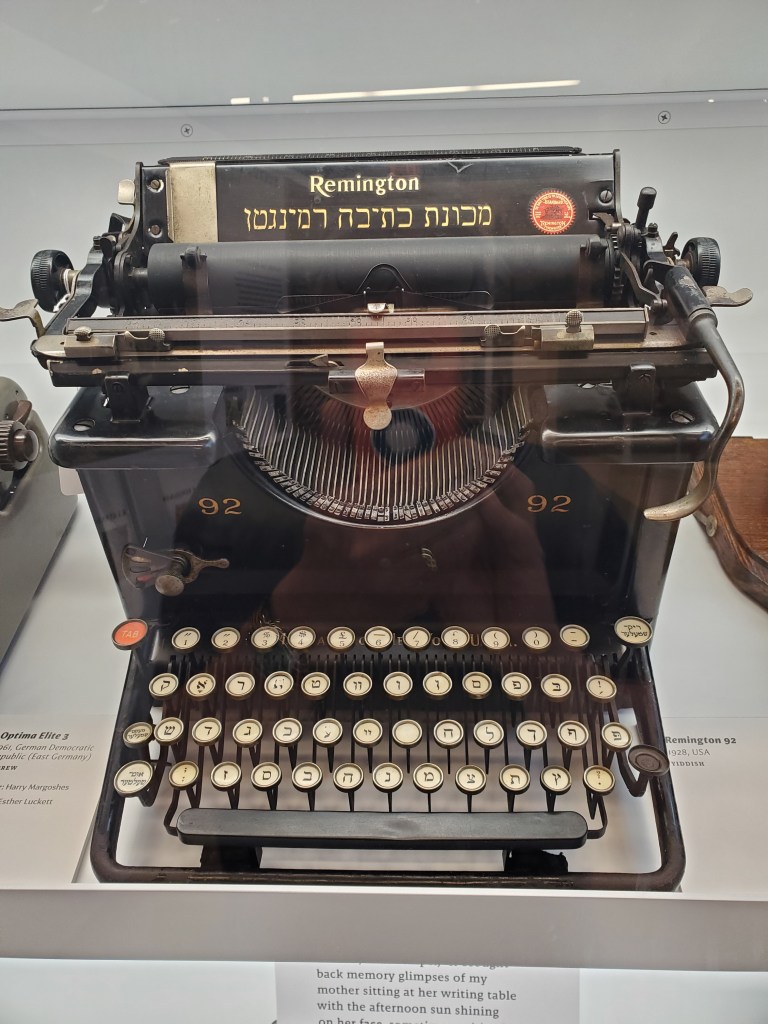
I heard Singer speak once, I forget where. He was wonderful (vu den?). If you’d like a taste, seek out his short story “The Admirer.” It’s a real hoot. (It appeared in The New Yorker of 1/6/1975.)

Barry Howard, of the Dull Men’s Club (UK) writes: The gritter/salt spreading truck goes past our house at precisely 21:30 every time it’s needed. [OC note: By my calculations, that’s 9:30 PM].
Roger Allen: Sounds like the only time it’s needed is 21.30.
Barry replied to Roger: It’s a very small truck.
And I wrote to Barry: I fail to see the relevance.
Steven Henry: Personally, I’d wait up for that.
Paul Bryant: I got knocked off my bike by one of those lorries once. I yelled at them through gritted teeth. [OC: Ha! Gritted teeth!]
David Fisher: We had a competition a while ago to name a new gritter our council had just got. And Gary won.
I asked David what some of the other entries were. Am awaiting his reply.
Barry didn’t include a photo with his post. So we sent Phil over to England to look into it. It might have looked like this, he reported.

I’m not sure why I love this story from today’s Met Diary. It’s by Carrie Klein. I do remember that for my second year in law school I was sharing grad housing with several friends. We bought groceries as needed and then the year ended and we had to clear out. The only item left on the last morning was some pancake mix we bought the very first day and never used the whole year. So for our last breakfast there we made pancakes and they were good.
Dear Diary:
In 1966, when I was still in high school, my older sister and I were allowed to go to New York on our own for the summer. It was the first time we had flown on a plane.
The only advice we were given was to stay at the Martha Washington Hotel because it was only for women and to send home every day one of the stamped postcards we had been given to prove we were alive.
The hotel was dark, old and hot, but it had what was described as a “roof garden.” There was no actual garden, but the roof offered us our first glimpse of the city’s skyline.
My sister had heard that the “happening” place in the city that summer was Greenwich Village. So after one night in the hotel, we walked down Fifth Avenue to Washington Square and then onto Sullivan Street.
We struck up a conversation with a man who was fixing a doorknob. We asked if there were any apartments available in the building. He said someone had just left a fully furnished place a few days earlier. The rent was $30 a week.
We dragged our suitcases 30 blocks downtown and moved in. “Summer in the City” was the big song that year, and this was going to be ours.
After settling in, we were hungry. We searched the kitchen to see whether anything edible had been left behind. All we found was a greasy bottle of oil, a half-full bag of flour and a few onions. My sister had a eureka moment.
“Let’s make onion rings!” she said.
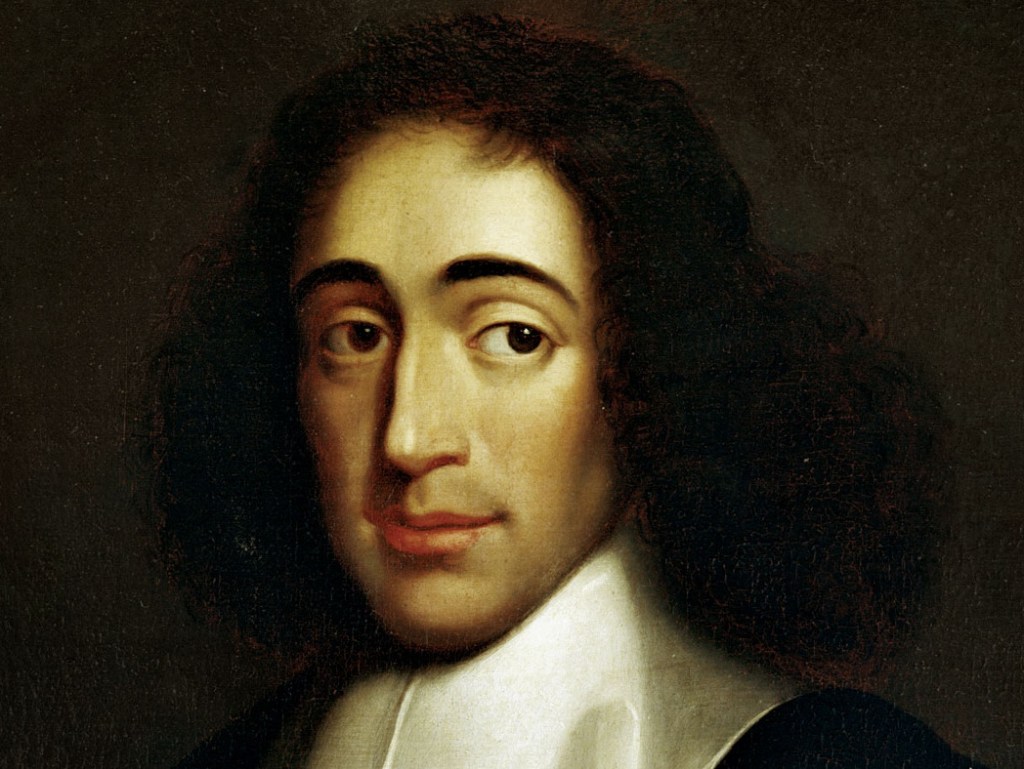
On this date in 1632 the philosopher and mathematician Baruch (or Benedict) de Spinoza was born in Amsterdam. He was Jewish and received a Jewish education in a Talmud Torah. However, like many Jews, he got in big trouble for his affinity for Bacon. In his case, it was Francis Bacon. Also Rene Descartes. He was accused of putting Descartes before des horse. So the rabbis gave him the boot for thinking outside the box. And stay out! He supported himself as a lens grinder. Did you hear about the optician who backed into the lens grinder and made a spectacle of himself?
Spinoza’s most important idea was that everything in the universe is made of a single material: gabardine. [No, not gabardine.] Also, that everything in the universe is subject to natural laws. He said that the soul and the body are not separate, but two parts of the same thing. He believed that God did not stand outside the universe, but rather that the universe itself was God, and that everything in the universe was perfect and divine.
OK. Whatever. I am way too stupid to come near any of that. Here’s Benny:
This poem is called “Permission Granted.” It’s by David Allen Sullivan and was in The Writer’s Almanac earlier this week.
You do not have to choose the bruised peach
or misshapen pepper others pass over.
You don’t have to bury
your grandmother’s keys underneath
her camellia bush as the will states.
You don’t need to write a poem about
your grandfather coughing up his lung
into that plastic tube—the machine’s wheezing
almost masking the kvetching sisters
in their Brooklyn kitchen.
You can let the crows amaze your son
without your translation of their cries.
You can lie so long under this
summer shower your imprint
will be left when you rise.
You can be stupid and simple as a heifer.
Cook plum and apple turnovers in the nude.
Revel in the flight of birds without
dreaming of flight. Remember the taste of
raw dough in your mouth as you edged a pie.
Feel the skin on things vibrate. Attune
yourself. Close your eyes. Hum.
Each beat of the world’s pulse demands
only that you feel it. No thoughts.
Just the single syllable: Yes …
See the homeless woman following
the tunings of a dead composer?
She closes her eyes and sways
with the subways. Follow her down,
inside, where the singing resides.
Special kudos to our gorgeous granddaughter Robin (nee Lianna) who crewed for the Morristown HS production of Shakespeare in Love. We saw the show last night and loved how much fun the cast was having with it. The girl who played Gwyneth Paltrow was beautiful (and talented) and Will was great too. A swordfight had us worried someone might actually get hurt. Zoey and Leon saw it with mom and dad too.
“Will you join the crew again for the Spring musical (Les Miz)?” we asked Robin. Yes! she answered without hesitation. Kinehora – can’t wait!

Hey, GP — you’ve got some competition down in Mo-town.

Mark Cairns of the DMC (UK) asks: “Should we ban the use of the exclamation mark? In denoting excitement it surely sets itself against our very creed?”
Wow. Unsurprisingly, it generated quite a hubbub: close to 70 comments.
John David Salt opined: If we do, it’s going to cause minor inconvenience every time anyone wants to discuss the !Kung people of the Kalahari, or refer to the Devonian village of Westward Ho! It will also be mildly inconvenient for mathematicians to have to write out “factorial” in full.
Tim Lockley added: particularly as matters ferroequinological are a popular subject here, and the only railway with an exclamation mark in its title would be excluded (the BA&WH!)
Ian Smith: No, but we should frown upon its excessive use. Only use one, and where the situation clearly excuses it. And don’t get me started on the near-criminal random use of apostrophes..
Laura Wilson: I’m a proponent of bringing back the interrobang.
OC note: The interrobang is new to me. Here’s one:

Ronnie Dykes makes an excellent point: We’re not dull because we don’t get excited; we’re dull because we’re excited by things that others consider to be dull.
Murray Atkinson: Should we ban all punctuation used incorrectly? In doing so we would surely improve literacy.
Andy Spragg: in the same way as, e.g., banning driving faster than the speed limit prevents that from happening, you mean?
Murray: Yes.
Dave Greenslade: Banning it will screw up thousands of passwords on accounts as many people use it as the special character now increasingly required in passwords.
To which Mark Cairns replied: I just mean banning it here, Dave — not in the whole world.
I suggested not banning it outright, but requiring that it only be used horizontally.
OMG, readers — is it just me? I find that entire discussion hilarious. (Okay — George and Phil say it’s just me. Still.)
See you tomorrow!!!!!
 The Wellington Files