It’s the birthday of the poet Lawrence Ferlinghetti (1919, Yonkers). He died in 2021, just shy of his 102nd birthday. In the Navy during WWII, he was the commander of a 110-foot ship. He said: “Any smaller than us you weren’t a ship, you were a boat. But we could order anything a battleship could order so we got an entire set of the Modern Library. We had all the classics stacked everywhere all over the ship, including the john. We also got a lot of medicinal brandy the same way.”
Here he is in front of his bookstore in SF.

This poem by LF is called “11.” [The spacing works well if you are reading it on a laptop-sized screen. Your phone may screw with it.]
Fortune
has its cookies to give out
which is a good thing
since it’s been a long time since
that summer in Brooklyn
when they closed off the street
one hot day
and the
FIREMEN
turned on their hoses
and all the kids ran out in it
in the middle of the street
and there were
maybe a couple dozen of us
out there
with the water squirting up
to the
sky
and all over
us
there was maybe only six of us
kids altogether
running around in our
barefeet and birthday
suits
and I remember Molly but then
the firemen stopped squirting their hoses
all of a sudden and went
back in
their firehouse
and
started playing pinochle again
just as if nothing
had ever
happened
while I remember Molly
looked at me and
ran in
because I guess really we were the only ones there
I try to solve the Monday NYT puzzles using only the down clues. I usually get pretty far before caving, but today I made it to end. Yay. It’s not that you don’t work on the acrosses at all. You can still figure them out based on the letters you fill in from the downs. You just don’t read the across clues. E.g., after filling in a few downs today it was easy to see 20A was BATHROOM SCALE. Here’s a good way to use one, BTW.

One word I was surprised to learn I knew was POMADE. Its clue was “Greasy hair ointment.” Yuck.

I gasped (not really) when I saw 56D: “Toy bricks” was LEGOS. It’s a big point of contention — what the plural is. The Lego people want you to say “Lego bricks.” Yet sh*tloads (brickloads?), of folks just say Legos, like the constructor today. The acronym AFOL was used in a comment which I looked up. It’s “adult fans of Lego.” There’s a Youtube AFOL channel devoted to all sorts of Lego stuff.
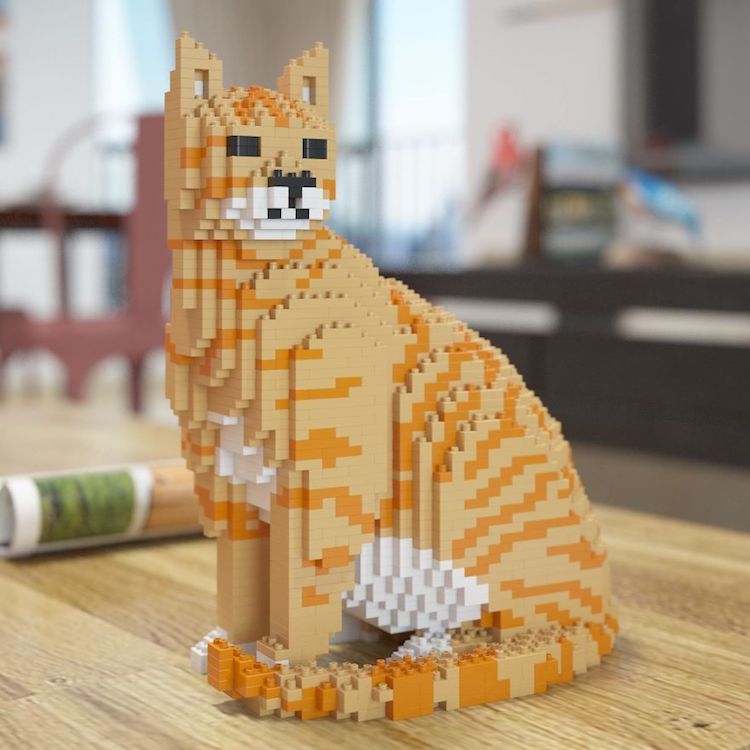
There’s some neat Lego art out there.

Try to not let your cat eat any Lego bricks, though. There’s no telling what may happen.
We had a blast with Caity, Danny, and Zo at Lianna’s HS production of Les Miz yesterday. It’s such an emotional production and the kids really threw their hearts and souls into it. The snippet below doesn’t fully capture the intensity. Lianna was in the crew and they put in long hours to make it all come together. We are so proud of her.
The performance we saw was the final one, and the emotional release for the cast when it ended was overwhelming. With the audience giving them a standing ovation, many cast members were openly weeping: more boys than girls. We have enjoyed many fine HS productions over the years, but this one carried everyone involved — cast, crew, and audience — into an extraordinary place. Bravo Morristown High School!
Astute OC readers will recall I shared a post from the Dull Men’s Club (UK) yesterday on escalators in the London Underground that have the handrails moving at a slightly different speed from the stairs. Some comments (27) have since been posted and here is a selection of the dullest.
Tim Robinson: Imagine the stairs as being like the rim of a wheel and the handrail is like the outer edge of the tyre, they are both rotating in sync but the outer edge has longer to travel so the linear speed is more. When the handrail gets to the bottom it has further to travel to get back to the top then the stairs does. (Sorry not sure that makes much sense. I can see it in my head but it’s difficult to describe.)
David Mortimer: I think what you mean is the circumference of the hand rail is larger than the foot plate. I don’t think this precludes the functional surfaces travelling at the same linear speed. I think the extra distance the hand rail needs to travel would simply mean you’d be holding a different part on each escalation. And that wouldn’t matter to the user.
[What?]
Vince Peterbilt: The invention of the escalator was a US/European collaboration with one team working on the steps and the other on the handrails. Unfortunately one team was working in imperial measurements while the other used the metric system, and despite their best efforts when they converted the calculation to match they were a bit off and thus the handrails always move at a different speed to the steps.
Mark Daniels: It is for safety. If the hand rail is moving faster than the steps, there will be a tendancy to be pulled forward very slightly, thus ensuring you do not fall backwards. This is very important on up escalators and causes no problem on down escalators. Most people will re-adjust their hand position if the difference becomes significant without even realising.
Here’s a young woman remarking on the divergent handrail speed to her beau.

See you tomorrow!
 The Wellington Files