Aaron’s Boone’s near-haiku may become this season’s motto, at least for NY baseball. This time it was the Mets who could say:
The audacity
Of the call standing
Is remarkable.
And the result this time was a triple play! Here’s the story: The Mets were playing the Gnats in DC yesterday and they had runners on first and second with no outs: Vientos on first, and Nimmo on second. Winker (“Wink”) was at bat and hit a soft liner towards first. First baseman Lowe made a nice backhanded play on it, trapping the ball on a short hop. But the ump did not have a good view and said Lowe caught it on a fly. Both runners left their bases without tagging up (which is what they should have done, since the ball was only caught on the bounce). Lowe threw to Abrams at second, so Nimmo was out. He then tagged Vientos, who advanced there from first. That was the third out.
But he trapped it. It hit the ground. The replay clearly showed that. So why wasn’t the call overturned on review? Because, for some (crazy?) reason, the question of whether a ball was caught or trapped is reviewable when it occurs in the outfield, but not when it occurs in the infield. The call was not reviewable. Mets manager Mendoza begged the umps to confer as a group, thinking one of the other umps must have seen the play clearly as all the Mets did from their dugout, but the umps refused. The call stood.
The Mets ended up losing by one run. The call may have cost them the game. It was the third ever triple play pulled off by the Gnats — and only the first at home.
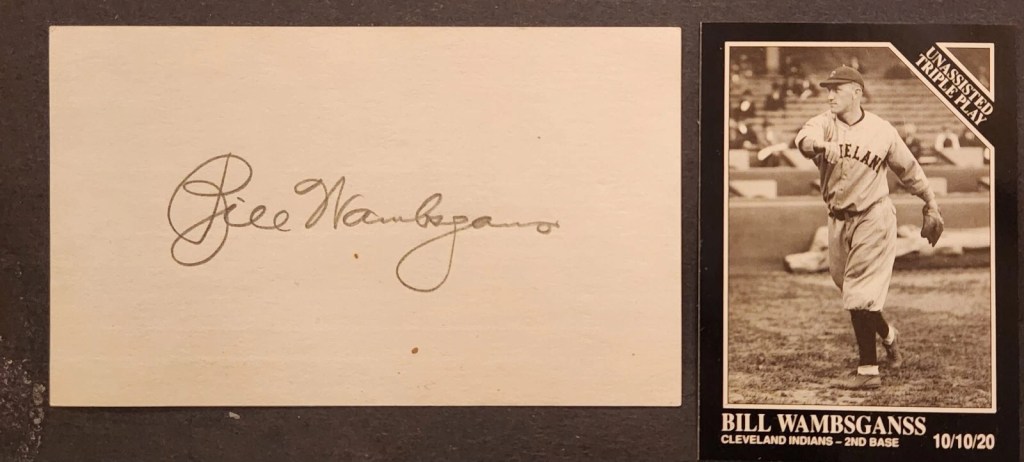
That play involved two fielders — Lowe caught the ball for one out. And Abrams made both of the other outs by touching second base and then tagging the runner from first. An “unassisted” triple play — where one fielder makes all three outs — is much rarer. There have only been fifteen ever. (Perfect games occur more often.) The most famous was by Bill Wambsganss for Cleveland in the 1920 World Series. Oddly, as rare as they are, in May 1927 two occurred within 24 hours of each other. It was then a 41-year wait for the next.
If I may crow a bit, I got a big laugh out of my g’kids Leon and Rafi yesterday. We picked them up from school and Leon was holding a little sapling to plant at home. They had planted a tree at school for Arbor Day, and each student was given a little one to take home. Leon said he didn’t remember the type of tree it was. I said “Evergreen?” and he said yes. I said that’s because it doesn’t turn brown in the winter so it is “forever green.” Okay. Then I said, “Do you know what else is green?” and they both listened attentively. “MY BIG FAT BUTT!!” I exclaimed, and they roared. Maybe the biggest laugh I ever got out of them.
That’s a good example of one of the great lessons I learned from my brother — not expressly — by observation. Trying to make someone laugh is a way of saying you love them.

The puzzle was very good today — top notch constructor team of Sarah Sinclair and Rafael Musa. I learned a neat piece of slang: MOOD, at 27A. It’s slang for “that’s so relatable.” It’s better than just saying “same,” “me too,” or “I hear ya.” It’s like you’re saying “I can relate to that and it’s the story of my life.”
“That gorgeous girl in my bio class shot me down again.”
“Mood.”
Here’s egs on it:
Farmer: I was out in the field and my cow did something so relatable, I said MOOD.
Pal: What’d the cow do?
Farmer: Mooed.
Pal: Was she ok?
Farmer: Yeah, just a little MOODy.
15A was a little unusual: “Tantric meditation practiced while in a sleeping state.” Answer: DREAM YOGA.
I got this from Wikipedia: “In the yoga of dreaming, the yogi learns to remain aware during the states of dreaming (i.e. to “lucid dream”) and uses this skill to practice yoga in the dream.” A lot of my tax students took a similar approach in class. They entered a dream-like state, occasionally tipping over onto the floor with a thud. I’m not sure I’d call it “lucid,” though.
Please make up your own joke about combining dream yoga and goat yoga. I can’t do everything around here.
At 54A, the clue was “Rely on audience support during a show?” and the answer was STAGE DIVE. Here’s one:
And then there’s this.
31A was good. The clue was “Words on a statue honoring Washington.” So you start thinking about George, but it’s about Denzel. The answer was BEST ACTOR, and the statue was an acting award. It led Rex to share this short wonderful piece.
It was an example of a puzzle with cluing so erudite and clever that you stop and think — wow, there can really be a lot more to these puzzles than silly wordplay.
Here’s how they clued the simple four-letter word WEPT: “‘The young man who has not ___ is a savage:’ George Santayana.”
And at 43D, the clue was “Something picked in a fortunetelling game,” leading Rex to wonder, “‘What the hell is a fortunetelling game?’ I couldn’t think of any. Magic 8 Ball? Is that a ‘game?’ But no, the ‘game’ was some version of ‘(s)he loves me, (s)he loves me not …’” The answer was PETAL.
OK, let’s see what’s up at the Dull Men’s Club (UK).
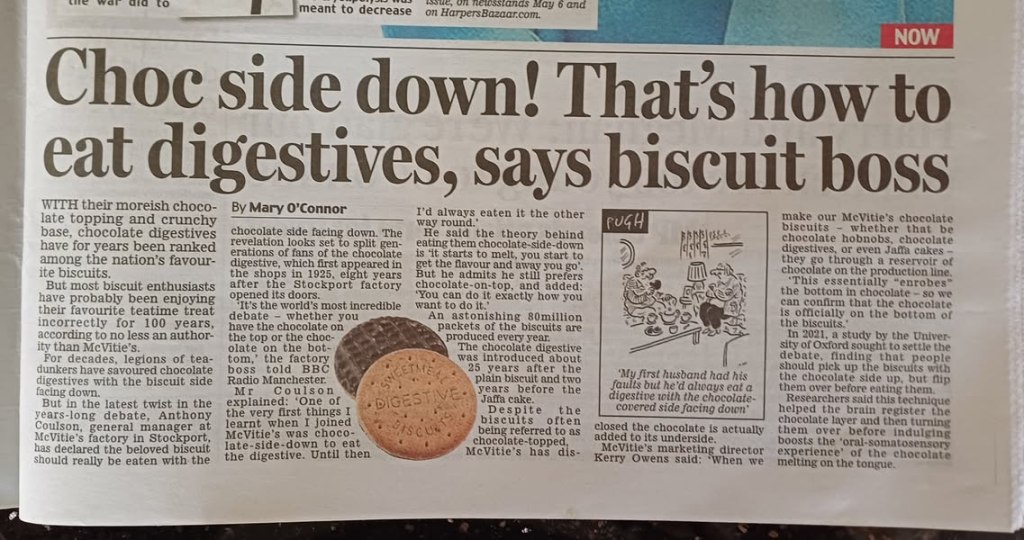
Brian Greenhalgh posted this photo on how to eat those half-chocolate biscuits. And then wrote: “Chocolate side down? Must be joking.”
Here are the dullest of the 28 comments:
Adrian Bull: Your taste buds are on your tongue, not the roof of your mouth. So if you want to taste chocolate more than biscuit, it makes sense. Then again, I know that but still eat them the “right way up.”
Mike Knee: Whichever side is on the bottom will get more heat from the hand, if the biscuit is held lightly, which is the main reason I hold them chocolate side up. However, I think the flavour and the crumb-dropping behaviour are both better chocolate side down.
Daniel Faraday-Kiss: This doesn’t work for dunkers. Chocolate on the bottom makes it heavy side down and more likely to break off in your brew. Also causes more Chocolate ingress into the tea. I’d also feel uncomfortable putting a biscuit on a plate with chocolate down. All in all I give this information 7 thumbs down.
Ben Farrington: He’s not the boss of me.
John Scotland: Noooooooooo. . . .
Mike Pezaro: NOBODY TELLS ME HOW TO EAT MY BISCUITS. That be fighting talk!
Neale Rumble: I like to eat them in pairs, choc to choc.
[Sadly, at this point the matter took a slightly ugly turn.]
Mark Daniels: Chocolate side down is the only way that makes sense. Come on! Where are your taste buds, people?
Sultan Brown: Don’t you chew?
Mark: Think, Sultan Brown, think! It’s really not that difficult. Taste buds are on the tongue, chocolate is concentrated on one side of the biscuit. Where do you want that when biscuit enters your mouth??? Chewing comes later… Duh!
Martin Tweddle: Same as pizza or anything else you want your tongue to taste
Robin Smith: That’s where I’ve been going wrong. I’ve never tasted any topping on a pizza for that reason – they only taste of bread and nothing else.
Andy Steele: When a digestive biscuit is made, it’s plain and the writing is on the top. It gets a pattern on the bottom side from the mesh that it’s baked on. If this biscuit it subsequently turned into a chocolate digestive, the chocolate is not poured on. That would be very tricky to get right. Instead it travels through a lake of molten chocolate which sticks to the underside. As it cools the classic hatched marking appear as the mechanisms flip it over. The chocolate which was the bottom, now becomes the top. But the bottom is now the originally top of the plain digestive. Thus, it has two tops, and therefore no bottoms. Which way up a person eats them, becomes an arbitrary decision as both sides are tops.
Avi Liveson: For a brief moment there you almost seemed to be making sense.

Let’s leave it at that. See you tomorrow!
 The Wellington Files