Since the circumference of the Earth is 25,000 miles, how can Norway have over 60,000 miles of coastline? That was what the puzzle told us today. But according to Norway itself (on its own webby site) 60,000 is correct. The “trick” is you include all of the fjords and islands. I guess it adds up.
This is part of the coastline. Whoa — I didn’t realize till just now how much it looks like Bayonne, NJ.

In case, like me, you are wondering how the hell you’re going to make it through these next four years, here’s a Met Diary story for you. It’s by Nick Trepanier.
Dear Diary:
I was standing at the corner of Lexington Avenue and 42nd Street. The blinking “walk” sign indicated four seconds left to cross.
Tired and somewhat defeated after a long day, I thought to myself: I’m not going to rush this time.
Just then, a tall woman dressed in pink from head to toe, with pink nails, heels, sunglasses and cowboy hat to match, slapped me on the back.
“We got this!” she said.
We darted across the avenue together and high-fived when we got to the other side.
Who comes up with this stuff? At 47A today the clue was “Participant in a hybrid sport that requires both brains and brawn,” and the answer was CHESS BOXER. Yes, chatterheads, there is an actual sport that combines boxing and chess. Two combatants play alternating rounds of blitz chess (speed chess) and boxing until one wins by checkmate or knockout. It’s popular in the UK, India, Finland, France, Russia, and, as of today, apparently, Crossworld.

You’ve seen the acronym CAPTCHA, right? And if you’re like me you’re perfectly fine with not knowing what the hell it means. Until something about it shows up in the puzzle. Today the clue at 60A was “What the “T” in CAPTCHA stands for,” and the answer was TURING TEST. What?
Okay, let’s take a step back. First, CAPTCHA stands for Completely Automated Public Turing Test to tell Computers and Humans Apart. It’s a type of challenge–response Turing test used in computing to determine whether the user is human in order to deter bot attacks and spam. The Turing test, originally called the imitation game by Alan Turing, tests a machine’s ability to exhibit intelligent behavior equivalent to that of a human. Glad you asked? I started to dig a little deeper but it quickly became clear I am too stupid for it.
Hey — Hi Lois! LOIS LANE popped into the puzzle today. Yes, that Lois Lane — Supe’s babe. I think we have some cheese in the fridge, but we’re out of Fresca since George, you know, was jailed. You drink coffee?
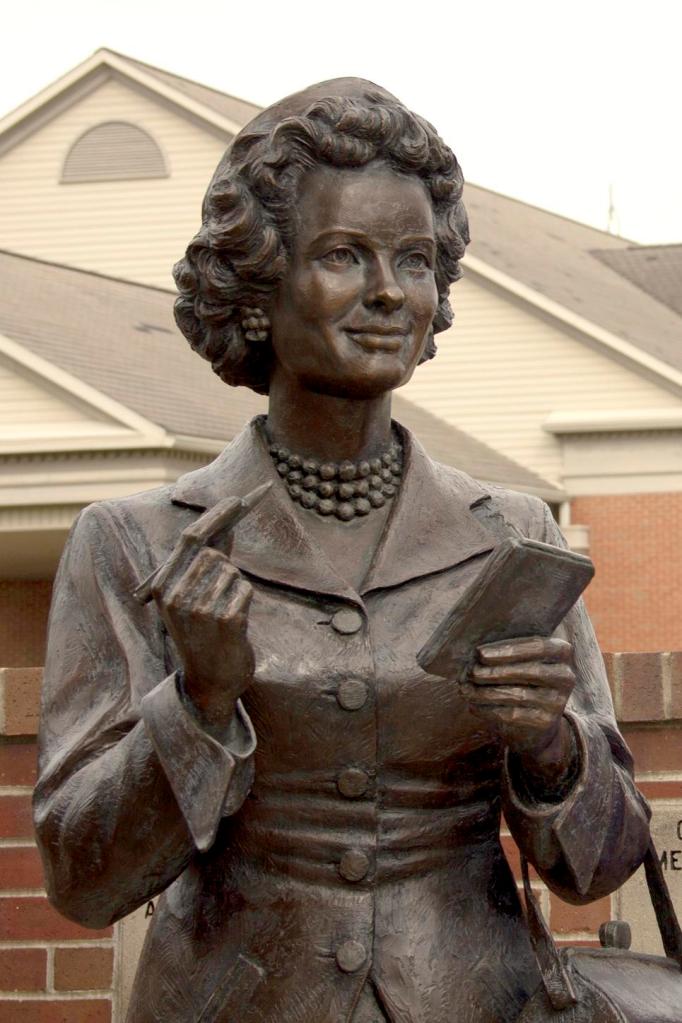
The first actress to play Lois was Noel Neill, who was pretty hot in her own way, way back by 1948 standards. NN was born in Minnesota in 1920 and lived to the age of 95, passing away in 2016. She didn’t have much of a career outside of her Lois work. In 2010, the southern Illinois city of Metropolis unveiled a statue of Lois Lane modeled on Noel Neill. Neill stated that she was honored to be memorialized with the statue.

Margot Kidder may be the best known LL, from the Superman movies, and she played Lois less as a damsel in distress and more as an independent brave and intelligent woman. Margot was born in Yellowknife, Canada, and sadly, died by suicide (drug and alcohol overdose) at the age of 69 in Montana. She had a very troubled life. She was married to the actor John Heard, but they separated after only six days. She was romantically involved with PM Pierre Trudeau in the early ’80s. She had her only child, a daughter, with her first husband, the writer Thomas McGuane.
You can see why Kent fell for her.

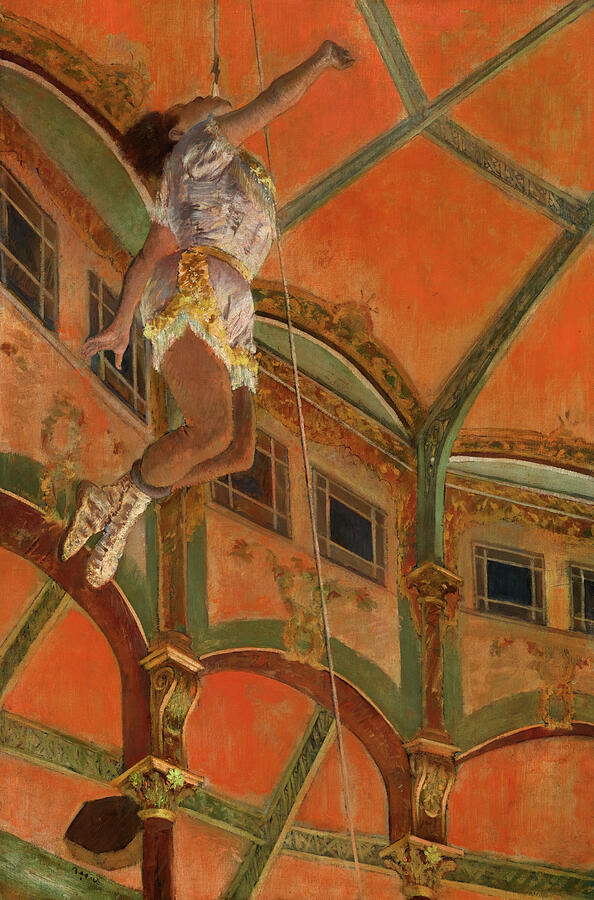
At 11A, the answer was LALA. How would you clue it? There was that movie La La Land. Or maybe “song syllables?” But those would both be too easy for Saturday. So the constructors went with: “Edgar Degas’s ‘Miss _____ at the Cirque Fernando.’” According to Wikipedia, it is Degas’s only circus painting, and Miss La La is the only identifiable person of color in Degas’s works.
Miss La La was a mixed-race acrobat, known as la femme canon. The nickname came from her most sensational trick: to fire a cannon suspended on chains that she held in her teeth while hanging from the trapeze, hooked at the knees. (Yeah, that same old tired trick any five-year-old can perform blindfolded today.) In the painting, Degas has the viewer seeing the spectacle as the audience would have done, gazing up at the daring feat taking place above.
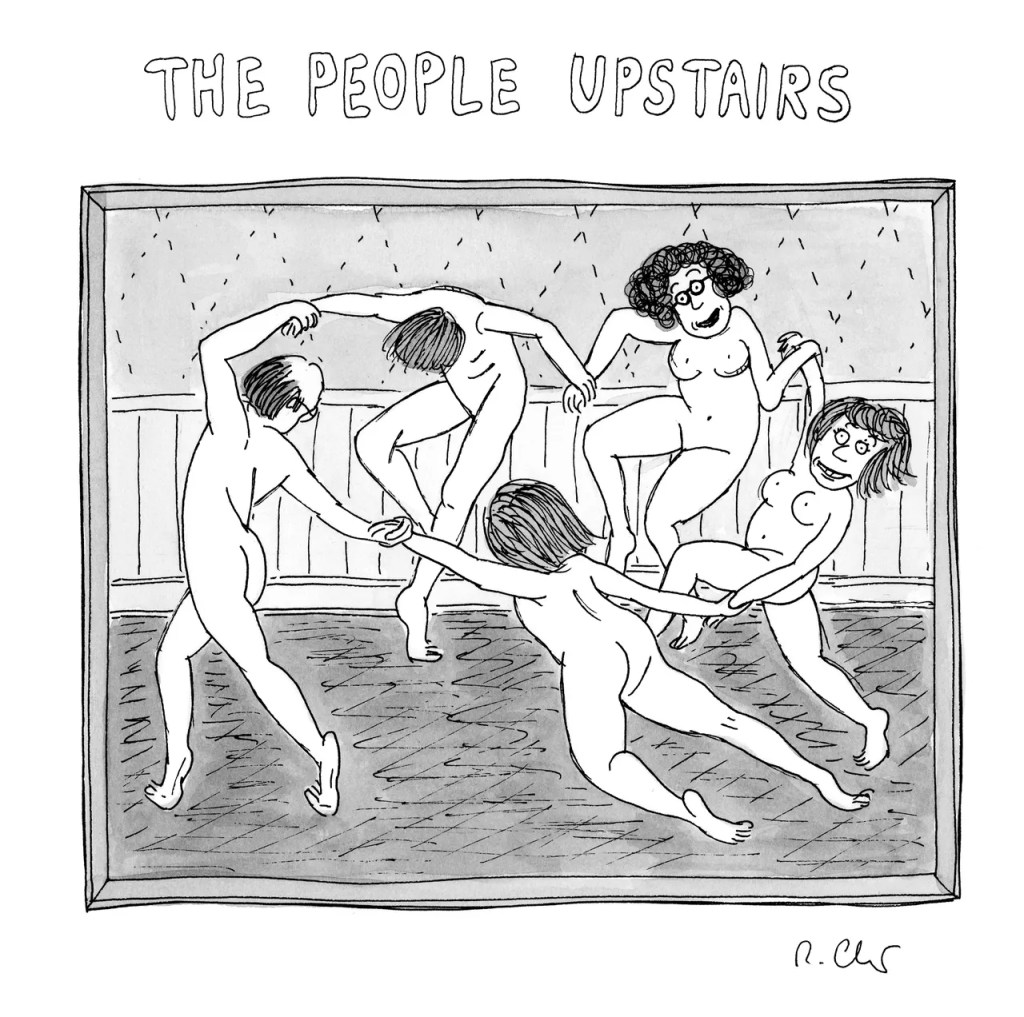
Let’s go with art for our farewell tonight too. It’s Roz Chast’s work from the May 12/19 New Yorker. See you tomorrow!
 The Wellington Files