We took a deep dive into the bowels of governmental bureaucracy and emerged whole. Got off to a bad start when I failed to make the turn the GPS lady was adjuring me to make — it seemed like a turn into a restaurant parking lot. But, five minutes later, having bumbled around for a second chance, I took the turn and, sure enough, the Motor Vehicle Commission building was hiding behind the restaurant out of sight and as inaccessible as possible. But I made it by the ID check and the strip search didn’t tickle too much. Twenty minutes later we emerged with new plates (C33WGK) and a whole bunch of paperwork validating me and our little 2012 Toyota Camry. Yay! God Bless New Jersey! (We traded cars with Sam who could use the larger Subaru to greater effect with their two little ones.)
This poem was yesterday’s poem of the day from Poem-a-Day by poets.org. It’s by Elias Lönnrot and was translated from Finnish by John Martin Crawford. It’s called “From the ‘Kalevala’ [Proem].”
Mastered by desire impulsive.
By a mighty inward urging,
I am ready now for singing,
Ready to begin the chanting
Of our nation’s ancient folk-song
Handed down from by-gone ages.
In my mouth the words are melting,
From my lips the tones are gliding,
From my tongue they wish to hasten;
When my willing teeth are parted,
When my ready mouth is opened,
Songs of ancient wit and wisdom
Hasten from me not unwilling.
Golden friend, and dearest brother.
Brother dear of mine in childhood,
Come and sing with me the stories,
Come and chant with me the legends
Legends of the times forgotten,
Since we now are here together.
Come together from our roamings.
Seldom do we come for singing,
Seldom to the one, the other,
O’er this cold and cruel country,
O’er the poor soil of the Northland
Let us clasp our hands together
That we thus may best remember.
Join we now in merry singing,
Chant we now the oldest folk-hue,
That the dear ones all may hear them,
That the well-inclined may hear them.
Of this rising generation.
These are words in childhood taught me.
Songs preserved from distant ages,
Legends they that once were taken
From the belt of Wainamoinen,
From the forge of Ilraariuen,
From the sword of Kaukomieli,
From the bow of Youkahainen,
From the pastures of the Northland,
From the meads of Kalevala.
These my dear old father sang me
When at work with knife and hatchet;
These my tender mother taught me
When she twirled the flying spindle,
When a child upon the matting
By her feet I rolled and tumbled.
Here’s Elias, just a bit past his rolling and tumbling days.

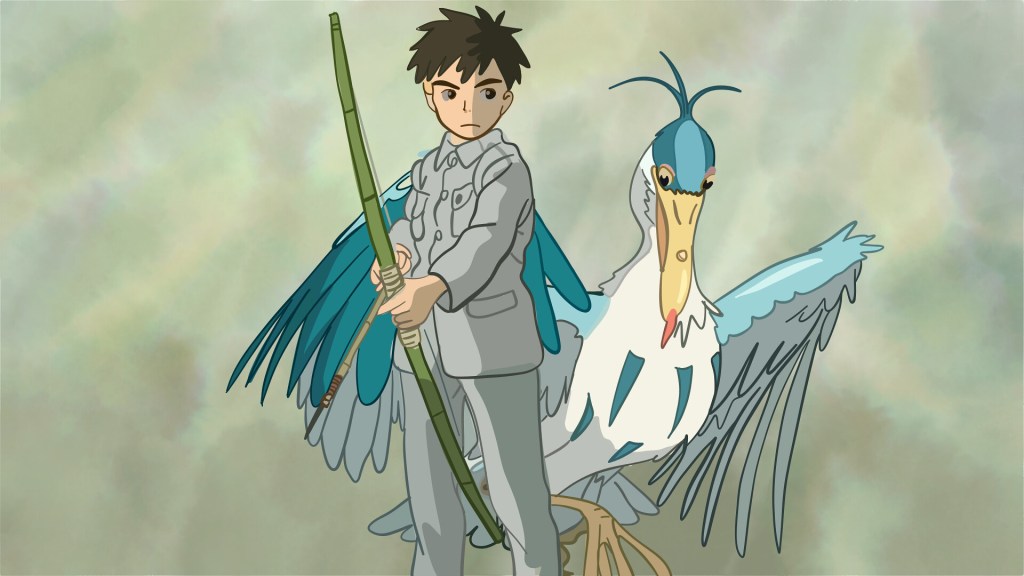
I’m glad that HAYAO Miyazaki was in the puzzle today because I have a bone to pick with him. Miyazaki is widely regarded as one of the most accomplished filmmakers in the history of animation. His The Boy and the Heron won the Academy Award for Best Animated Feature in 2023. My bone: we didn’t like it. That’s it: more of a chicken bone than a dinosaur bone. We saw it in Oregon the day after Michigan won the National Football title. Don’t know what all the fuss is about.
Do you know what a spurious correlation is? It’s when statistics show a connection between things, but it’s false (spurious) — there is no rational basis to accept the connection. Schwalberg’s example in class (50 years ago, alav hashalom), was that statistics showed a connection between cigar smoking and car theft: obviously absurd (unless, as I theorized to him, the thieves were after the ash trays in the cars). Anyway, I’ve long wondered whether the correlation between family dinners and all sorts of wonderful results later in life was spurious. A recent op-ed piece addressed the issue.
As Frank Bruni put it introducing a snippet from it for his For the love of sentences feature, Erin O. White exposed the tyranny behind the insistence that all members of a household gather reverently toward the end of the day for a shared meal: “The messaging on family dinner is intense! I would like to get the P.R. machine behind family dinner working for the end of gun violence in America. Family dinner will make your children smart! It will keep your children off drugs! Your children will learn languages, turn away from vaping and join model U.N. if you just sit together at the table for 15 minutes every evening, a plate of food in front of you.” Erin just stopped serving them and the world didn’t end.

Music clues like these terrify me: “Only black key in a G major scale.” How the hell am I supposed to know that’s F SHARP? Anything harder than “Big brass instrument” for TUBA loses me.
Drove up to Montclair State College last Thursday to catch a good band: Nefesh Mountain. They put on a terrific show. Here’s a sample, which, in retrospect, seemed to catch the spirit of the No Kings rally we attended just two days later.
The controversy du jour from today’s puzzle was at 39D where the clue was “Aforementioned.” The answer was VERY SAME. So what do you think? Equivalent? Close enough for crosswords? I’m generally pretty loose on these, but this one gets on my goat a bit. Here’s Rex on it:
“VERY SAME is way more colloquial than mere ‘aforementioned’ and requires a much clearer, more proximate referent. I could drift away from my topic and then use ‘aforementioned’ to bring you right back, whereas if I used ‘VERY SAME,’ I’d need to have just been talking about whatever I was talking about for it to make sense. Aforementioned is a defensible clue, just a vague and rather unclear one, to my brain.”
Anony Mouse says:
I don’t agree that “aforementioned” is a legitimate clue for “very same,” even when one could be swapped for the other in a sentence. “Very same” means “identical.” It doesn’t mean “previously stated.” The gulf is just too wide.
But commenter jberg writes: Rex, I think you’ve got it backward. VERY SAME doesn’t always mean aforementioned, but aforementioned always means VERY SAME. At least, that’s how I always read words.
And commenter tht added: To me, “aforementioned” is pretty close to “same as above,” and VERY SAME would function as an emphatic variant. The answer should be capable of subbing in for the clue, where “capable of” implies “under some circumstances,” and not necessarily “under all circumstances.” E.g., it works in this example: “Kacie herself was asking that very same question after hearing the news,” i.e., aforementioned can be substituted for very same here.
My head is starting to hurt. Let’s let it be.
Why does the press continue to report on whatever Trump blows out of his ass on Ukraine? He’s long ago forfeited any credibility he may have had, which is none anyway. Save your breath and save your ink. Ukraine will continue to blow up Russian oil facilities and Russia will continue to blow up civilians. Call me back in six months and we’ll see what we’ll see.
These Ukrainian women are beautiful and tough as nails. Don’t look at us in that tone of voice, Iryna!

We’ll let that stern visage close things out tonight. See you tomorrow!
 The Wellington Files
One response to “The Pastures of the Northland”
nice music, thanks!
LikeLike