On the third anniversary of Susan’s death: a motto associated with her:

Even a Monday puzzle can have a WOE or two. That’s an XW acronym for “what on earth?” Yesterday there was “Leaf on a sushi tray.” You know, that little green leaf next to or under the wasabi? In gas station or supermarket sushi it’s plastic. Otherwise it’s SHISO. Here’s how to use it in a sentence: I’m so hot for her and SHISO cold. Don’t the gents look young here?
Everybody’s favorite clue/answer yesterday was “Put in a good word, perhaps?” Answer: EDIT. Here’s Commenter Lewis: Here’s a word appearing more than 700 times in the NYTXW, and you’d think the well would have run dry on new clues. But this one is not only terrific, it’s a debut. Mwah!
We love this: Did you know that in many sites when CPR is performed the music used to provide the rhythm is “Stayin’ Alive?” We learned that from the clue for CPR at 28A today: “E.M.T. process often administered to the beat of ‘Stayin’ Alive.’”
Anony Mouse contributed the following: Before “Stayin’ Alive” (we’re talkin’ the ’70s), CPR was taught to the tempo/rhythm of “My Melody of Love” by Bobby Vinton. Thankfully, the docs discovered the pace was too slow to revive enough patients, and we moved on from slow polka to disco!
Sticking with music for a bit, we bid goodbye to Bob Weir of The Grateful Dead. Bob passed away on Saturday at the age of 78. He met Jerry Garcia when he (Bob) was 16 (and Jerry 21). Bob followed some banjo music into a music store where Jerry was about to give lessons. Bob had his guitar with him and they started jamming. They teamed up to form a jug band which later morphed into The Dead.
Bob married very well and had two daughters (Monet and Chloe) with his wife Natascha, who was 20 years his junior. You can see below how pretty she still is as he grew into some sort of rock formation (pun intended).
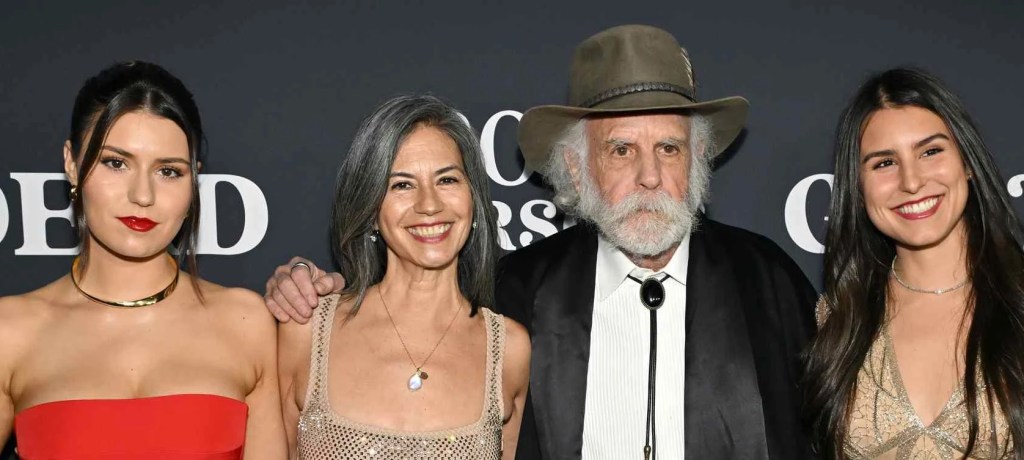
In 2024, Bob and the Grateful Dead became Trump-Kennedy Center honorees. They were inducted into the Rock & Roll Hall of Fame in 1994 and given a lifetime achievement Grammy Award in 2007.
The dreadful news of the day seeped into the crossword today at 43D where the clue was “Vice-presidential candidate of 2024.” TIM WALZ, of course.
It set Rex off:
TIM WALZ is an interesting full name to squeeze in there, though at the moment all it does is remind me of the Siege of Minneapolis (ongoing). Would be nice if Walz and other elected officials had any kind of answer for the violence being perpetrated by the federal government. Give a bunch of weak, poorly-trained, sadistic CLODS (37A: Buffoons) automatic weapons and body armor, set them loose to terrorize ethnic Somalis and other non-white immigrants (so—virtually any non-white person), and let them know in no uncertain terms that they are above the law … and presto, you’ve got yourself your very own Gestapo. That is what ICE is at this point. Bizarre to pretend otherwise. Buncha dudes too incompetent and cowardly for actual war, doing their little war cosplay games in American cities with live ammunition, gleefully, boastfully hurting people. You’re either into it or you’re not, but … Gestapo is the correct analogy.
[ICE was also in the puzzle, at 12D, “Bartender’s supply.”]
I liked the theme today. It centered on the iconic Queen song: WE WILL ROCK YOU. Three theme answer were things that rock you. NEONATAL NURSE, MECHANICAL BULL, and TECHTONIC PLATES.
Boop!

I loved 9D today too. The clue was “Yogi, once.” Answer: BEAR CUB.

At 59A, “Birthplace of Marlon Brando and Warren Buffett,” was OMAHA. It’s also where John and Linda live in this exquisite John Prine song. Joe is somewhere on the road.
Aside from Congress, there is probably no group as dedicated to nonsense as the Dull Men’s Club (UK Chapter). DMC Member Andy Spragg posted the following recently:
As the result of a bout of interior window-cleaning on Friday, I discovered that our long-serving grey plastic bucket had not one but two holes in it (dear Liza). Fracture “stars” in its base to be precise, so that its lack of hydraulic integrity was not visible initially, and only became apparent when it started to leave recurring small puddles on the bedroom floor and window ledge. To my surprise, Asda did not sell a satisfactory replacement, so I was obliged to head for B&Q where they had loads at £1 each. So I bought two, one orange and one black, allowing us to allocate each one by colour to different duty categories yet to be determined.
Le bucket est mort. Vive les buckets!
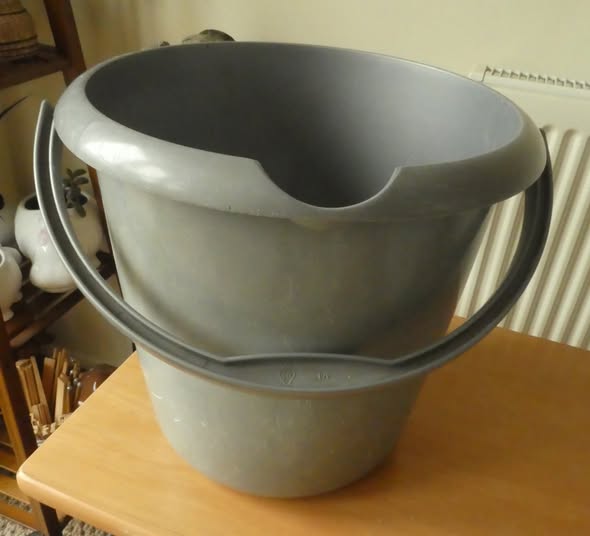
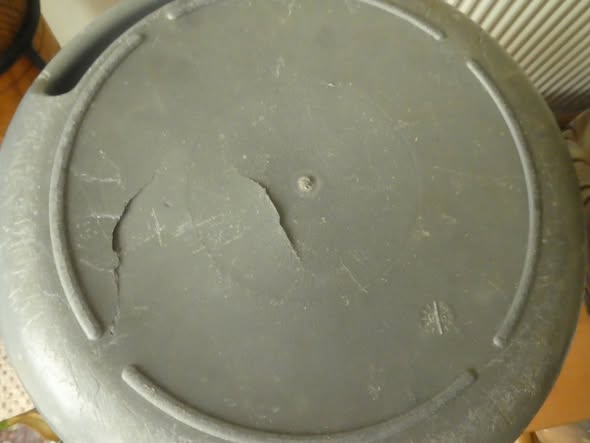
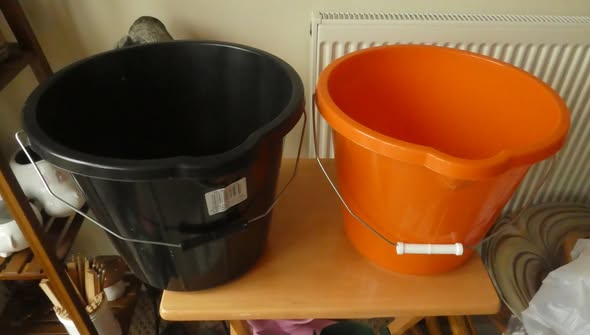
Jim Dunbar: At the risk of causing a heated debate i feel i must pull you up on the use of the word hydraulic when just referring to water in a bucket.
Andy: I’ve carried out a quick review and I’m going to take this as a lesson learned. Seems the word, correctly used, has more specific connotations than I realised. That said, I found this example of use in the Cambridge English corpus, which corresponds closely to the intended sense in which I used the word: “Melted paraffin wax was poured over the agar to provide an effective hydraulic seal.”
Andy: however, I feel I must also pull you up, not only for twice failing to capitalise your first person singular pronoun, but also for failing to enclose the word ‘hydraulic’ in speech marks. A comma after ‘debate’ would have been nice too. Small points in comparison, I readily concede, but no less valid for that.
Jim: i’ll give you the capitalisation issue, however in casual texts it is allowed. I didn’t use inverted commas as i am not quoting your actual speech, just merely what you typed. (Technical get out )
)
Can’t accept the Cambridge English example as being close though. The fact that they mention a “seal” via use of wax indicates some form of pressure involved, hence hydraulic.
I did tell you this may cause a heated debate. Not dull but enjoyable. It has resulted in me still being in my PJ’s past midday though.
Andy: Not technical get-outy enough! I said “speech marks” rather than ‘quotation marks’ precisely because you weren’t quoting my actual speech. Technically, what you wrote is grammatical nonsense without the use of some device to indicate that the word in question (‘hydraulic’) is not being used as a word in the context of the sentence in which it finds itself, but rather as a reference back to a previous sentence.
As for the Cambridge English example, there can’t be a lot of pressure involved, agar being a jelly, as used in Petri dishes. There’s not a lot of pressure involved in water in a bucket, either, just the hydraulic head (which is what effects the movement of water through the fractures). So I take it back; I now believe my use of the word was technically correct 
This is a most enjoyable debate! Please change out of your PJs before replying, though; we don’t want to frighten the children
Jim: kids long grown up and gone.
I thought speech was talking. The word hydraulic as many words do, has greek origins. Hydro (water) and aulos (pipe or tube). I didn’t see a pipe or tube and i don’t think a crack counts. As for the last paragraph, you lost me when i saw grammatical spelt incorrectly.
I really must get dressed.
Andy: aaargh! Careless old me. I shall correct “gramatical” forthwith. You are of course right about the origins of the word “hydraulic.” but the word has multiple meanings these days, and pipes and tubes are not involved in all of them, for example: “of, concerned with, or employing liquids in motion.”
Now for goodness sake, soldier, get dressed!
Jim: Ha ha. I am now dressed and i’m in my garage doing some dull woodworking making a 5-drawer cabinet for my woodworking gear.
Sorry about your bucket situation. It’s not easy finding a strong plastic one nowadays.
See you next time, Chatterheads. Thanks for popping by.
 The Wellington Files