-
Grief Bacon
I’m welcoming a new poet into Owl Chatter today, by way of The Writer’s Almanac. It’s Joyce Sutphen, and she wrote this one, Silo Solo, in 2010.
My father climbs into the silo.
He has come, rung by rung,
up the wooden trail that scales
that tall belly of cement.It’s winter, twenty below zero,
He can hear the wind overhead.
The silage beneath his boots
is so frozen it has no smell.My father takes up a pick-ax
and chops away a layer of silage.
He works neatly, counter-clockwise
under a yellow light,then lifts the chunks with a pitchfork
and throws them down the chute.
They break as they fall
and rattle far below.His breath comes out in clouds,
his fingers begin to ache, but
he skims off another layer
where the frost is formingand begins to sing, “You are my
sunshine, my only sunshine.”
Sutphen is from Minnesota and is 73. She was the poet laureate of Minnesota from 2011 to 2021, following Robert Bly. She has a PhD in Renaissance Drama from UMinny.

Happy Birthday to Edith Wharton nee Jones, born in 1862 in New York City. The Joneses were wealthy New York society folks, and the expression “to keep up with the Joneses” refers to them! (Not kidding.)
In the puzzle today, 44A “Sky-blue” was AZURE. Commenter Wanderlust took issue with it, saying that’s the color of the sea, and cerulean is sky blue. But Merriam-Webster defines both azure and cerulean as sky blue. I think the color for the sea may be “sea blue,” or “deep sea blue,” which is darker than sky blue. The sea can contain colors other than blue, e.g., green. Homer refers to the “wine-dark sea.” (Not Homer Simpson — the other Homer.)

At 36A, “Challenge for a translator, maybe” was IDIOM. It made LMS think of some words that other languages have that English doesn’t:
Sobremesa (Spanish) – The time spent at a table after eating. The food is gone, but everyone is still sitting around chatting. (When I worked at Quinn’s Mill in Atlanta and some patrons were sobremesa-ing at closing time, we’d turn up the AC to make it really cold.)
Kummerspeck (German) – Excess weight gained from emotional overeating. Literally, “grief bacon.”
Shemomedjamo (Georgian) – When you’re really full, but your meal is just so delicious, you can’t stop eating it? This word means, “I accidentally ate the whole thing.” This is pretty much me with any order of homemade potato chips and some ranch dressing. I’m powerless to stop.
Tartle (Scottish) – That panicky hesitation just before you have to introduce someone whose name you can’t quite remember.The weekday grid is usually 15×15, but today it is 15×16 to accommodate 7D: “Response from someone who merely glanced at an online post, maybe” which is TOO LONG; DIDN’T READ, often shortened to the initialism TL;DR.
It inspired this typical self-deprecating wonderful note from LMS:
I kind of winced at TOO LONG; DIDN’T READ. If I consider the continuum of my comments over the years here I would have hoped to grow less long-winded. My first tentative contributions were really short because I was so afraid that people would wonder if I’m stupid. Now I write treatises that remove all doubt.
Another comment suggested an alternate clue for TL;DR — “Student’s excuse for flunking pop-quiz about ‘Crime and Punishment.’”
A few days ago I discussed a puzzle answer: PROOFS, but I forgot to share a New Yorker cartoon on it that I like. It’s a lawyer talking to the press, outside the courthouse. And he’s saying: “The proof was in the pudding. Unfortunately, the judge ruled the pudding inadmissible.”
The clue at 42A was “Me too!” and the answer was SO DO I. It’s one of those annoying clues because it can just as easily be “so am I,” or “ditto,” so you have to wait before committing. Today, however, it led Son Volt to share this extraordinary song with us. If you give it the few minutes it asks of you — it will lighten your day, I promise.
Ginny Redington Dawes died back on New Year’s Eve. She was 77. She was a songwriter best known for her jingles, e.g., for the “Coke is it” campaign, and tunes for Kit Kat bars and Tide detergent. She married Thomas Dawes, who was also a jingles writer! — he did “Plop Plop Fizz Fizz” for Alka Seltzer, and “7Up, the Uncola.” He died back in ’07.
She also wrote some pop songs that did well, and started out as a singer herself. When she performed in 1975 in an Upper East Side restaurant, a review in the NYT called her a “startling performer” who sang “in a deep, strong, beautifully controlled voice that is filled with vivid colors, as she moves from low, sexy passages to an open, lusty shout.” Ginny was a Brooklyn girl, born and raised.

Last, let’s hear it for Joe Burrow, quarterback of the Cincinnati Bengals. They just upset the Bills in the snow in Buffalo and are headed to KC now to play the Chiefs. If they win, they’ll be in the Super Bowl for the second year in a row. (They lost to the Rams in the SB last year.)
I’m mentioning Joe here in Owl Chatter because he gave the perfect answer to a question that was asked of him after the game last Sunday. In the modern era of football, because of the salary cap, free agency, etc., it’s very hard for a team that achieves excellence to maintain it for more than just a few years — their “window of opportunity,” so to speak.
That’s what the question for Joe was about. It was something like — “Is there a sense of urgency to win this year? How long is the window open?” He didn’t hesitate with his answer: “The window’s my whole career; the window is always open.” You tell ’em Joe!

Thanks for stopping by, everybody.
-
Riki-Tiki-Tavi
Marie-Henri Beyle, better known as Stendhal, was born on this date in 1783 in Grenoble, France. Among the dozens of other pseudonyms he used were William Crocodile and Old Hummums (I’m not kidding), but Stendhal was the one that stuck. He got it from Stendal, the name of a German city, and added the H to help with its pronunciation. He hated his father so he fled to Paris as soon as he could, but got sick there, as a result of which his hair fell out. (Don’t you hate when that happens?) He wore a toupee his entire life. Disappointed in Paris, he enlisted in Napoleon’s army for the invasions of Italy and Russia, the latter of which did not go too well.
In 1818 he fell in love with the wife of a Polish officer. When she did not reciprocate, he trailed her across Italy (what today would be called stalking), disguising himself by wearing green eyeglasses. We’ve all been there — amirite, fellas? — I still have a drawer full of them. He couldn’t win her over, bespectacled or not, so he returned to Paris where he wrote his masterpieces.
In 1817, while in Florence, he visited the Basilica of Santa Croce, where Machiavelli, Michelangelo and Galileo are buried, and he was overcome by emotions. But I mean really overcome — heart palpitations, nearly fainting, that sort of stuff. Today, when someone is overcome by a work of art to the point of needing medical attention, it’s known as The Stendhal Syndrome. It was so named in 1979.
The staff at Florence’s Santa Maria Nuova hospital are accustomed to tourists suffering from dizzy spells or disorientation after viewing the statue of David, the artworks of the Uffizi Gallery, and other historic treasures of Florence. The syndrome is not listed as a recognized condition in the Diagnostic and Statistical Manual of Mental Disorders, so it may not be covered by insurance. There are no known cases of the syndrome’s arising after exposure to Owl Chatter.
There is also a Jerusalem Syndrome, triggered by religious sites, as opposed to artwork, and a Paris Syndrome, which is a severe form of culture shock.
I tried to find a photo of Stendhal with the glasses, but failed. Here he is, though, followed by a film based on the syndrome.


Remember I mentioned that something in a puzzle can open a little door for you? Some folks fall down a rabbit hole. Well, today, at 26A, an “aid for squeezing into a tight piece of footwear” was, of course, a SHOEHORN. It caused LMS to post the following.
“SHOEHORN — Mom gave me an extra one she had – one for old people that is almost a yard long. You know, so you don’t have to bend over. I just thanked her and shoved it in the back of my closet, quietly relieved that I wasn’t There yet, didn’t need something so obviously for old people. Fast forward a year and a half – now I use it from time to time for this one pair of tight shoes and darn if it’s not a swell invention. I also join mom in some daily MiraLAX and find myself using her 10X magnifying mirror when I’m in the mood to be horrified by a real close-up of my face skin. I went to church with her yesterday – we have to get there 30 minutes early for the 8:15 service – and this woman came over and joked that she saw me and thought I was my 87-year-old mom. I tell you what. This will flat bring you down a peg or two. When I catch myself scowling through a slit in the closed blinds at a truck I don’t recognize parked on the street, I just sit down and wonder where my life has gone.”
Someone else noted that a SHOEHORN is, in fact, a musical instrument, but it can only play footnotes. Or sole music.
“Lack of seriousness about a serious situation” was LEVITY at 59A. Levity was once a scientific term, thought to be a physical force like gravity but pulling in the opposite direction, like the helium in a balloon. As recently as the 19th century, scientists were still arguing about its existence. Today levity refers only to lightness in manner.
“Crystal filled rocks” was GEODES at 21A. They can be quite pretty.

The Monday NYTXW is, of course, supposed to be the easiest of the week. Some folks add to the challenge by trying to fill in the grid by looking only at the down clues. I haven’t tried that. Today’s, though, was unusually easy, which elicited this funny (IMO) comment by kitchef (a spoof of the sort of comment that is common on Fridays and Saturdays):
“Ridiculously hard. I mean, “Heaven’s opposite” gives you HELL? What on earth does that mean? “Not delayed” = ON TIME??? “Wet forecast” = RAIN??????? How on earth are we supposed to solve this thing?”
If you were a baseball fan in the first half of the ’70s, you remember that the Oakland A’s won the World Series three years in a row, ’72 – ’74. Sal Bando, who died last Friday at the age of 78, was their captain and played third base. In ’71 he was runner up for the AL MVP, finishing behind teammate Vida Blue. He had a very solid career, averaging 23 HR and 90 RBI over his last eight years in Oakland. Before turning pro, he played college ball at Arizona State U and won the College World Series with them in 1965.
Bando and teammate Gene Tenace were guest voices in a Simpsons episode in 2006. Here’s a shot from his induction into the College Baseball Hall of Fame.

At 8D, the African mammal resistant to snake venom is a MONGOOSE. The most famous mongoose is Riki-Tiki-Tavi from a short story by Kipling. In the story, Riki saves a family from cobras. In general, mongooses are considered protectors from snakes. (The plural is mongooses, not mongeese.) There is no term for a group of mongooses in An Exaltation of Larks. Since we have a gaggle of geese, maybe it should be a mongaggle of mongooses? Nah.
Remember the folksinger Donovan Leitch (Mellow Yellow)? He’s still alive and not too old (76). He has a song about the mongoose Riki-Tiki-Tavi. It’s kind of catchy.
And here’s what they look like:

That’s a cute image to end on. See you tomorrow!
-
White Chocolate
Yesterday’s puzzle suggested CHEERIOS (11D) as an alternative to bread crumbs for gluten avoiders. But here’s a caveat from an anonymous post:
“There is one substantive mistake in the clues that is a health hazard for people with Celiac disease. Cheerios aren’t safe for those with the disease because the oats they use aren’t certified gluten-free and are in fact often contaminated with wheat or other gluten containing grains. Canada made General Mills remove the GF label because of the frequency of contamination. GM would say that sufficient certified oats aren’t available for their needs. Fair enough, but then don’t claim that the product is GF. Further, the label complies with US FDA rules, but our rules are dangerously wrong.”
Yikes! Rachel! Jenny! Put down those Cheerios and run!!
Our favorite Congressman, George Santos, has been appointed to the House Science Committee. Rep. Bill Foster, a dem from Illinois, is also on that committee. Foster is an award-winning physicist who holds a PhD from Harvard. Here is his “welcome aboard” tweet:
“As the only recipient of the Wilson Prize for High-Energy Particle Accelerator Physics serving in Congress, it can get lonely. Not anymore!… I’m thrilled to be joined on the Science Committee by my Republican colleague Dr. George Santos, winner of not only the Nobel Prize, but also the Fields Medal—the top prize in Mathematics—for his groundbreaking work with imaginary numbers.”
Let’s get to some beautiful writing right away. At 55A, today’s puzzle includes Jhumpa LAHIRI — author of the Pulitzer-winning “Interpreter of Maladies.” And Rex commenter Barbara S. was kind enough to share this sample of Lahiri’s writing:
“Eventually I took a square of white chocolate out of the box, and unwrapped it, and then I did something I had never done before. I put the chocolate in my mouth, letting it soften until the last possible moment, and then as I chewed it slowly, I prayed that Mr. Pirzada’s family was safe and sound. I had never prayed for anything before, had never been taught or told to, but I decided, given the circumstances, that it was something I should do. That night when I went to the bathroom I only pretended to brush my teeth, for I feared that I would somehow rinse the prayer out as well. I wet the brush and rearranged the tube of paste to prevent my parents from asking any questions, and fell asleep with sugar on my tongue.” (Interpreter of Maladies)
Here’s Ms. Lahiri. She’s 57, of Indian descent, born in London.

There was much grumbling today about 93 down: “State of uneasiness, informally.” The answer was FANTODS. The only reason it rang a bell for me is it was a Merriam-Webster “word of the day” within the last year or so. Saying “the fantods” is an arcane way of saying “the creeps.” It was used by Mark Twain in Huck Finn. DrBB, a former lit professor, commented on Rex’s professed ignorance of the word. (Rex is a lit prof too.) Here’s what he said:
I find some of Rex’s literary blind spots baffling. Of course we all have them, and certainly this one isn’t going to be a gimme for everyone, but still The Adventures of Huckleberry Finn is way up on the list of “Things You’re Supposed to Know,” stuff you’re gonna end up teaching even if it’s outside your specialty, and the word is SO richly redolent of time and place that for me it just plunked right into that place in my brain that retains this sort of thing forever the first time I encountered it, and revisiting it made me realize why.
Turns out it’s not really trivial. It occurs at the climax of the description of a key moment in the narrative, when Huck first encounters Jim at the outset of their journey of escape, and in context that single word does a huge amount of work in creating the time and place and character of Huck himself. I’m certain Twain, who was supremely finicky about craft and usage, selected it precisely for that fact. It stands as such a fine example of Twain’s economy and artistry that I’m just going to have to share the whole dang scene here on behalf of anyone who didn’t appreciate this bit of fill as much as I did:
“So I took my paddle and slid out from shore just a step or two, and then let the canoe drop along down amongst the shadows. The moon was shining, and outside of the shadows it made it most as light as day. I poked along well on to an hour, everything still as rocks and sound asleep. Well, by this time I was most down to the foot of the island. A little ripply, cool breeze begun to blow, and that was as good as saying the night was about done. I give her a turn with the paddle and brung her nose to shore; then I got my gun and slipped out and into the edge of the woods. I sat down there on a log, and looked out through the leaves. I see the moon go off watch, and the darkness begin to blanket the river. But in a little while I see a pale streak over the treetops, and knowed the day was coming. So I took my gun and slipped off towards where I had run across that camp fire, stopping every minute or two to listen. But I hadn’t no luck somehow; I couldn’t seem to find the place. But by and by, sure enough, I catched a glimpse of fire away through the trees. I went for it, cautious and slow. By and by I was close enough to have a look, and there laid a man on the ground. It most give me the fantods. He had a blanket around his head, and his head was nearly in the fire. I set there behind a clump of bushes in about six foot of him, and kept my eyes on him steady. It was getting gray daylight now. Pretty soon he gapped and stretched himself and hove off the blanket, and it was Miss Watson’s Jim! I bet I was glad to see him. I says: ‘Hello, Jim!’ and skipped out.”
DrBB continued: TBH I didn’t care for this particular puzzle all that much over all, but one of the chief pleasures of doing these things is when some seemingly opaque clue opens up a window like this. Hurray for FANTODS says I.
Here’s Twain:

The bread bakers among you may know the expression to “proof” yeast, but it was new to me. (The clue at 6A was “Activates, as yeast,” and the answer was PROOFS.) Proofing yeast tests its vitality—you’re proving it’s vigorous enough to make dough rise. To proof yeast, you dissolve the yeast in warm water with sugar and wait until it’s creamy-looking with many small bubbles, which indicate the yeast cells are doing their thing. The only yeast that requires proofing is yeast you suspect is old.
For 103D, the clue was “Interlocking bricks,” and the answer was LEGOS. The LEGO company wants us to say “Lego blocks” (or Lego bricks) as the plural — not legos. But here’s what TTrimble says: “You’re in your bare feet and you step on a LEGO [or LEGO brick, IF YOU WISH]. In the moment of pain, do you command the youngsters to pick up their LEGOS, or do you go all prescriptivist and call them LEGO bricks, because that is what corporate headquarters says is correct? Be honest now.”

So nice to see ISLA Fisher at 42A in the puzzle today — in her own right. She was mentioned in Owl Chatter recently as the wife of Sacha Baron Cohen when he was in the grid. Fisher considers herself Australian, having been raised there since she was six. Her parents are Scottish and she was born in Muscat, Oman, where her dad was working as a banker for the United Nations. BTW, I was a little surprised to learn that, to avoid charges of favoritism, the U. N. conducts all of its finances using Monopoly money.
Fisher’s breakthrough came with the movie Wedding Crashers, with Vince Vaughn and Owen Wilson. One reviewer called her an “unexpected, scene-stealing joy.” She used a body double for a sex scene. She converted to Judaism before marrying Cohen, and, you may recall, they have three cute kids. Here’s a nice shot of her.

Since we had the discussion of gnus recently, I was wondering what you call a collection of gnus. From “An Exaltation of Larks” it turns out there’s nothing official, but an “implausibility of gnus” has been suggested. Similarly, an “aarmory of aardvarks.”
Here are a few others I like: a pew of church mice, a rumination of cows, a malocclusion of beavers, a stand of flamingo, a dropping of pigeons.
Enough. Good night.

-
Shabbat Shalom
As I flipped over to the NY Times obituaries today, I remembered Prof. Aronstein who taught Estate Planning at Penn, although it was (optimistically) called “Transmission of Wealth.” He told us how you can tell who the Estate lawyers are in Philadelphia. “They wear pinstriped suits, ride in on the local train from Paoli, and smile as they read the obituaries.”
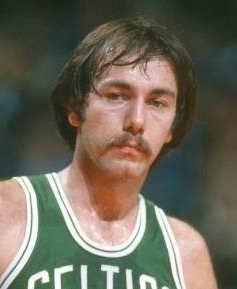
NBA guard and coach Chris Ford died on Tuesday at 74. He played for Detroit and Boston. He won the NBA championship in 1981 with the Celtics. He later coached for them too. Before becoming their head coach, he was an assistant under Hall of Famer K.C. Jones. (KC died on Christmas day, 2020, at age 88, alav hashalom.) KC was the coach at Brandeis when I was a freshman there. He came to our dorm once for a brunch, and seemed like a genuinely nice guy. He said he considered football too, early in his career, but gave it up when he felt the ground shaking as a 300-pound lineman was coming at him full speed for a tackle.
Back to Chris Ford. He was playing for the Celts on October 12, 1979. He caught a pass from Nate “Tiny” Archibald behind the three-point arc, took a shot, and it went in. Kevin Grevey of the Washington Bullets also sank a 3-point shot that night. The reason I mention it is it was the first day of the three-point shot’s existence in the NBA. After the Bullets’ game, a reporter told Grevey that his “three” made basketball history as the first one ever made. But three days later, the NBA issued a news release stating that Ford’s was first. According to the NYT, it was unclear at exactly what time in the evening each shot was made, but Ford has received credit for it. Grevey said he didn’t think about it until more than ten years later when he ran into that reporter again. He said he would look into it further, but told The Times in 2021: “I swear I don’t care.” Alright, everybody — you heard him — the man doesn’t care.
In addition to his historic three-pointer, Ford had one dunk of note. He dunked (at least once) on Hall of Famer Julius Erving, one of the greatest dunkers the game has ever seen. Erving’s nickname, of course, was Dr. J., and Ford’s dunk over him earned Ford the nickname “Doc.”
Rest in Peace, Doc.
You all know Ken and Barbie, right? Well, in today’s puzzle, at 12 down, the clue was unusual: “Earring Magic _____ (1990s doll that developed a cult following).” Three letters, and the answer was KEN — yes, the Ken of Ken and Barbie. But you may not recognize him. Here he is:

Here’s how it came about. Mattel conducted a survey of girls asking if Ken should be kept on as Barbie’s boyfriend, or if he should be tossed in favor of a new one. The survey revealed that they wanted Ken kept on, but with a “cooler” look. Hence, in 1993, Magic Earring Ken was introduced (as part of the 6-doll Magic Earring series).
He had blonde highlights in his hair, and his outfit included a lavender mesh shirt, purple fake-leather vest, earring (of course), and a necklace of some kind. Well, unless you live under a rock, you will note that it screams “Gay.” In fact, the necklace was viewed by some as a sex toy popular in that community. It made quite a splash. It was featured on the front page of the NYT’s Arts and Leisure section and it became the highest-selling Ken doll in history. When the “sex toy” issue was “outed,” however, Mattel discontinued production and pulled it from the shelves. They are available on eBay for around $100, and, apparently, make occasional appearances in crossword puzzles.
What day is it today? — Saturday. How appropriate and sweet, then, for the 13-letter answer at 29A to be SHABBAT SHALOM! Thank you, David Distenfeld, same to you!
And here are his notes on the puzzle. Any words seem foreign to you?
“I’m a bit verklempt to be debuting SHABBAT SHALOM on, appropriately enough, a Saturday. Not to get all schmaltzy, but it’s so exciting I could plotz or kvell, maybe both, who knows. Mazel tov to me!
“With this, my fifth puzzle (but who’s counting), I truly feel like part of the New York Times crossword mishpocheh.
“Now I hate to be a kvetch, but oy vey did it feel like forever to get a response on this puzzle and I had major shpilkies while waiting; my pulkes were pulsating, my tuchus was twitching. I know — it wasn’t pleasant for me either.
“But then those mensches on the editing team had the chutzpah to email a big ‘Yes’ and all that other mishegas just disappeared.
“If you could have seen me in that moment: my schmatte completely shvitzed through, my punim covered in schmutz, tchotchkes strewn across my bathroom floor. This schlub couldn’t have been happier if he was noshing on some blintzes and rugelah, Bubelah.
“Anyway, enough of my shtick — enjoy this meshuggeneh crossword and, as my Zayde used to say, ‘”‘Gesundheit.’”
There are some heavy hitters from show biz in the grid today. Hello Tina FEY! Tina was born in Upper Darby, PA, not far from Philly, and she attended U. Virginia. Did you know she saved a man’s life once? She heard a man calling for help and called the police. It turned out his kayak flipped and he was drifting in the Hudson River without an oar. The police were able to get to him about a mile north.
And did you notice a scar a few inches long on the left side of her chin and cheek? It’s a creepy story — when she was around 5 she was slashed in the face by a stranger in the alley behind her house. Yikes!
She is married to a pianist, composer, and music director (one person) and they have two daughters: Alice and Penelope. Here’s a pic — yes, I see the scar now, barely. Not so bad.

Five down: “Brother from another mother, maybe” was HALF SIBLING, and it brought out this comment from egsforbreakfast: “If your step mother acts as surrogate to carry one of your biological mother’s eggs which has been fertilized by your biological father, is the newborn your one-and-a-half sibling? Maybe I’m overthinking this stuff right now because just yesterday a friend told me that his daughter and her wife each had babies from one wife’s eggs and sperm from a male friend of theirs, making the babies full biological siblings. Cool, but kinda mind warping for a few nanoseconds.”
SETH ROGEN, in the grid at 29D, was born and raised in Vancouver, Canada. His parents met in a kibbutz in Israel. He has described them as “radical Jewish socialists.” The only business he ever wanted to be in is comedy. He started working as a teen at Bar Mitzvahs, private parties, and, later, bars. At 13, he was writing comedy. He wrote jokes for a mohel (cutting remarks, no doubt). He dropped out of high school to work at his craft, and his mom supported the decision. He was doing well, and hooked up with Judd Apatow at age 16.
In June 2018, Rogen was invited by Mitt Romney to speak at a seminar on Alzheimer’s disease in Park City, Utah. Speaker of the House Paul Ryan was in attendance, and asked Rogen for a photo after Ryan’s children engaged Rogen in conversation. Rogen refused. He told Stephen Colbert,: “I look over and his kids are standing right there expectantly, clearly fans of mine, and I said, ‘No way, man! Furthermore, I hate what you’re doing to the country at this moment, and I’m counting the days until you no longer have one iota of the power that you currently have.’”
Rogen married actress Lauren Miller in 2011. They have said they do not plan to have children.

Designer Christian Dior was born on this day, back in 1905, and died in 1957 when he was only 52. In 1946, his “New Look” brought a voluptuousness back to women’s fashion after the boxy style that predominated during World War 2.
He reestablished Paris as the center of the fashion world, with him as the arbiter of fashion. Here’s an example of a House of Dior design of a more recent (2010) vintage.

That’s a pretty note to end on. See you tomorrow!
-
A Fair Wind
If you found yesterday’s owl chatter about Hunter’s graduation ceremony and the lovely Emily Ratajkowski to be a tease, you can feast on much more of it (and her) via this extensive coverage in the Daily Mail (see link, below). There are numerous photos of Ms. R, and several of me snuck in there too! (I’m the fellow in the back row with the mustache.)
Yesterday’s discussion on the usefulness of HS math in later life, hit home with owl-chatter-reader Judy who wrote: “Beth [daughter] and I have a running conversation/argument about the purpose of learning HS math — and she was quite good at it back in HS. But she claims she never uses it now. I argue that it’s part of one’s education to learn critical thinking skills and to (hopefully) become a thoughtful, intelligent adult. Same argument applies to science, literature, history, etc. So, she shared this with me.”

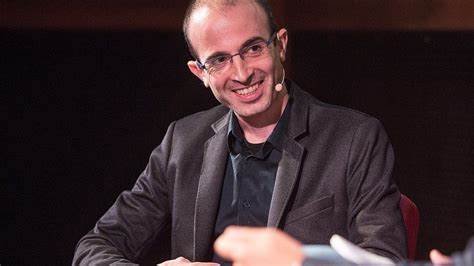
Turning to the puzzle, there was much buzz about a long (15-letter) across answer that threw almost everyone for a loop. Maybe you’ve heard of him? “Best-selling Israeli author of ‘Sapiens: A Brief History of Humankind.’” (Ouch, right?) It’s YUVAL NOAH HARARI.
Harari has said “The bitter truth is that the world has simply become too complicated for our hunter-gatherer brains.” (As 12 down tells us: TRUE DAT!)
He’s a history prof at the Hebrew U. of Jerusalem. His writings examine free will, consciousness, intelligence, happiness, and suffering. Wow! — exactly the purview of Owl-Chatter! Well, at least the suffering part.
Harari taught himself to read at age 3. He is gay and married his husband in a civil ceremony in Toronto . He does not have a smartphone. He has said that Vipassana meditation changed his life. He meditates two hours a day and goes on a 30-day meditation retreat each year, in silence and with no books or social media. The only exception he makes is for Owl-Chatter. After learning that Trump cut off funding for WHO during the pandemic, he and his husband donated $1 million to the organization.
Welcome to Owl-Chatter, Professor.
I had no idea what 6 down was either: “Hip-hop duo _______ Sremmurd.” The answer is RAE. But this one I may remember for next time because it’s Ear Drummers, backwards. (Thanks Rex!)
There were some neat food answers. TOOTSIE ROLL, at 18D, and CHOW MEIN, right next to it at 5D. But the Chow Mein may have been left out of the fridge for too long because it’s crossed by NOISOME (“foul-smelling”). That may explain why the crossing answer at 17A is: HATE TO EAT AND RUN. And if your fillings can’t handle that Tootsie Roll, it’s NOT A BAD IDEA (19D) to have one of those TARTS at 49D for dessert instead.

Here’s a poem by Ted Kooser from Winter Morning Walks that’s a little whimsical.
Found, on the gravel road I walked this morning,
one beer can, part full of frozen tobacco juice
that when I shook it came apart like chunks of amber,
and a quarter-sized piece from a fluted china plate,
with a soft pink rose the size of a pencil eraser
and a curl of flying, pale blue ribbon. In a nearby tree,
five noisy crows who had seen me stooping there
were busy creating a plausible story.
David Crosby (August 14, 1941 – January 18, 2023)
And it’s a fair wind
Blowin’ warm out of the south over my shoulder
Guess I’ll set a course and go(Wooden Ships)

-
Violin Curves
If you wanted a clue for the name of the constructor of today’s NYTXW, you might use “word with fluid or harm.” It’s Daniel BODILY.
It’s a good puzzle. Remember your PEZ dispensers and candies? The clue for it at 63D says it was originally marketed as a smoking cessation aid. I don’t remember that. In that connection, however, someone noted that the dispensers seem to be like cigarette lighters, which is a little creepy.
The clue for ESCALATOR was cute: “It may have a down side.”
And how about 48D?: “Log feature,” is GNARL. The G is silent, unlike the G in the GNU I ran into somewhere recently. My online dictionary defines gnarl as “a rough, knotty protuberance, especially on a tree,” and offers this nice example of its use: “a blackthorn topped with a two-humped gnarl.”
[Speaking of GNU, I was remiss in not pouncing on it and sharing the absolutely terrific Gnu Song, by Flanders and Swann. If you only click on one owl-chatter song this week, make it this one.]
At 43A, “Step in a mathematical proof” was LEMMA. That’s a word I was always fuzzy on. The dictionary says it’s “a subsidiary or intermediate theorem in an argument or proof.” I think I get it. If you are trying to prove something that says if A, then D, but you have to go from A to B, first, and then B to C, and finally from C to D, you are proving “if A, then D,” and the smaller steps you take to get there are lemmas.
It led to some discussion of mathematics in general among the commentariat. Is HS math useful later in life? Personally, I don’t use it very often, but that doesn’t mean it’s not worth studying. If it’s an exercise that sharpens the mind, it’s worthwhile. The Rabbis don’t study the Talmud to learn the specific laws it describes, but to appreciate the sharpness of the analysis.
I’ll share this comment with you, although I don’t think I agree with it.
“FWIW, I was a very good math student at one time — though it’s hard to remember that now. I took 4 years at Dalton (when only 3 were required) and then took a Calculus elective course my Freshman year at Smith. And while the MIT recruiters never came knocking at my door, my math board scores were pretty high. And yet…
“I don’t remember any math at all and I certainly don’t use it. Whether it’s algebra, geometry, trig or calculus, here’s the way I think about : Math is a house of cards. Take one card away, and all your knowledge collapses. The card can be a single theorem. A single proof. A single equation. A single anything. Because everything in math is built on something else.
“Look, I can forget everything I ever learned about the reign of Charles I or the Treaty of Versailles and still remain absolutely brilliant on the subject of the American Civil War. I can completely forget Hawthorne’s perfectly awful ‘The House of the Seven Gables’ but be able expound convincingly on ‘The Grapes of Wrath.’ And if I were knowledgeable about art (which I’m not) I might be able to talk at length and in detail about Monet and Cezanne while forgetting everything I was taught about Picasso.
“But one dares not forget ANYTHING in the field of mathematics — because if you do, you’re likely to forget EVERYTHING. That’s what’s happened to me. And while I’m deeply sorry about it — I used to LOVE math, after all — there doesn’t seem to be a hell of a lot I can do about it. All the math discussions on this blog are going right over my head.”
But is that true? If you forgot, or never studied, geometry, does that mean you can’t understand algebra? And on the other side of the equation: if your field is literature, and you’ve never heard about Shakespeare, might not your grasp of later literature be compromised?
I think we deserve a treat after that. How about another model, fellas? They seem to be falling all over themselves to get included in owl chatter. Three days ago, we had the poor supermodel who passed away, and today we had another knockout giving the commencement address at Hunter College’s graduation ceremony. I’m not kidding. The speaker was model Emily Ratajkowski, described in the program as a NYT best-selling author, entrepreneur, actress, model, and activist. She has a massive following on Instagram that she parlayed into a successful clothing line, has appeared in the films Gone Girl, and I Feel Pretty, and her collection of essays “My Body” was an instant NYT bestseller. She also created a conceptual art piece that was sold via auction at Christie’s. She advocates for women’s health issues as a spokesperson for Planned Parenthood.
She’s not a Hunter grad. She went to UCLA for just one year. I guess they invited her as an example of an extraordinary success story. She spoke well and didn’t seem like a phony. She seemed truly honored to have been asked. It was nice that Chuck Schumer spoke briefly right before her, and the whole scene had all that regalia all over the place. Emily herself was dressed modestly in an academic gown, which certainly helped keep the drooling to a minimum.
She’s 31. She has a son who will turn two in March. She and her husband are divorcing. Her mom is Jewish and her dad is Catholic. She identifies herself as “Polish-Israeli.” Here’s a photo of her:

Jonathan Raban passed away on Tuesday. He was 80. The name rang a bell because I read (and liked) one of his books a long time ago — about a trip he took down the Mississippi River. He didn’t want to be considered a “travel writer,” which connoted writing travel guides — where you stayed, what you ate. One tribute said his books offered a “view of the world that was both darkly comic and sardonic, delivered in prose that can pierce your heart with its accuracy.”
The obit in The Times includes the following passage from his book “Bad Land: An American Romance,” in which he explored how homesteaders were lured to settle desolate areas in Montana but had their dreams dashed.
He described the derelict houses they left behind:
“Their windows, empty of glass, were full of sky. Strips of ice-blue showed between their rafters. Some had lost their footing and tumbled into their cellars. All were buckled by the drifting tonnage of Montana’s snows, their joists and roof beams warped into violin curves.”

Mary Kaye Richter, who died at age 77 around Thanksgiving last year, suspected there was something off about her son Charley by the time he was a toddler. His skin was dry and scaly, he was very sensitive to warm weather, and he had very little hair and not a single tooth. When she took him to a dentist, x-rays revealed he had no permanent teeth. The diagnosis of hypohidrotic ectodermal dysplasia was very rare — in fact, at the time there were only seven other known cases in the U.S. So research was minimal and support networks did not exist. That was around 43 years ago.
From her farmhouse in Illinois, Mary Kaye got to work. She started a foundation, and soon discovered dozens of other cases and then hundreds. It now serves over 9,200 families worldwide and has raised close to $4 million to fund research at 40 medical facilities. And of course she took care of Charley. For teeth, he got dentures. She came up with an idea that let him play outside with friends in the summertime heat. She’d give him a popsicle when he went out, and when he came back his head would be all blue or red because he’d rub it on himself to keep cool.
Charley is 44 now and says he has lived a good life, thanks to his mom. He got married and has two daughters, although the marriage ended in divorce. And he runs the family farm of 2,000 acres.
Here’s a shot of Mary Kaye with kids she met through her work.

Good night, everybody — see you tomorrow!
-
Styx and Stones
There’s a story in the food section of The Times today on malt liquor. I didn’t know what it is, other than something sold along with beer. It’s a beer for people who don’t like the hoppy or bitter ales that are the hallmarks of craft brewers. So it’s not for me. The first example they give of a resurgence of malt liquor is produced by the Virginia Beer Company and is called “39 Words.” But the article does not explain why it’s called 39 Words nor what those words are. WTH? It seems like something the readers of Owl Chatter need to know, so I did a little digging. First of all, it’s billed as “A strong beer brewed for all women,” and was released on Women’s Equality Day last year, which is August 26, the date in 1920 upon which the 19th Amendment to the Constitution was adopted, granting women the right to vote. (Sorry about that long sentence – it just kept falling down the stairs.) And the 39 words are the words in the Amendment. Here they are:
The right of citizens of the United States to vote shall not be denied or abridged by the United States or by any State on account of sex. Congress shall have power to enforce this article by appropriate legislation.
Yup: it’s 39.

“Bridges in film,” at 57A today is JEFF. He won a Best Actor Oscar once, for Crazy Heart in 2009, which was terrific. Maggie Gyllenhaal was nominated for Best Supporting Actress in it, but lost out to Mo’nique in Precious.
Other Oscar-nominated roles of Jeff’s include The Last Picture Show (1971), Thunderbolt and Lightfoot (1974), Starman (1984), The Contender (2000), True Grit (2010), and Hell or High Water (2016).
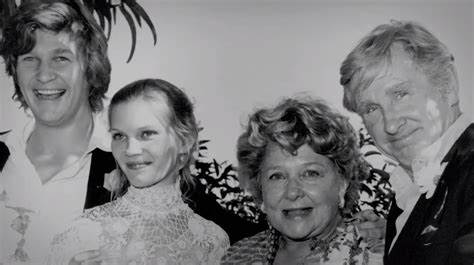
Raise your hand if you’ve ever fallen in love with a waitress/waiter. In 1975, while filming Rancho Deluxe, Bridges met Susan Geston, who was working as a waitress. They got married in 1977 and have 3 daughters and a granddaughter. A little arithmetic tells me they’ll be celebrating their 46th anniversary this year. Mazel Tov! Here’s a family shot of Jeff and Sue with Jeff’s mom and dad. You may recognize the dad.
There was a terrible pun in the puzzle at 41A. The clue was “‘I’m [blank] of you’ (Valentine’s Day message for a plant lover?)” And the answer was FROND. OK, a groaner for sure. But commenter lydianblues said:
“While peering into a fish tank in an aquarium store, looking at the leafy water-plants and sea creatures: “with fronds like these, who needs anemones” . . .
Fans of Olympic sports should recognize two incredible woman athletes in today’s puzzle: U.S. gymnast Suni LEE, and Jamaican speedster ELAINE Thompson-Herah.
Suni Lee is Hmong-American. She was the 2020 Olympic gymnast all around champion, and is tied for tenth as most-decorated American female gymnast, with six world championship and Olympic medals. She’s 19, was born in St. Paul, MN, and attends Auburn University.

And Elaine Thompson-Herah — fuhgedaboutit. She is the fastest woman alive at 100 meters. She is the only female sprinter to win both the 100 and 200 meter dashes at consecutive Olympics (2016 and 2020). (Only one male has done it: fellow-Jamaican Usain Bolt.) She is 30 years old, and married to former sprinter and coach Derron Herah. If you’ve got a minute, you can watch her run:
At 11D, the 1983 hit song that began with “Domo arigato” was MR. ROBOTO, by Styx. It’s foreign to me, but was a big hit for them. It’s off their “concept” album Kilroy Was Here, a rock opera. The new direction the band took with it created some tension and led to a breakup. This appears to be the message:
The problem’s plain to see
Too much technology
Machines to save our lives
Machines dehumanizeAnd on that creepy note, we’ll bid you goodbye. Thanks for stopping in.
-
Dagnabbit!
It’s not unusual for a son to go into his father’s business, but when your dad is Evel Knievel you might want to think twice. Robbie Knievel didn’t, but he died last Friday in Reno, Nevada, at age 60 from pancreatic cancer, not some crazy stunt.
Robbie, who was thankful his dad Evel didn’t name him “Drivel,” started riding motorcycles when he was old enough to hold onto the handlebars, and performed his first show with his dad in Madison Square Garden when he was 8.
Robbie hurtled over part of the Grand Canyon in 1999, but broke several ribs upon landing. (D’oh!) It was 25 years after his dad tried to clear the Snake River Canyon but tumbled into the rocky chasm below due to a parachute malfunction. Don’t you hate when that happens?
He had three daughters and five grandchildren. He said his dad saw him as a competitor, but he was really his dad’s biggest fan.

It’s Michelle Obama’s birthday today. Michelle met the Prez when they were working for the same law firm in Chicago. On their first date, they went to see Spike Lee’s movie, Do The Right Thing.
When I was growing up, the two big international sex symbols were Brigette Bardot and Gina Lollobrigida. Gina L. died yesterday in Rome at 95. She starred in films alongside Bogart, Burt Lancaster, Anthony Quinn, Yul Brynner, Rock Hudson, and, in Europe, Belmondo, Mastroianni, Trintignant, and Montand. After twenty years of that, she turned to photography, and of her first published collection the Times stated: “Believe it or not, she takes good pictures and isn’t just trading on her name.” She also wrote, directed, and produced a film on Fidel Castro, based on an exclusive interview she had with him, and was an exhibited sculptor. She leaves a son and grandson.
Here she is, when her powers were still intact. Smoky eyes.

I found today’s puzzle a little blah, or, if you prefer, meh. The clue at 8D was “Sketchy behavior,” and the answer was SHADINESS. It elicited the following note from LMS:
“I watch enough crap Housewives TV to know from SHADINESS. Since it refers to behavior, I wonder why the inventors of English didn’t go with “shadery” instead. A Housewife once referred to another woman’s gossip as some major bitchassment, and I was stunned, humbled, and deeply impressed by the inventiveness.”
At 26A, the clue was “Aw rats,” and the answer: DAGNABBIT. Here’s either an interesting or painfully boring discussion of that unusual word:
“Dagnabbit,” is, of course, a taboo deformation of the word “goddammit.” Let’s break down “goddammit” into two parts: “god” and “dammit.”
One strategy is called metathesis, which is a switch of sounds within a word. Pretty simple: instead of “god,” you’d say “dog.” Use some dissimilation for the vowel—change “ah” to “agh”—and you end up with “dag.” Excellent! Halfway done!
“Nabbit” as a switch for “dammit” is more fun, because we get to use both dissimilation and metathesis. “M” and “n,” remember, are paired together, very similar sounds. So swap out one for another. “D” and “b” are also pairs: they’re called stops, which means that you halt the movement of air from your mouth. (That’s as opposed to a sound like “s,” which could theoretically go on for as long as you have air in your lungs. But you can’t make the “d” or “b” sounds without stopping air from flowing.)
So using dissimilation, we get to “bannit.” Pretty good, but not great. What if we use metathesis to swap the position of our new consonants within that word? Ah ha! Nabbit. Put them together and we’ve figured out dagnabbit.
[Ouch — my brain hurts.]
Actual headline in the NYT today on page A12: Crackdown On Sick Days Is Hindered By Sick Days.
I was not surprised to learn at 56A today that IKEA is an acronym. But I had no idea it was from: Ingvar Kamprad, Elmtaryd (the farm where he grew up), and Agunnaryd (his hometown in Småland, southern Sweden).
Now aren’t you glad you’re a regular reader of owl chatter? Where else will you get vital information like that? I ask you.
The clue at 35A was “Whom one might go see at ‘tooth hurty,’ per a classic joke.” You all know that one, right? DENTIST — “2:30” is “tooth hurty.”
A Rex commenter confessed to not knowing the joke and sought an explanation which was quickly provided. (The community takes care of its own.) And I added the following:
For those of you who are craving more bad dentistry jokes (and, let’s face it, who isn’t?):
1. A Texan is in the chair. The dentist says “Everything looks fine.” The Texan says: “Drill anyway, Doc — I feel lucky.”
2. Mrs. Johnson is in the chair. Just before the dentist begins to drill, she reaches up and grabs him by the nuts. He says, “Mrs. Johnson, what in the world is going on?” And she says: “Now, we’re not going to hurt each other — are we?”
One of the features of the NYT Opinion section is a weekly conversation between Gail Collins (on the left) and Bret Stephens (on the right, but not a Trump supporter). I was happy to see Stephens refer to the obituary of Adolfo Kaminsky today, the anti-Nazi forger, discussed in owl chatter recently. (Kaminsky was part of a French Resistance effort that saved 10,000 lives, mostly children.) Stephens called it “the single best piece in The Times last week.” He said the piece is a powerful reminder of Rabbi Hillel’s declaration in the Mishna that, “In a place where there are no men, strive to be a man.”
Amen to that, Rabbi.
Thanks for stopping by.
-
Calf Muscles
Never happy to see anybody die, but when it’s a Swedish supermodel who merits an obit in the Times, we at least get to sift through beautiful photos. Rest in peace, Tatjana Patitz. She was only 56. A very successful modeling career brought her some small film roles, most notably in Rising Sun, with Sean Connery in 1993. But in the role she was a nude murder victim, and she said “Oh my God, I don’t want my parents to see it.”
Tatjana was in a few funny commercials. In one, she is working the counter in a dingy Western diner on a blistering hot day, and a hunky young man walks in wearing an unbuttoned shirt, boxers, and no pants. There is a moment of “sexual chemistry” (as the Times puts it), but what he is really after are his Levi jeans which are in the refrigerator behind her. Check it out — it’s funny, and she’s gorgeous (he is too).
Here’s a nice shot of her that won’t get any of us in trouble.

Alfred T. Goodwin, a federal judge from 1969 until his death, also has an obit today. He passed away last Dec. 27 in Bend, Oregon, at age 99.
He wrote the majority opinion in the 2-1 decision striking down the pledge of allegiance because the words “under God” are a state endorsement of religious belief. The Ninth Circuit upheld the decision in a 15-9 vote. I remember the case, and I remember the Supremes went against it, 5-3, restoring the pledge. But I only learned today that the Supreme Court decision was procedural. It held the plaintiff lacked standing to bring the case. He was an atheist who had a daughter in the public school system. The Supreme Court never ruled on the constitutional issue.
Rest in peace, Your Honor.
Did you know that an EMU has calf muscles, according to today’s puzzle? They don’t fly but can run as fast as 30 MPH.
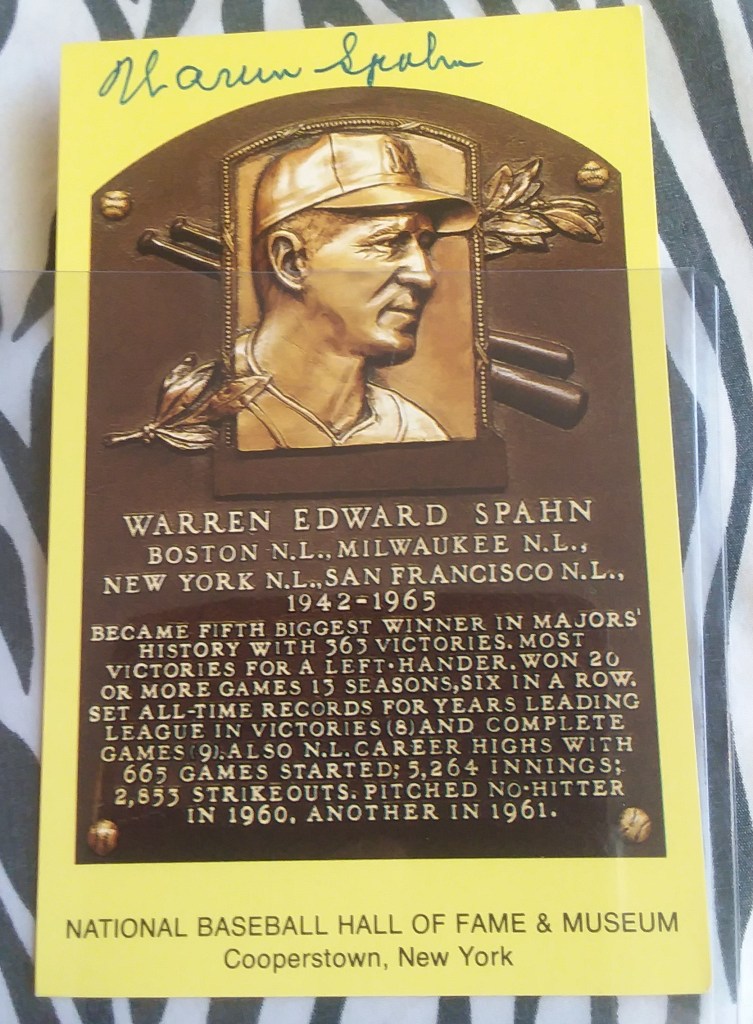
Yesterday’s puzzle included Warren SPAHN, boringly clued with “Warren in the Baseball Hall of Fame.” Spahn made a brief appearance in the majors in 1942 when he was 20, but enlisted in the army when the season ended. He saw action at the Battle of the Bulge and was awarded a Purple Heart and Bronze Star. Amusingly, when Spahn was with the Braves in 1942, he had a bit of a tiff with Casey Stengel who was their manager. Stengel ordered Spahn to hit a batter with a pitch and Spahn refused. (The batter was Pee Wee Reese of the Dodgers and it was an exhibition game.) Stengel accused Spahn of having no guts and sent him back down to the minors.
Stengel later said that it was the worst managing mistake he ever made: I said “no guts” to a kid who went on to become a war hero and one of the greatest lefthanded pitchers you ever saw. You can’t say I don’t miss ’em when I miss ’em.
Spahn holds the MLB record for most wins by a lefty with 363. He won 20 games or more 13 times and won the Cy Young Award in 1957. He was an All Star 17 times and pitched two no-hitters. Get this — he had 2,583 strikeouts, but for several decades his HOF plaque said he had 2,853. In fact, the autographed postcard plaque from my collection, below, has the wrong amount.
On July 2, 1963 he was locked in a pitcher’s duel with Juan Marichal that lasted 16 innings. Willie Mays won it by hitting a homer off Spahn on Spahn’s 201st pitch. Marichal threw 227. Amazingly, Spahn went 23-7 that year, as a 42-year-old, with a 2.60 ERA. It was his last winning season, however.
Let’s close with the poem Kooser wrote on January 16th, my birthday, in Winter Morning Walks:
A flock of several hundred small brown birds,
all of one mind, crazily chases its tail
across a muddy field and into a grove of trees.
They are full of joy, like a wheel that breaks loose
from a truck and bounds down the road
ahead of the driver, then eventually slows
and falls behind, wobbling onto a spot
on the shoulder, rocking around on its rim,
then settling with a ringing cry.

-
Owl-Chatter Midterm answer key
Here is the official answer key for the owl-chatter midterm. I guess it’s no fun to take tests, even for fun — nobody entered! Oh, well. Maybe next time.
Owl Chatter Midterm Exam: The Answer Key
- The NYT crossword puzzle grid of Sunday 12/22/22 was controversial because its design appeared to show:
a. A Christian Cross
b. A symbol disrespectful to Muslims
c. A swastika
d. A Jewish Star of David- The word “sockdolager” played a role in:
a. Washington’s crossing the Delaware
b. Jefferson’s drafting the Declaration of Independence
c. Lincoln’s assassination
d. The moon landing- Complete this phrase: Happy as a clam ———-
a. in high water
b. in cold water
c. on the beach
d. in the sun- Who is a patron saint of Owl Chatter?
a. Ana de Armas
b. Arthur Sullivan
c. Joe DiMaggio
d. Taylor Swift- Which song did Taylor Swift write in response to a bad review?
a. Red
b. Mean
c. Shake It Off
d. Sticks and Stones- What type of institution was named to honor Portia, the Shakespearean character in The Merchant of Venice?
a. a nursing school
b. a business school
c. a medical school
d. a law school- A “smew” is a:
a. bird
b. rodent
c. cactus
d. fish- A lawyer named Sue Yoo is an example of a(n)
a. metonym
b. homonym
c. holonym
d. aptronym- Who was born on Pi Day (March 14th)?
a. Groucho Marx
b. Albert Einstein
c. Isaac Newton
d. Marie Antionette- Marathon runner Lonah Chemtai Salpeter runs as a citizen of what country?
a. Kenya
b. The U.S.
c. Israel
d. Ghana- Ai Weiwei created an artwork out of 100 million what?
a. pebbles
b. sunflower seeds
c. shoelaces
d. dried leaves- Where would you find a “second line””
a. Chicago.
b. Disneyland
c. Los Angelas
d. New Orleans- Hippopotomonstrosesquippedaliophobia means:
a. fear of long words
b. fear of large mammals
c. fear of loud noises
d. None of the above- “I’m not really a waitress” is:
a. a line in a movie
b. a line in a song
c. a shade of nail polish
d. the name of a book- “Nugatory” is a word used by whom in Owl Chatter lore?
a. William F. Buckley
b. Pat Moynihan
c. Rodney Dangerfield
d. Lisa Simpson- Vuvuzela is:
a. A country in South America
b. A skin blemish caused by the sun
c. A popular Peruvian casserole
d. A horn that produces one note when blown into- Hall of Famer Rod Carew was born:
a. in a taxi
b. in a hospital room
c. on a train
d. in a baseball stadium- Cellist Charlotte Moorman won fame for playing the cello:
a. With her feet
b. In Hanoi during the Vietnam War
c. On top of the Washington Monument
d. Topless- What part of Mary in The Pieta had to be replaced by using a block from her back after vandalism?
a. Fingers
b. Nose
c. Elbow
d. Foot- Melville’s “Moby Dick” was based on an actual whale whose name was:
a. Whitey
b. Big Whitey
c. Mocha Dick
d. Larchmont- What color is the Esperanto flag?
a. Green
b. Red
c. Taupe
d. There is no flag- In the 2012 Olympics, gymnast Aly Raisman used what music for her gold-medal-winning “floor final?”
a. Taylor Swift’s “Shake It Off”
b. The Norwegian National Anthem.
c. The Beatles’ Let It Be
d. Hava Nagila- The late Don Christopher of Gilroy, CA, was known as “The [what] King?”
a. Garlic
b. Turnip
c. Pumpkin
d. Avocado- What was Cincinnati Reds pitcher Tom Browning wearing when he pitched his perfect game?
a. Two wedding rings from two marriages
b. A Jewish “Chai” pendant
c. Red underwear
d. No underwear- What opera did Puccini die before completing?
a. Tommy, the Rock Opera
b. Turandot
c. La Boheme
d. Madama Butterfly
-
Subscribe
Subscribed
Have a WordPress.com account? Log in now.

