Welcome to the first post of the new year, everybody! Broadcasting tonight from the luxurious (sorta) Sheraton Suites in downtown Wilmington with adorable grandson Morris (Mo) safely tucked into his travel crib next to his folks. A lovely time was had by all at the Finkelman’s New Year’s bash, where the Nanaimo bars rocked!
Here’s a panoramic shot of the city.

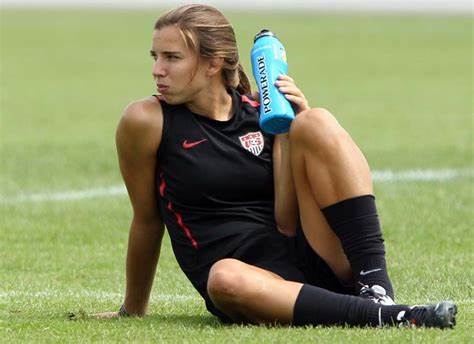
Local Girl Makes Good. TOBIN Heath made the grid today at 60D: Soccer star ______ Heath. Born and raised in Morristown NJ, right up the road from owl chatter headquarters, Tobin has been described as “perhaps the USA’s most skillful player” by the U.S. Soccer Federation, and she was voted the U.S. Soccer Athlete of the Year in 2016. She has won gold with the U.S. team numerous times.
In June 2022, Heath shared a photo on Instagram of a painting she produced titled Out Now, which depicted the words “I am gay” spelled out in large, multi-colored all caps block letters. Here’s our Jersey girl taking a breather, and that painting.

At 65A, the clue was “‘An empty set exists,’ e.g.,” and the answer was AXIOM. And here’s a comment by T Trimble that I had to read twice and that made my brain hurt a little:
Once upon a time, “axioms” were described as “self-evident truths” from which mathematical arguments proceed. And that’s still the common meaning, as when one says, “it’s axiomatic that…”. In mathematics today, the “self-evident truth” part is dropped, but the idea that axioms are the starting points of theories is retained. So, we can write down axioms for Euclidean geometry, and we can also write down axioms for systems of non-Euclidean geometry. The derived consequences of the first theory will be inconsistent with those of the second theory, but there’s no problem, as long as we don’t claim legitimacy of one over the other, but think of them as pertaining to different mathematical worlds. You could think of axioms as provisional: if we suppose a world where such-and-such axioms are true, then certain consequences follow. Thus “truth” is relative and contextual. It took a very long time for mathematicians to attain that understanding, but it’s a commonplace today (even though the struggle continues at the logical and foundational levels).
Questions, anybody?
The theme of the puzzle was clever today. There was a long answer that you got by solving a clue. Then there were circled letters within that answer that formed another word. Then that “duo” was referred to in the answer to a different clue. WTF!! As I tell my students, maybe an example will help.
The clue for 50A was “Colorado, Idaho, and Wyoming among others,” and the answer was MOUNTAIN STATES. In that answer, the letters M, A, T, E, S, were circled, giving you the word “mates.” Then at 98A the clue was “Useful people to know,” which was FRIENDS IN HIGH PLACES. Get it? “Mates” are friends, and “Mountain States” are high places and the word “mates” was in the words “Mountain States.” (There were four of those.)
Everyone’s favorite clue was “Barely sits still?” Answer: POSES NUDE.
In yesterday’s puzzle (Saturday’s) the clue at 45A was “Didn’t wait for a restaurant job?,” and the answer was BUSED. (Get it? Wasn’t a waiter: was a bus boy.)
Egsforbreakfast had this to say: “I’ve never understood why BUSED is preferable to bussed. Maybe I was abussed as a child. I’m sure I was a bust as a child. Later I was the victim of a bust because I stole a bust from a museum. The lady that arrested me had a bust that I still remember.”
Did you ever make up your own language with your little brother or sister or a school friend? Me neither, but ESPERANTO is the world’s most widely spoken “constructed international auxiliary language.” Created by the Warsaw-based ophthalmologist L. L. Zamenhof in 1887, it was intended to be a universal second language for international communication, or “the international language.” The word esperanto means “one who hopes.”
Esperanto’s vocabulary, syntax and semantics derive predominantly from languages of the Indo-European group. The vocabulary derives primarily from Romance languages, with substantial contributions from Germanic languages. Slavic languages also influenced the grammar and phonology. Prefixes and suffixes may be freely combined with roots to generate words, making it possible to communicate effectively with a smaller set of words.
Esperanto is the most successful of this type of effort. Estimates put the number of people who know how to speak Esperanto at around 100,000. Concentration of speakers is highest in Europe, East Asia, and South America. The language has also gained a noticeable presence on the internet in recent years, as it became increasingly accessible on platforms such as Duolingo, Wikipedia, and Google Translate.
According to Zamenhof, he created the language to reduce the “time and labor we spend in learning foreign tongues,” and to foster harmony between people from different countries: “Were there but an international language, all translations would be made into it alone . . . and all nations would be united in a common brotherhood.”
In 1954, the UN granted official support to Esperanto as an international auxiliary language in the Montevideo Resolution. However, it is still not one of the official languages of the UN. Esperanto has not been a secondary official language of any recognized country, but it entered the education systems of Hungary and China. The U.S. Army has published military phrase books in Esperanto. As the clue at 34D states: it has its own “green star” flag (below).
If someone asks in Esperanto if you speak Esperanto (Ĉu vi parolas Esperanton?), you can say: Mi ne komprenas vin, which means “I don’t understand you.”
One of the comments yesterday was: I bought an Esperanto book back in the 80s and left it on the shelf for about 30 years. Turns out you can’t learn it that way.

Bonan nokton — Good night!

