Greta Andersen, who spent much of her life wrinkled, died at her home in Solvang, CA, last month. She was 95. Fittingly, her passing was announced by the World Open Water Swimming Association, which I guess could be known as WOWSA.
Andersen broke 18 world marathon swimming records and was called the greatest female swimmer in history. She was the first woman to complete five crossings of the English Channel. Her second crossing was brutal. She was seasick and dizzy by the fourth mile (it’s 21 miles wide), and as she neared the final stretch, she was hit by a powerful current. The last 300 yards took her an hour and a half. She was going to give up but she saw a chalkboard her husband was holding on shore that said “Hi Greta, you can’t give up.” Out of the 29 swimmers, only five made it, and she was the only woman to finish. She came in first, over four hours ahead of the next finisher. (One of the four men finishers was disqualified for coming out of the water in the wrong place. Idiot!) Andersen was disappointed, though, because she missed setting the record by ten minutes.
She represented Denmark in the 1948 Olympics in London, the first Olympics held after a 12-year hiatus caused by the war, and won one gold and one silver medal.
Andersen was born in Copenhagen on May 1, 1927. She was 12 in 1940 when the German occupation began. Her parents cut her hair and dressed her as a boy for 5 years, fearing she would be raped by German soldiers. The ruse worked.
Andersen’s first two marriages did not go swimmingly and ended in divorce. Maybe she should have let her hair grow back and lose the boy clothes. Just sayin’.
But she was survived by her third husband, a doctor. She had no children, but had many students in the swimming school she ran for decades.
She emigrated to the U.S. in 1953, where open water swimming could be lucrative. She was largely undefeated in her career, with one notable exception: the Molokai Channel, 27 miles between the islands of Molokai and Oahu in Hawaii. She attempted a crossing twice in 1961. Here’s how The Times described her second try:
“On her second swim, which she began just after midnight, she battled sharks — she swam for a time in a specially designed cage — and was bumped by porpoises. She was swamped by 20-foot waves, and stricken with seasickness. There were rain squalls. But it was the current that bested her in the end. She fought it for nine hours, until her crew pulled her from the water at 11:06 that evening, still 9½ miles from Oahu. She had been swimming for nearly 24 hours.”
She was often called the “great Dane,” a Danish pastry, or the Danish mermaid. An observer once compared her stroke “to watching a gandy dancer drive railroad spikes.” Rip Yeager, the captain of a yacht that was part of her support team said, “I take my hat off to her. She’s a real woman in every sense.”

“Gandy dancers,” noted above, was the name for the early railroad workers, those who worked on the rails, not the train cars. The name came from the dancing movements of the workers as they wielded a lever-like tool which was either called a gandy or was made by a Gandy tool company. The expression “to take gandy from a baby” comes from this era. [No, it doesn’t.]
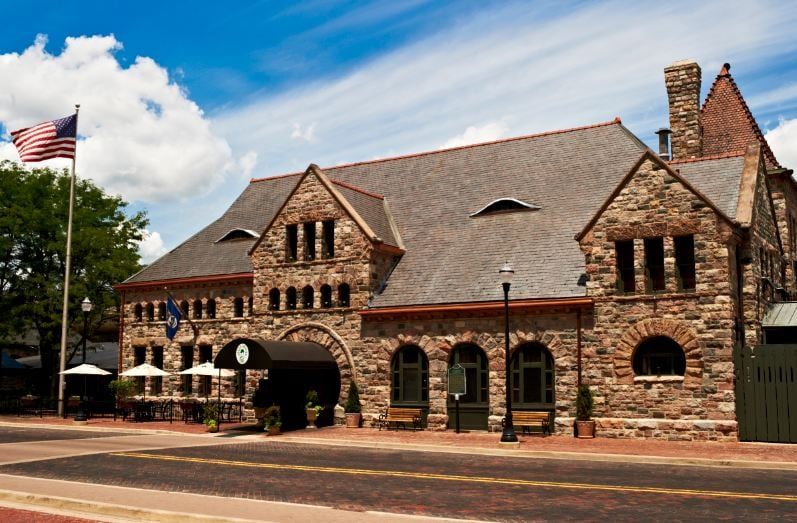
The depot in Ann Arbor for the Michigan Central Railroad was a Richardsonian Romanesque structure built solely of rock-faced masonry. The stones were quarried from Four Mile Lake, located between Chelsea and Dexter. The architectural features of the building, such as arches and lintels are emphasized by changes in color and texture in the stone. The building has a high gable roof with two dormers. The eastern portion of the building has large arched windows, and the western portion has double-hung windows with small circular ones above. The main entrance is through a large round-topped arch; the doorway has been modernized. The interior of the original depot featured an elaborate ticket booth, a ceiling and trim made of red oak, French tile floors, stained glass windows, and a large terra cotta fireplace.
Owl Chatter saw this building on a visit to Annie Arbor a few years ago. Part of it still serves as Ann Arbor’s Amtrak station. The other part has been converted into a very posh seafood restaurant called Gandy Dancer. Gonna have to try it one day, no question. And the similarly named Wisconsin beer (burp)!

The puzzle was a knock-down drag-out brawl for me today, I barely escaped with a few guesses. Of course, Rex rated it medium. Argggh.
You hear of KAMAL Hasaan, “Indian megastar in over 200 films?” I hadn’t. But commenter Dinesh Kithivasan says: I live in Chennai, India (Kamal’s home turf) and am beyond thrilled to see Kamal Haasan make his debut appearance in the NYT crossword. He is an incredibly multi-faceted personality – he has written and directed some very fine films, and he is an excellent singer and dancer. Above it all, he is a prodigious acting talent who deserves to be as well-known as the Al Pacinos and Meryl Streeps of the world. One of his finest films, Nayakan (Hero), was listed in Time’s All-Time top 100 movies.”

Al Who? Meryl Who?
The clue at 23A was “Something squares lack,” and it was HIPNESS.
LMS said: “HIPNESS looks weird. I tried to investigate why HIP means cool but lost interest pretty quickly. I guess hippy, hippie are related. Hipster. HIPNESS would denote the state of being hip. Hippery could denote stuff like meditating, participating in love-ins, and wearing tie-dye. I spent a year one afternoon at a baby shower for a hipster and was asked to do all kinds of hippery, fun for the like-wow-man-ya know-cool guests, but extremely embarrassing for this buttoned-up Capricorn.”
I liked the clue for 30A: “Metaphorical throwaway.” The answer was BATHWATER, you know, with which you try not to toss the baby out too. 9D “Some baking discards,” was a good clue for EGGWHITES, although someone noted you don’t “discard” them immediately. You put them in the fridge in a bowl, find them a week later, try to remember how they got there, and then toss them out.
11D, “Circus covering,” was CLOWN MAKEUP. Did you know some people have a phobia about clowns? It’s called coulrophobia.

Phil on Modern Family suffered from coulrophobia, which made for some funny episodes when Cam became Fizbo the clown.

It was a good puzzle despite the absence of starlets. The only tuchas sighting was at 14D: “Rears” for SEATS.
“Choice chickens,” at 25A was CAPONS. Did you know it was so cold up here this week that I saw a turkey walking with a capon?
Here’s a poem from The Writer’s Almanac today.
I Love You
by Billy Collins
Early on, I noticed that you always say it
to each of your children
as you are getting off the phone with them
just as you never fail to say it
to me whenever we arrive at the end of a call.
It’s all new to this only child.
I never heard my parents say it,
at least not on such a regular basis,
nor did it ever occur to me to miss it.
To say I love you pretty much every day
would have seemed strangely obvious,
like saying I’m looking at you
when you are standing there looking at someone.
If my parents had started saying it
a lot, I would have started to worry about them.
Of course, I always like hearing it from you.
That is never a cause for concern.
The problem is I now find myself saying it back
if only because just saying good-bye
then hanging up would make me seem discourteous.
But like Bartleby, I would prefer not to
say it so often, would prefer instead to save it
for special occasions, like shouting it out as I leaped
into the red mouth of a volcano
with you standing helplessly on the smoking rim,
or while we are desperately clasping hands
before our plane plunges into the Gulf of Mexico,
which are only two of the examples I had in mind,
but enough, as it turns out, to make me
want to say it to you right now,
and what better place than in the final couplet
of a poem where, as every student knows, it really counts.

Thanks for wasting some time with us today! See you tomorrow!
 The Wellington Files