The NYT asked a bunch of 10-year-olds to predict the future. Here are some clips:
What will life be like in 2050?
I’m thinking of drones delivering things to you.
What would you get delivered?
Pizza.
Are there any famous people today who might be a bigger deal in 2050?
LeBron James and Elon Musk.
Who will be running the country?
I think it might be me.
What else will be different?
I think Mount Rushmore is going to fall down.
Why?
Someone’s going to bomb it or something.
What will our food be like in 2050?
We’ll have different sorts of crops. We’re going to figure out how to make purple apples. They’ll be really sweet. People like sweet apples more than sour apples. I like sour apples, though.
What will we do for fun?
There’s going to be new instruments. People have been using a pumpkin to make an instrument. We’re going to figure out how to do something along the lines of that — use natural resources, like potatoes, to make some sort of instrument that’s got a totally new sound.
SHEL Silverstein was in the puzzle today. His clue was “Silverstein who wrote and illustrated ‘The Giving Tree.’” It reminded me of one of my favorite-ever New Yorker cartoons:
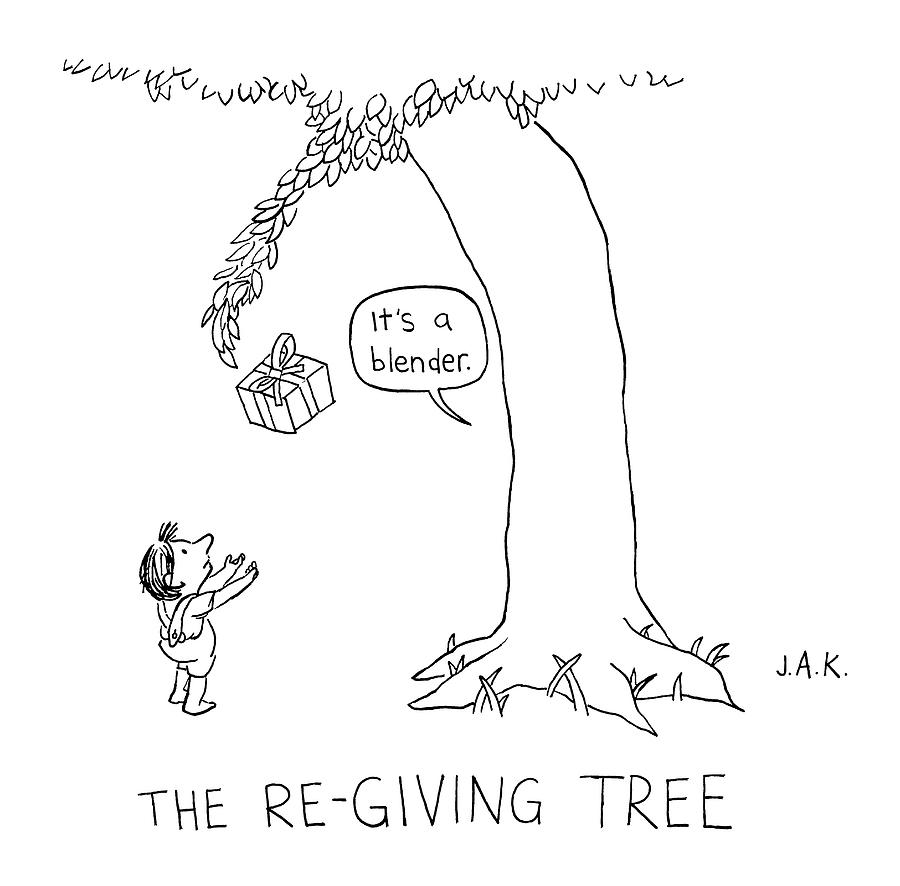
Sadly, in his later years, Silverstein was a mere SHEL of his former self.
At 53D yesterday the clue was “Isle of ___ (Scottish locale whose name sounds like an expression of endearment).” The answer was EWE, but I didn’t get it. As one commenter asked: How is that an expression of endearment, unless you’re a sheep lover? But it’s phonetic: Saying “Isle of Ewe” sounds like “I love you.”
Also learned what SCORIGAMI means. It’s a term coined in 2014 for when a score in a sporting event occurs for the first time. There was one yesterday in the Bears/Panthers game. The final score was 59-37 Bears. That score had never occurred before in an NFL game.
This pretty Honey Bear was thrilled.

A story in the Times recently discussed “familects,” special terms or words that are made up within families and are exclusive to them. Lorijo Peters wrote in and shared the following:
“Back in July 1991, our family was at a zoo and had just passed a number of peacocks strolling the grounds. My 3-year-old son was sweating in the intense afternoon heat and declared, ‘I’m sweating like a peacock!’ That phrase quickly became our family’s standard way of declaring that we were hot. That son died in 2007 at the age of 19 in a motorcycle accident, but 18 years later, we still say that we are sweating like a peacock. In memory of him and that little gift to our family, I recently got a peacock feather tattoo on my arm. It makes me smile every time I look at it.”
Here a few notes from today’s Writer’s Almanac. Agatha Christie was born on this date in 1890. Hercule Poirot was introduced in her very first book and appeared in 33 of them. When she tired of him, she killed him off in 1975 in Curtain. The NYT ran a full-page obituary for the fictional character. (Not kidding.)
François VI, duke de La Rochefoucauld, was also born on this date, in 1613. He was a real card and published a book of funny maxims in 1665. Among them was “We all have strength enough to endure the troubles of others.”
Last, born on his date in 1889, was humorist Robert Benchley, pictured below. He wrote: “The freelance writer is a man who is paid per piece or per word or perhaps.”
This shot is from a short of his called “How to Eat” in which he portrays a hapless Joe Doakes illustrating how to dine in various difficult circumstances.

I am definitely off my game. I read Jill Lepore’s piece in the New Yorker on the 9/11 anniversary, from which the sentence, below, is taken. And it struck me as especially wonderful, but I didn’t think to take the next step and send it in to Frank Bruni for his “For the love of sentences” feature. Of course, someone else did. Damn you, Stan Shatenstein, of Montreal!
Lepore writes that she was teaching a class when the dreadful news started filtering in via cell phone calls to students. No one knew what was really going on.
“What was safest: stay or go? Go, I decided. I ended class. Go straight to your dorms, and be safe, be safe. Then I got on my bicycle, turned on a radio bolted to the handlebars, listened to the unfathomable news, looked up at the clearest, bluest sky—no planes, no planes, no planes—and pedaled across the river to a day-care center to pick up my very little boys because mammals gather their young.”
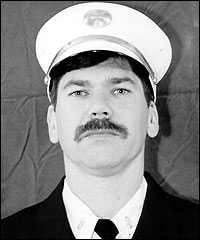
The person closest to us who was a victim was then-brother-in-law Tony Russo’s firefighter brother Michael, 44. He left a wife and 8-year-old son behind. Just learned that the son, 33 now, is a firefighter too. Apparently, many children of firefighters who perished on that day have followed in their footsteps.
Here’s Michael. Rest in peace.
Cincinnati’s Elly de la Cruz is one of those tall, gorgeous ballplayers you just can’t take your eyes off of. He’s 24, 6′ 6″, and from the Dominican Republic.

He’s having a damn good year (.284 batting average (12th highest in the NL), with 27 dingers). And an intriguing question arose over this recent home run of his. Take a look.
It left the field of play and it left the ballpark. Statcast tagged it at 457 feet from home plate. But the question that landed it here in Owl Chatter is, did it leave the state? What? Yeah, you heard me. When it landed outside the park it bounced and rolled into the Ohio River. Ohio ends at the river and Kentucky starts on the other side of the river. By making it to the river, had the ball reached Kentucky? In other words, had de la Cruz hit a ball out of the state of Ohio?
I’ll keep this explanation brief, but nevertheless tedious. The language forming the state of Ohio says it rests north and west of the river. That would mean the river was not part of Ohio, and was therefore Kentucky. But it was reasoned a river’s level is changeable and a state’s border has to be fixed. So the Supreme Court finally ruled in 1980 that the official state border should be the low-water mark of the Ohio River as it existed in 1792, when Kentucky was admitted into the union. That places the border into the river about 250 feet beyond the Ohio-side shore. And that means the ball did not make it to Kentucky. Too bad.
Let’s close with this pop song by Blue Rodeo, a Canadian band It’s linked to the puzzle via 53D: “Cowboy contest.” RODEO. It captures that dangerous “head over heels” feeling when you first fall in love. Awwww. You remember that, right? Listen to it five or six times — it’ll come back.
See you tomorrow gang.
 The Wellington Files