-
Blood Oranges
Mmmmm, what’s that neat smell? Don Christopher died this month in Gilroy, CA. He was 88. We all have a lot more garlic in our diets because of this man. For much of the last century, garlic (sometimes called the “stinking rose”), was considered exotic and was rarely found in the home. The influx of immigrants in the ’70s along with more health-conscious eating laid the groundwork for a garlic boom. Gilroy became the garlic capital of the world, and Christopher became known as the Garlic King, greatly expanding its production on his farm and boosting it in every way possible. The town of Gilroy’s association with garlic was so strong that Will Rogers once said Gilroy was the only town he knew where you could marinate a steak by hanging it on a clothesline.
Christopher founded the Fresh Garlic Producers Association in 1978. In 1979 he created the Gilroy Garlic Festival, and only expected a thousand or so visitors. But over 15,000 came, and it grew to 100,000 by the early 80s. The Food Network played it up. From 1975 to 1994, the country’s garlic production tripled. Then, in 2019, a gunman opened fire at the festival, killing three and wounding 17. The festival was sued, and then the pandemic hit. The festival was canceled in 2022 and for the foreseeable future. But the demand for garlic remains strong. Don’s grandson Ken, the executive VP of the ranch, expects to set a sales record this year: Over a billion bulbs sold.
Sadly, Don Christopher died without ever getting the answer to his life-long question: How many people does it take to change a garlic bulb? The answer, my friend, is blowin’ in the wind. The answer is blowin’ in the wind.
Here’s a shot of Christopher doing what he did best — talking up the bulbs.

The NYT obit also referred to garlic’s vampire-fighting powers.
Did you know that Count Dracula and his wife almost didn’t get married? It’s true. When they went for their blood tests, he found out she wasn’t his type. And she was upset that he never earned his college degree – he flunked art because all he would draw is blood. They also had a big fight over whether to invite his cross-dressing cousin to the wedding — Count Dragula.
But the wedding was nice — they hadn’t seen some of the family since her Bat Mitzvah. They served blood pudding, blood oranges, blood sausages, Bloody Marys, and Bloodweiser. For the band, they got Blood, Sweat and Tears. Once they were married, she almost threw him out of the castle when she suspected that his secretary was going down for the Count, and she caught them necking once. There’s always something. I could go on in this vein, but enough is enough. If you’re a little squeamish, please scroll by this shot of an actual vampire. It can be pretty upsetting.

Is there a story in the news more delicious than that of George Santos? He’s the guy just elected to Congress from Long Island after lying about everything on his record that you could lie about. I’m kind of proud that he chose to lie about going to college at a CUNY school (Baruch). He chose Baruch over the Ivies or Stanford!
He admitted to many of the lies, having no choice but to do so, but he had an explanation about his lie that he was Jewish. [You may find this hard to believe, but I am not making it up.] He said he never claimed to be Jewish. He said his claim was that he was “Jew”-ish. You know: “Jew-like.” (Based on some Jews on his mother’s side.) Put that in the “you can’t make this stuff up” file. So I got something out of the whole sordid business. Remember I was lamenting that I didn’t have a favorite suffix? It’s “ish” now. No question.
Here’s Santos, swearing to something. Does he look Jew-ish to you?

In the puzzle today, 1 across was CABALS (“small groups of conspirators”), and the word triggered a bit of a brouhaha. Commenter Natasha said the word comes from Jewish mysticism — Kabbalah, and has anti-Semitic connotations. She said the word should be shunned! Others noted the word is also associated acronymatically (I made that word up!) with five ministers in the government of England’s King Charles II. The initial letters of the names or titles of those men (Clifford, Arlington, Buckingham, Ashley, and Lauderdale) spell CABAL. Bottom line: the word does derive from the Hebraic Kabbalah, since its use predates the five ministers, but it does not appear to have taken on an anti-Semitic flavor. So you should feel free to continue using the word, as far as I’m concerned, maybe just not around Natasha. Why ask for trouble?
BTW, Charles II was known as the “merry monarch,” and acknowledged at least twelve illegitimate children. He doesn’t look all that merry, or handsome, to me. But who am I to judge?

The clue for 2 down was “Sean who voiced the Teenage Mutant Ninja Turtle Rafael,” and the answer was ASTIN. WTF??!! I’m supposed to know that on a Tuesday? Even on a Saturday that’s ridiculous. But the acrosses were easy, so all is forgiven.
You may recognize Sean (below). He’s been in stuff, including the popular Stranger Things, and 24. And get this — his parents are Patty Duke (she of the identical cousins), and John Astin — Gomez on The Addams Family. Who didn’t love Gomez? Anyway, Sean looks like a nice kid.

There’s no such thing as identical cousins, amirite? Here are the lyrics from the old Patty Duke Show:
Meet Cathy, who’s lived most everywhere,
From Zanzibar to Berkeley Square
But Patty’s only seen the sights
A girl can see from Brooklyn Heights –
What a crazy pair!But they’re cousins,
Identical cousins all the way.
One pair of matching bookends,
Different as night and day.Where Cathy adores a minuet,
The Ballets Russes, and crepes suzette,
Our Patty loves to rock and roll,
A hot dog makes her lose control –
What a wild duet!Still, they’re cousins,
Identical cousins and you’ll find,
They laugh alike, they walk alike,
At times they even talk alike –You can lose your mind,
When cousins are two of a kind.I tried to get a sexy shot of Patty Duke. Fuhgedaboutit. This is the best I could do, fellas. She just wasn’t that kind of girl.

With W. H. AUDEN in the grid today at 13 down, a poem would be fitting. Auden’s too hard for me, though (duh). Here’s one by Kooser from Winter Morning Walks that’s more my speed. (A photo of bittersweet follows.)
How is it bittersweet could know
to send its blind gray tendrils
spiralling into the empty limbs
of this particular cedar, dead and bony,
set apart, in winter, on a hillside,
where the bright red berries
in their orange, three-petalled flowers
are shown in such perfection?
-
Me Tarzan, You Valerie
For those of you who, like me, pretty much forgot everything you learned on American History, it may be news that a significant early turn in the Revolutionary War took place on Christmas night 1776, right here in Jersey. The 5,000 men with Washington still able to fight were demoralized from defeats and retreats. “These are the times that try men’s souls,” Tom Paine wrote in a pamphlet, urging the effort on. Congress had abandoned Philadelphia, fearing a British advance.
When Washington learned the British garrison at Trenton was weakly manned (by Hessians), he crossed back over the Delaware River in an icy storm with 2,400 men. They marched nine miles and overtook the garrison. The Colonials’ spirits were buoyed by the victory at Trenton and enlistments increased. Several weeks later, Washington defeated the Brits at Princeton, causing them to abandon their posts in Jersey. By March, Congress moved back into Philly. Historians credit the Battles at Trenton and Princeton with saving the Revolutionary cause.
(It’s unclear how the British were able to get into Princeton in the first place because their SAT’s were low.)

See those chunks of ice in that picture of Washington, above? Today’s puzzle started right off at 1 across with: “Floating ice chunk,” and I filled in floe, but it turned out to be BERG. I wasn’t the only one who did that, and here’s quite the explication by commenter Barbara S., whose husband, amazingly, is a glaciologist:
ME: What do you think? Which is a better answer for the clue: BERG or floe?
MY H: “Chunk” implies something smaller than a BERG which, famously, are colossal and mostly invisible. I’d tend to prefer floe. But another possibility, although it’s too long, is “bergy bit.”
ME: “Bergy bit”? What?? Did you just make that up?
MY H: No. It’s a term you see in the literature.
ME: Literature? What literature? A children’s book on the Arctic?
MY H: No, the scholarly literature.
ME: Do you mean to tell me that if I were to read a scientific paper on the northern oceans in the journal Nature, I’d encounter the term “bergy bit”?
MY H: Undoubtedly.
ME: Where on earth did that goofy term come from?
MY H: I’m not sure. Possibly scientists who are geeks and live in their heads too much. Or maybe from seamen in wooden sailing ships who were trying to navigate the north Atlantic through to the northwest passage. They needed to know by sight which ocean-based iceforms tended to be the most dangerous, and they may have made up these terms. Another one is “growler.”
ME: “Growler”? For an iceform? Are you sure you aren’t about to invoke the big bad wolf?
After this conversation I [Barbara S.] did some research, and found this on the National Oceanic and Atmospheric Administration (NOAA) website:
“To be classified as an iceberg, the height of the ice must be greater than 16 feet above sea level and the thickness must be 98-164 feet and the ice must cover an area of at least 5,382 square feet.
“There are smaller pieces of ice known as ‘bergy bits’ and ‘growlers.’ Bergy bits and growlers can originate from glaciers or shelf ice, and may also be the result of a large iceberg that has broken up. A bergy bit is a medium to large fragment of ice. Its height is generally greater than three feet but less than 16 feet above sea level and its area is normally about 1,076-3,229 square feet. Growlers are smaller fragments of ice and are roughly the size of a truck or grand piano. They extend less than three feet above the sea surface and occupy an area of about 215 square feet.”

Hard to segue from that to Ron ELY, clued at 45 down as “Ron of Tarzan fame.” He’s still living and is 84. During the filming of the Tarzan series that ran for three years on NBC from ’66 to ’68 (57 episodes), Ely did virtually all of his own stunts, breaking his shoulder twice and suffering two dozen major injuries, including lion bites. Among his many other TV roles, Ely played Dobie Gillis’s older brother in one episode, and was in an episode of L.A. Law.
Ely married his high school sweetheart in 1959, but they divorced in 1961. I guess drooling all over someone in Algebra and Trig for two years doesn’t always translate into a good marriage. Good to know.
He waited until 1984 to remarry. His wife this time was Miss Florida in 1981, Valerie Lundeen, and they had three kids: Kirsten, Kaitland, and Cameron. Here’s a family photo:

On October 15, 2019, Valerie was found stabbed to death in the family home; Ron was unharmed. Police were called to the scene and Ely identified their son Cameron as the assailant. He was located and confronted by the police. Although he obeyed their instructions at first, he lunged at them and shouted that he had a gun (he didn’t have a gun). He was then killed by 22 gunshots. The DA ruled it was justifiable homicide and no charges were brought against the officers. Ely filed a Federal wrongful death lawsuit against the Santa Barbara Sheriff’s Office. According to Ely, the shooting was uncalled for and the officers failed to give proper care to his wife and son. As far as I can tell, the matter has not been resolved.
Asked for comment, Ely, who should know, stated “It’s a jungle out there.”
Next time someone with a lisp tells you he has to take a PITH, don’t show him where the bathroom is –toss him an orange. The clue at 30 down was: “Bitter part of an orange.” I was today old when I learned that PITH is that white stuff that is part of the peel or rind. As it happens, the pith is rich in Vitamin C, fiber, and anti-oxidants. So someone who is “pith poor” has not eaten enough oranges. (Pleathe — don’t thtart me.) Here’s what your peeled oranges should look like:

Wow — it’s David Sedaris’s 66th birthday today! Without question, you should stop reading this ridiculous blog, and pick up any collection of his stories. Here are some quotes:
“If you’re looking for sympathy you’ll find it between shit and syphilis in the dictionary.”
“Real love amounts to withholding the truth, even when you’re offered the perfect opportunity to hurt someone’s feelings”
“If you stepped out of the shower and saw a leprechaun standing at the base of your toilet, would you scream, or would you innately understand that he meant you no harm?”
[IMHO — that third one? It doesn’t get any better than that.]
I’m happy to note I finished grading the tax exams. For a class of around 35 students, 4 failed and two got A+. Too many C’s. Oh, well. Another semester in the books.
Thanks for stopping by!
-
Ragamuffin
Met Diary this week ran a feature selecting the top five items for the year and picked a winner. I’m going to share one of the non-winners, though. It’s by Jane Moos Cohen, and is called “Extra Ticket.”
It was April 1992, and I had two tickets for the Chicago Symphony at Carnegie Hall.
The person I had invited to join me was unable to come, so I did something I had never done before: I stood on the sidewalk and held up the extra ticket to see if I could find a taker.
A man approached me, asked for a discount, and we completed the transaction.
We sat next to each other, and the rest is history. I had just turned 40, he was 45 and neither of us had been married. We got engaged that August and married in October, 30 years ago last month.
Happy Anniversary, my love.

01 April 2019: Carnegie Hall is a concert venue in Midtown Manhattan in New York City, United States, located at Seventh Avenue. Manhattan is world’s major commercial, financial and cultural center and the most densely populated of New York City’s 5 boroughs. Local people are crossing the street.
Oh, my goodness — Phil Ochs is here, at 100 down today, clued as a “Joan Baez contemporary.” My heart skipped a beat. His song “Changes” was sung at my wedding by sisters-in-law Bobbie and Judy. “Sit by my side, come as close as the air.” Our cat Philly was named after him.
But the song of his I want to share in owl chatter this morning is the extraordinary “When I’m Gone.” Here are the lyrics, and you can hear him perform it while you read them via Youtube with a simple click, below:
There’s no place in this world where I’ll belong when I’m gone
And I won’t know the right from the wrong when I’m gone
And you won’t find me singin’ on this song when I’m gone
So I guess I’ll have to do it while I’m hereAnd I won’t feel the flowing of the time when I’m gone
All the pleasures of love will not be mine when I’m gone
My pen won’t pour a lyric line when I’m gone
So I guess I’ll have to do it while I’m hereAnd I won’t breathe the bracing air when I’m gone
And I can’t even worry ’bout my cares when I’m gone
Won’t be asked to do my share when I’m gone
So I guess I’ll have to do it while I’m hereAnd I won’t be running from the rain when I’m gone
And I can’t even suffer from the pain when I’m gone
Can’t say who’s to praise and who’s to blame when I’m gone
So I guess I’ll have to do it while I’m hereWon’t see the golden of the sun when I’m gone
And the evenings and the mornings will be one when I’m gone
Can’t be singin’ louder than the guns while I’m gone
So I guess I’ll have to do it while I’m hereAll my days won’t be dances of delight when I’m gone
And the sands will be shifting from my sight when I’m gone
Can’t add my name into the fight while I’m gone
So I guess I’ll have to do it while I’m hereAnd I won’t be laughin’ at the lies when I’m gone
And I can’t question how or when or why when I’m gone
Can’t live proud enough to die when I’m gone
So I guess I’ll have to do it while I’m hereThere’s no place in this world where I’ll belong when I’m gone
And I won’t know the right from the wrong when I’m gone
And you won’t find me singin’ on this song when I’m gone
So I guess I’ll have to do it
I guess I’ll have to do it
Guess I’ll have to do it
While I’m here
Youtube allows for comments below the performances, and I found this one below “When I’m Gone:”
“An angelic voice, a beatific heart, a sturdy conscience, a troubled mind and addicted body. It’s no way to go through life, son. Thank you for trying as long as you did.”

That’s a tough segment to follow, but who better to try than Jennifer Aniston, or JEN, at 58D. I looked for a funny quote of Rachel’s but found a better one of Ross’s, which was probably spoken to Rachel:
“You’re over me? When were you under me?”
Sounds like Groucho.
I looked through about 100 photos of her, trying to pick the perfect one. She’s pretty even when she’s not trying. In this one, she’s trying.

It’s Rod Serling’s birthday today (1925), of The Twilight Zone. There were 172 episodes of the original show, starting in November of 1958. I remember several, including one in which a dollhouse enthusiast becomes a miniature figure in his dollhouse at the end.
Serling was born to a Jewish family in Syracuse, NY. His dad was a grocer and his mom a homemaker. He was a chatty child and once, during a two-hour car drive, his mother, father, and brother decided to stay silent to see if Serling would notice. He didn’t; he spoke nonstop for the entire ride. He smoked 3 to 4 packs of cigarettes a day and died of a heart attack when he was 50. File it under “Way Too Young,” in The Twilight Zone.

Dorothy Wordsworth, William’s sister, was also born on this day in 1771, in Cockermouth, Cumberland, England. (We’ll just let that sit there, and tiptoe away.) Get this — she was a poet too, filling journals with her verses, and William often stole from her work, including parts of some of his best known poems such as “I Wandered Lonely As A Cloud.” WTF Bill?!
Their parents died when William and Dorothy were young and they were separated and sent to live with different relatives. When they later reunited (when she was 23), they stayed together for the rest of their lives. Bill wrote this of her in Tintern Abbey:
Of this fair river; thou my dearest Friend,
My dear, dear Friend; and in thy voice I catch
The language of my former heart, and read
My former pleasures in the shooting lights
Of thy wild eyes …
My dear, dear Sister!
Everybody’s favorite clue today was at 69D: “Cut with a letter opener?” If you can think of “cut” as a cut of meat, and “letter opener” as “starting with a letter,” you can come up with T-BONE STEAK.
TIL (Today I Learned) that RAGAMUFFIN is a breed of cat, known for being friendly and having thick fur. A pair of ragamuffin kittens:

Meowy Christmas, everybody!
-
Germany 3, England 2
To steal LMS’s phrase, “I was today old” when I learned that Beethoven originally named his Third Symphony to honor Napoleon Bonaparte, who was a hero of his as a “man of the people.” But that image was exploded when Bonaparte declared himself Emperor. When Beethoven found out, he broke into a rage and exclaimed, “So he is no more than a common mortal! Now, too, he will tread under foot all the rights of Man, indulge only his ambition; now he will think himself superior to all men, become a tyrant!” Beethoven seized the top of the title-page, tore it in half and threw it on the floor. The page had to be recopied, and the symphony was renamed The Eroica (heroic) Symphony.
But he must later have had mixed feelings. A copy of the score that still exists has two handwritten subtitles that included “Bonaparte” scratched out. But three months later he told his publisher the title was really Bonaparte, and it was eventually published with the title “Heroic Symphony — composed to celebrate the memory of a great man.”
There were eight 15-letter answers in today’s puzzle — 2 each next to each other, and symmetrically placed, in each direction. Quite a feat of construction. And one was BEETHOVEN’S THIRD, thus the above chatter. Another one was ELECTRICAL POWER that was clued “It’s measured in watts,” and may have been a subtle link to another answer: TYRESE Gibson, the singer and actor, who was born and raised with his three older siblings by his single mom in Watts (LA) after his dad left them. Quite a success story. He has sold over 4 million records in the U.S. and is an actor in the “Fast and Furious” films. He got his start when his HS music teacher suggested he audition for a Coke commercial. I guess it went well.

My favorite of the long answers was ALABAMA SLAMMERS “Southern Comfort cocktails.” I don’t drink them, I just like how they sound. It led LMS to comment:
“I was at my sister’s last night for a Christmas party, and her husband had an array of bottles in his makeshift bar. Southern Comfort was among them. We were thinking of different cocktails, but ALABAMA SLAMMER didn’t come up. Well, actually, we were trying to invent Christmas-themed cocktails like a ‘Mistletoe Margarita’ and a ‘Santa Sidecar.’ I said, Hey! How ‘bout a Tom Coins?! Crickets. Blank stares. I explained, You know, the noel version!. They still didn’t get it. Sigh. Rodney Dangerfield and all that.”
It took me longer to figure out Tom Coins than to do the puzzle, but I got it. The “Noel” version of a “Tom Collins” would be a Tom Coins, — after you remove the “Ls.” Get it? Noel!
Before I saw that I thought it might have come from a Rodney Dangerfield line so I googled “Dangerfield Tom Coins,” but got nothing. She only mentioned Rodney because she “got no respect.” I did get to listen to some of his lines though. Here’s one:
Boy, my neighborhood is tough – I asked a cop, “How long does it take to get to the subway from here?” He said, “I don’t know — no one’s ever made it.”
Today’s “Writer’s Almanac” recounted a well-known WWI Christmas Eve story I had heard, but it added (for me) a crucial fact. As you may know, the fighting in the trenches was brutal, but on Christmas Eve 1914 British soldiers heard the Germans singing Silent Night at one point and joined in. Then both sides raised candles and lanterns and a German said, “Tomorrow is Christmas, if you don’t fight, we won’t fight,” and a truce settled in for the one day.
The Germans sent over beer and the British sent over plum pudding, and they met in between the lines and exchanged handshakes and small gifts. Someone produced a soccer ball and a game ensued. Fighting resumed on the 26th.
The “new fact” I learned was that the Germans won the soccer match, 3-2. (Britain won the war.)
In general, during the war, soccer often helped reduce tension among the troops. Here’s a shot of an impromptu game that was played in Greece on Christmas Day, 1915.

The clue at 3 down was a trick! “Bush growth” didn’t mean “shrub,” it meant something native to the “Bush region” of Australia, i.e., the undeveloped and unsettled region (not as remote as the Outback which is more rugged and arid). And the answer was EUCALYPTUS TREES, most species of which are native to Australia, with only a few present outside the continent.

Eucalypt wood is commonly used to make didgeridoos, the traditional Aboriginal wind instrument. The trunk of the tree is hollowed out by termites, and then cut down if the bore is of the correct size and shape. This one may be getting a thumbs up? Hard to tell.

George SEGAL, alav hashalom, was at 22 down, clued as “Actor George of ‘Who’s Afraid of Virginia Woolf?’” He was so young in that movie. He played Nick to Sandy Dennis’s Honey, and, of course, Richard Burton and Liz Taylor were George and Martha. All four received Oscar nominations and both women won. Burton lost out for Best Actor to Paul Schofield in “A Man For All Seasons.” Segal lost out for Best Supporting Actor to Walter Matthau in “The Fortune Cookie.” Mike Nichols directed Woolf and was also nominated, but lost out to Fred Zinnemann for “A Man For All Seasons.”
One of my favorite Segal movies was “The Hot Rock” with Robert Redford. Wonderfully funny. Ron Liebman as the car-obsessed getaway driver was especially good. Sadly, Liebman died in 2019.
Here’s an exchange Segal had with Jacqueline Bisset, who was playing Natasha (“Nat”) in “Who Is Killing the Great Chefs of Europe?:”
Segal: Come on, Nat, you don’t consider a roll in the hay with your secretary adultery?
Bisset: What do you call it, shorthand?
Here’s George, and then Jackie.


Happy Happy Merry Merry, everyone! Thanks for stopping by.
-
Bang The Drum Slowly
Ha! The clue for 42A today is “End of one’s money,” and the answer was BOTTOM DOLLAR. The Joker noted: “Bottom dollars are what one pays for a BBL.”
The clue for 28D was “Stay out of it!,” and the answer was MYOB (“mind your own business”). Egsforbreakfast crafted this “invitation to a cheap introvert’s party:” BYOB and MYOB.
The clue for 9D was “High-tech security device,” and the answer was RETINALSCANNER. Egsforbreakfast noted: “If you don’t like canned retinals, don’t get a retinalscanner.”
At 39A, “Hennery” was the clue for COOP, and LMS chimed in with: “Love the word hennery because -ery is my favorite suffix. A connery could be a prison, amirite? I like that, in addition to denoting a place, -ery can be tacked on to indicate a kind of behavior – jackassery, quackery, etc.”
[I don’t have a favorite suffix. I need to get out more.]
At 52D, a “good name for a florist or optometrist” was IRIS. And I was thinking a good name for an optometrist or a proctologist might be “Rod.” (Ouch!)

Bang the drums for Elayne Jones, who died last Saturday at the age of 94. She was a percussionist, and had quite a tale to tell. How did she choose percussion? “Racism,” said Jones . “Mr. Russ [her high school teacher] handed me a pair of drumsticks and said, ‘We all know that Negroes have rhythm.’ When my family would visit Barbados during my childhood, I loved the music and the dancing and the drummers, but it never entered my mind that I would play drums someday.”
Her talent took her to the High School of Music and Art in NY, and then to Julliard. Jones graduated from Juilliard in 1949, and that summer, she attended the Tanglewood Music Festival in the Berkhires, performing in the student orchestra. She studied with Roman Szulc, then-timpanist with the Boston Symphony Orchestra, as well as other musicians such as Leonard Bernstein and Aaron Copland. She said the six weeks at Tanglewood were one of the happiest experiences of her life.
Her career began with the NYC Opera and then the American Symphony Orchestra led by Leopold Stokowski, who was a great supporter of Jones. When she subbed briefly with the NY Philharmonic in 1958, she became the first Black musician to perform with them. She encountered racism and sexism every step of the way. She was instrumental in introducing the concept of the “blind audition,” in which performers audition behind a screen so race is not a factor.
When an opening arose in the San Francisco Symphony in 1972, she was awarded the position with the support of Seiji Ozawa, the music director, and she quickly wowed the SF music critics. One wrote that her work was “so rounded and suave, I just about fell out of my seat.”
After two years, however, despite her excellence and the full support of Mr. Ozawa, she was denied tenure by a committee of seven white men, two of whom rated her talent at 1 out of 100. Audience members picketed and organized petition drives and Ozawa resigned, although he stated it was for unrelated reasons. Jones sued the orchestra and the musicians’ union. A judge ordered a second, supervised vote by a new committee, but she was denied tenure again, supposedly based on her intonation. She took a tenured position with the SF Opera and had a superlative career, but her experience with the orchestra remained with her, bitterly. “I think her greatest contribution to percussion was that she paved the way for women and non-white players in the mostly-white world of classical music,” a fellow timpanist said. “Also, her strength as a player and as a survivor. And she was so much fun to watch!“
[Linda and I have been attending concerts of the NJ Symphony for decades and their timpanist from 1971 until his retirement in 2015, was a much-loved Black musician, Randall Hicks. Sadly, Mr. Hicks passed away in 2019.]
This photo is the cover of Elayne Jones’s autobiography, published in 2019.

My g-daughter Lianna is in 7th grade in the Summit NJ school district. So she’ll be in high school in two years, if all goes well, kinehora. So I get emails from the “Boosters,” with news about the high school sports teams. Is it common for a public school to have a women’s ice hockey team? Summit does. (And so does Chatham (I just looked it up.)) It sounds brutal. Here are a few sentences from the write-up of a recent game. No one died, but the language is pretty gruesome — slashing and killing seems to be a routine part of the vernacular:
“Josie DiFeo scored early after a turnover on the blue line. Later in the period, Anneliese Claus got called for a slash. While on the kill, Elizabeth Puskar got called for a crosscheck. We killed off a 5-3 penalty for 1:06 to keep it at a one-goal deficit. This was a huge kill for the girls.”
Here’s the team:

I’ve wasted enough of your time — Happy Puzzling!
-
Vermont Postscript
Owl chatter is back in NJ after a wonderful trip with Welly to see our Vermont friends, Susan, Lizzie, Robert, and Greta (woof woof!). I collected the hugs I was promised. Fair is fair. Here’s a shot of the view from their kitchen that doesn’t do it justice:

A riddle from Lianna: To quit your job, what do you need?
Give it some thought, and I’ll give you the solution somewhere down below.
There were two sports deaths this week. Cincy pitcher Tom Browning was only 62. He was very popular with the fans, in part because he was a prankster. On July 7, 1993, when the Reds were playing the Cubs at Wrigley, Browning snuck out of the stadium in his uniform, and joined the fans watching the game from the rooftop of a building across the street. (He was fined $500. Booooooo!)
Browning was called up from Wichita in September of 1984 and beat Orel Hershiser and the Dodgers in his MLB debut, pitching into the ninth inning and yielding only one run. He won 20 games his rookie year (1985), a feat no rookie had performed since 1954. An auspicious start, but who could have predicted his perfect game? — the only one ever by a Reds pitcher in their history. It was 1-0 over the Dodgers in Cincy on September 16, 1988. It took him 102 pitches — 70 were strikes, and he didn’t go to ball 3 on a single batter. He was wearing red underwear — something he always did on the days he pitched.

And Football Hall of Famer Franco Harris died, at age 72. His dad was an African-American soldier stationed in Italy in WWII and he married an native Italian woman — a “war bride.” She moved to the U.S. with him when he returned, and Franco was born in Ft. Dix, NJ, on March 7, 1950, just about 50 days after I was born in Brooklyn.
After excelling at Penn State, Harris had a phenomenal pro career with Pittsburgh — 4 Super Bowl wins and 9 Pro Bowl selections. He was the MVP of Super Bowl IX. His most famous play was dubbed “The Immaculate Reception” by Steeler sportscaster Myron Cope. With Pittsburgh down 7-6 to Oakland with only 22 seconds left in the game, a pass intended for Steeler receiver Frenchy Fuqua was deflected, and Harris scooped it up just before it hit the ground. He ran it in for a touchdown and the win. It was the first ever playoff win for Pittsburgh. Oakland claimed it touched Fuqua first, which would have meant Harris was not eligible to grab it under the rules then in effect. But the replays were inconclusive on the issue, and the league upheld the call.

OK — back to that riddle: To quit your job, what do you need? A job.
Now don’t you feel silly? (Thanks, Lianna!)
If you’ve been decrying the lack of opera chatter, decry no more. It’s the birthday of composer Giacomo Puccini, born in 1858. His full name was Giacomo Antonio Domenico Michele Secondo Maria Puccini. That’s some serious middle name shit. He wrote La Boheme in 1896 and Madama Butterfly in 1904, just to name two, but Puccini died in 1924 before he could finish his last one: Turandot. When Arturo Toscanini conducted the premiere of Turandot in 1926, he stopped the orchestra at Puccini’s final notes, saying, “Here the opera finishes, because at this point the Maestro died.” Later, another composer, Franco Alfano, wrote the last two scenes based on Puccini’s sketches.

Wanda Sykes was in the puzzle today — very funny lady. Some people can read from the phone book and I’m roaring. Here’s some of her work:
“I love my family but my family – they’re the type of people that never let you forget anything you ever did… I was in the first grade Christmas play – I’m playing Mary. Now, during the course of the play, I dropped the baby Jesus… They still talk about this. I go to my family reunion, and one of my cousins just had a baby. So I’m like, ‘Oh, that’s a cute little baby. Let me hold the baby…’ And my aunt runs over, ‘Don’t you give her that baby! You know she dropped the baby Jesus!’”
Also: “Seriously, I don’t need a gun. I’m easily annoyed. I would shoot people in my house that I invited over.”
Last one: “When my parents send me emails, the first three are blank.”
Wanda — you are welcome in the grid any day of the week!

I have to balance my Vermont morning with one from Nebraska, from Ted Kooser’s Winter Morning Walks:
An anthem of geese on the wing,
and over the next field
a thin flag of starlings billows and snaps.At dawn, a sudden fire on a hilltop
four miles east—
Joe Skala’s Airstream trailer
reflecting the sun.
Let’s see how the Jets are doing in their rare Thursday game against Jacksonville. Good night!
-
Mismo Bili Volonteri
[Owl chatter is broadcasting tonight from a dumpy little motel on the outskirts of Albany, on the way to collect a promised hug from Susan in Vermont. The heat works, and the wifi, and it’s quiet — heaven!]
Residents of Crossworld know that ORR is either Bruin ice hockey great Bobby or, less frequently, Yossarian’s tent-mate in Catch-22. That latter ORR had no first name in the novel, but was Ivor ORR in the mini-series. In any event, as far as I can tell, it’s never been Louis ORR, who played pro basketball for the Knicks from ’82 to ’88, after excelling at Syracuse. He died last Thursday at age 64. In my house, he’s best known as head coach at Siena College in upstate NY, where Linda went! In his one year there, he led the Saints to a 20-11 season and a three-way tie for first place in their conference. He moved on to coach at Seton Hall and Bowling Green.
Orr was 6′ 8″ but weighed only 175 (ridiculous), so he was careful to avoid overly physical play when he was in the NBA. He scored over 5,500 points in his pro career, including a game-winning three-point shot against the Celtics as time expired on Jan. 20, 1987. He was inspired to become an evangelical Christian by a sermon of Jimmy Swaggart’s, and saw coaching as a kind of ministry. He wrote verses on the back of his game plans. His favorite: “For I know the plans I have for you,” declares the Lord, “plans to prosper you and not to harm you, plans to give you hope and a future.”
Amen to that, Coach!

The Orr in Catch-22 would sometimes stuff crab-apples in his cheeks. Or horse chestnuts. He also held rubber balls in his hands and when anyone asked him why he had crab-apples in his cheeks he’d show them the rubber balls and explain that they are not crab-apples, they are rubber balls, and they are not in his cheeks they are in his hands. He thought that was a good story but was not sure it got across well because it’s hard to speak clearly with crab-apples in your cheeks. Yossarian once asked him why he had crab apples in his cheeks and he said because they are better than horse chestnuts. When Yossarian blew up and asked why he had anything in his cheeks, Orr said “I don’t have anything in my cheeks — they are crab-apples.”
What perfect nonsense! We can only dream of attaining nonsense that pure. We miss you Joe.
I enjoy reading the comments on the day’s NYT puzzle that are posted on Rex Parker’s column. On many days, they are just random notes on how people did with the puzzle. Sometimes there’s a gem or two — some of the folks are very funny. I’ve already stolen material liberally from LMS, a teacher of problem children who’s a brilliant and amazing woman.
I’ve noted how little things in the puzzle sometimes open neat little doors for me — for example, who would have known about the Brazilian Butt Lift had not the puzzle used BBL in a recent grid? And sometimes people are moved to tell stories.
Today’s puzzle asked what fruit was used to make slivovitz. It’s PLUM. It opened doors for two stories:
My cousins in Poznan gave me a bottle of Slivowitz once. They distilled it from plum wine made from the plums in their orchard. The orchard in which their grandfather had buried their valuables when the Germans were coming in 1939. They still dug the occasional hole back there, on a slow day, hoping to luck onto more valuables. They gave my mother one of the valuables once, a scapular which was a sizable piece of thick metal which would have stopped swords and bullets quite well if worn on the breast. They thought it was medieval but an art historian friend said it had phony rivets on it, it was a 19th century tourist trinket. But back to the plum brandy. I used to sip a thimbleful of it every Christmas Eve and think of the Polish relatives, till I had a drunk over for Wigilia one year and he decided based on the taste that it was cheap rotgut and swilled the rest of the bottle in about 3 large gulps.

Here’s the second one:
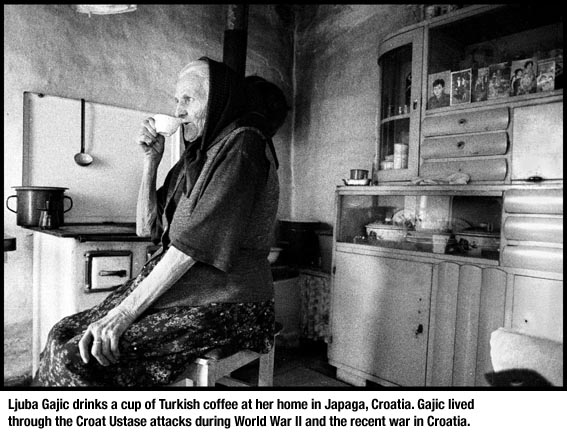
My first experiences with slivovitz/slivovica came back in the mid-90s when I took a year off from college to roam Europe, ending up for several months on a grassroots post-war reconstruction project in Pakrac, Croatia. We worked a lot on the Serbian side of town (the UN peacekeepers had left by then, so there was an understood border between the Croat and Serb sides that the internationals could cross without hassle). One morning, we walked over to Ljuba’s house to chop some wood. Ljuba was in her 70s, and lived not just through this war, but the horror of WWII. Despite her thin, frail appearance, she was still strong physically and mentally. She damned well would have chopped her own wood if we weren’t around. She greets us with shots of slivovica (which we just called “rakia”) and demitasses of Turkish coffee. Mind you, this is 9 a.m., and we’re starting the day with shots of seriously strong coffee and seriously strong spirits before we go out to wield a sharp axe for an hour or two. But this was hospitality.
I developed a fondness and palette for the drink. Every Wednesday, there would be a morning market near the town center and, among your standard provisions, there would be around six to eight vendors selling their homemade slivovitz. With free samples. Once again, bright and early in the morning. You could wander from stall to stall and get seriously blitzed by noon. But, with the sampling, you quickly learned the nuances of slivovitz and who made it well, and who just made awful rotgut. The flavors ranged from the unsweetened essence of Damson plums to odd off-flavors of soil and leaves. A trick was to dip your finger in the slivovitz, rub it on the back of your wrist, wait a moment, then take a whiff, as if you were testing a perfume. If it smelled of fruit and nothing else, it was good.
I found one vendor near the graveyard who had the reputation for having the best slivo in the area. On my way back to the UK and then the US, I picked up three two-liter Fanta bottles of the stuff for presents and personal consumption. Customs didn’t seem to care. My uncle (from Zakopane, Poland) loved the stuff so much, I gave him an entire bottle. He swore not only that it didn’t give him a hangover, but that he even felt better the next day after drinking it, as if it were some sort of elixir.
Three years later, I found myself living in Budapest. One of my fellow volunteers, a Kiwi named Jackson, came through town and stayed at my place for a month. His mother had just passed away, and he was backpacking across Europe to process his loss. In a bit of youthful spontaneity, we decided to rent a car and revisit Pakrac with a couple colleagues of mine. Part of the visit was impelled by the news of the death of Ljuba, whom we wanted to pay our last respects to at the graveyard. Part of it was for Jack. We arrive, find the graveyard and the austere plot, and say a few words. As I left the graveyard, I remembered the slivo, and I hoped I remembered the house. I approach the door, knock, and mumble the best of my half-remembered Serbian to say, “um…[mismo bili volonteri] we were volunteers here three years ago, we think we bought some rakia here, do you have any?” A blank face stared back at me, then a wave of comprehension, and a big smile. “Come in, come in! How much do you want!” We were sat, fed, and, of course, served shots of slivo. We talked about the town, how post-war life was progressing, all in my broken Serbian, and the understanding was though life was tough, things were getting better and people were tired of the tensions.
When I have a shot of slivo these days and taste the burning plum liquid slide down my throat, all of those feelings and memories fill my spirit.
He ended by sharing a link to this photo of Ljuba:
Oooh, it’s almost eleven and I have to make it to Middlebury by 1 tomorrow. And who the hell knows when I’ll grade the damn tax exams. They can wait. Thanks for stopping by!
-
The Maillard Reaction
Don’t drive if you just had a salad. What? Reports from Australia (in today’s NYT) say baby spinach has caused delirium, hallucinations, and fever in over 100 cases. The Victoria health department surmises it’s “anticholinergic syndrome,” caused by plants in the nightshade, jimson weed, and mandrake root family. These plants deprive the brain of acetylcholine which it needs to function. The loss of this stuff naturally (i.e, without eating spinach) is linked to Alzheimer’s disease, dementia, etc.
Get this though — there are two types of hallucinations: “formed” and “unformed.” One that is formed is concrete and recognizable — usually involving people, objects, and landscapes. One that is unformed involves shapes, patterns, and colors. Spinach-induced hallucinations are formed, and since they involve memory, they tend to involve people the sufferer knows or recognizes, such as deceased relatives. In more serious cases, you lose the capacity to distinguish the real from the unreal, so you can get sucked into the “story” where something bad is going on and people are trying to harm you in some way. Bottom line: If Uncle Charlie is coming at you with a knife and he’s been dead for a few years, you probably have nothing to worry about.
Pass the dressing.

An important follow-up to the BBL/barrel discussion! According to our Vermont friend Susan, the current usage of BBL is for Brazilian Butt Lifts. She adjured me to “think Kardashians.” The medical term is Gluteoplasty and a lengthy discussion can be found in Wikipedia under “Buttocks Augmentation.” The following is just the tip of the, well, let’s leave it at iceberg. [Note: I will replace buttocks with the Yiddish tuchas below because it’s a much funnier word.]
The corrective procedures for tuchas augmentation and tuchas repair include the surgical emplacement of a gluteal implant (tuchas prosthesis); liposculpture (fat transfer and liposuction); and body contouring (surgery, liposculpture, and Sculptra (Poly-L-lactic acid injections), to resolve the patient’s particular tuchas defect or deformity. Moreover, in the praxis of sexual reassignment surgery, the prosthetic and liposculpture augmentation of the tuchas can be performed on transsexual and transgender women to enhance the tuchas’s anatomic curvature in order to establish the markedly feminine tuchas and hips that project more (to the rear and to the side) than does the masculine tuchas.
A BBL in particular involves transferring fat from one part of the body, e.g., the hips, to the tuchas. It’s Brazilian because a plastic surgeon from Brazil devised it: Dr. Ivo Pitanguy. Dr. P passed away at the age of 90 in 2016 when an enormous . . . (you can finish that sentence).
Oh, alright, I’ll finish it . . . when an enormous tuchas he was working on rolled off the examining table and crushed him to death.
His grieving widow said “I always knew he’d come to an unhappy end.” She added “He was always behind in his work, and always worried about the bottom line. Still, he was a loving husband and helped me rear two children.”
Here’s a photo of Dr. Pitanguy:

And there’s another rash (Ouch!) of tuchases in today’s puzzle! Incredible! They are right up top at 8 across: “Dodos,” — ASSES. There is also an ASS from ASSN (“Org.”) crossing SEAT (from BOX SEAT).
The swastika flap from yesterday’s puzzle made quite a splash well beyond the boundaries of Crossworld. It’s been mentioned (denounced) in and by quite a few media outlets, including The Jerusalem Post and the NY Post. (Post Cereal has not taken a position.) Donald Trump Jr. lambasted The Times over it via Twitter.
The Times finally responded: “This is a common crossword design: Many open grids in crosswords have a similar spiral pattern because of the rules around rotational symmetry and black squares.”
23A was “Scorch” and I filled in SEAR first, but the answer was CHAR. And here’s what someone posted on the matter:
“Cooking snob here: searing is something you do intentionally to create a Maillard reaction on the outside of the meat because browned and crispy (seared!) food tastes good. Charring is something that happens accidentally when you leave it on the flame for too long and it is destroyed.”
“Maillard reaction?” Huh?
The Maillard reaction is a chemical reaction between amino acids and reducing sugars that gives browned food its distinctive flavor. Seared steaks, fried dumplings, cookies and other kinds of biscuits, breads, toasted marshmallows, and many other foods undergo this reaction. It is named after French chemist Louis Camille Maillard, who first described it in 1912. Many recipes call for an oven temperature high enough to ensure that a Maillard reaction occurs. At higher temperatures, caramelization (the browning of sugars, a distinct process) and subsequently pyrolysis (final breakdown leading to burning and the development of acrid flavors) become more pronounced.
So, boy scouts and girl scouts, the next time you’re searing marshmallows be sure to show off about the Maillard reaction. We were visiting Sam in Traverse City once and wanted to use the fire pit in his housing complex to roast some ‘mellows, and make smores. (Lianna was with us.) The problem was the pit was in use by 3 or 4 beer-drinking gentlemen and it didn’t look like they’d be moving on very soon.
So I approached them and asked if we could slip in briefly and roast up some marshmallows. Absolutely! They were very nice about it. So I said, “You’re welcome to have some.” And this one fellow, who had a very large belly which was flabbing out because he was shirtless, pointed to it and said: “Hey — you don’t get a body like this eating marshmallows!” Very funny!

I’ll leave you with a quote by Beverly SILLS who was sort of in the puzzle today, clued indirectly with “Prime bird-watching spots for indoor cats.” (Sills) According to commenter T Trimble, a 1971 Times Magazine article on Sills mentioned that she was a crossword fan and said: “Beverly can do a crossword puzzle in 20 minutes, in ink.”
She is known to have said: “You are never famous until you’ve had your name in a crossword puzzle.”
Thanks for stopping by! See you next time!
-
Breeches Roles
What an unusual turn of events. Back on January 3, 1993, the Houston Oilers took a 35-3 lead over Buffalo early in the third quarter. Stick a fork in them, right? What’s more, Buffalo’s starting QB (Jim Kelly) was out and backup Frank Reich was playing. But Reich led the Bills to a 38-35 win in what was then (and until yesterday) the greatest comeback in NFL history.
Fast-forward to 30 years later: the same Frank Reich began this year as the head coach of the Indianapolis Colts, but he was fired just last month. So yesterday, under new leadership, the Colts pulled out to a 33-0 lead over the Vikings early in the 3rd period. Again — the fork, right? NO! The Vikings rallied for a 39-36 win in overtime, eclipsing the record for the largest comeback by one point. Here’s Frank Reich.

That’s not all. Matt Ryan was the poor Colts QB who fell victim to the Viking comeback yesterday. He was also the losing QB for the largest Super Bowl comeback, when Tom Brady’s Pats stormed back to beat Ryan’s Atlantans in 2017. The Falcons were up 28-3 late in the 3rd quarter in Super Bowl LI, but lost 34-28. Here’s Ryan, in happier times.

So, if Reich were linked to another NFL comeback, it would be The Third Reich, right? Which brings us to a very unusual issue that arose on today’s NYT puzzle. Here’s the grid:
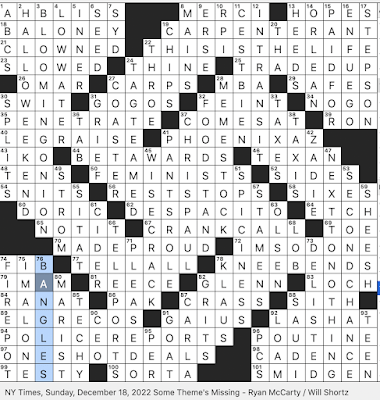
Take a close look at the grid design (squint). Here’s what commenter “egsforbreakfast” wrote. (And he’s generally a sane and interesting voice.)
“I’m a bit surprised that no one (including Will Shortz, Jeff Chen, Rex and others) has noted that squinting at this grid gives you a giant, unambiguous swastika. I’m not saying that it was intentional, but it’s just so inescapable that it’s hard to think about anything else.”
Others agreed with the observation, but “Geezer” said: “Egs — You’re funny and I like your posts but I worry about you.”
“The Joker” added: “When I squint and look at the grid I see people hallucinating.”
Anonymous said: “When I squinted at this puzzle, I saw the Shroud of Turin…”
My view? Well, it is a bit suspicious that the constructor’s name is Anoph Ditler. (No — it’s Ryan McCarty.)
I’m in the “Not a swastika” group. I agree with “Lewis” that’s it’s a “gorgeous swirling hypnotic” grid. He points out that McCarty’s puzzles are known for “stunning” grid designs. My vote is “not guilty.” But it’s right up there for you to see — you decide.
Wait, wait — hold on a sec! The clue for DORIC at 60 across is “Style of column at Berlin’s Brandenburg Gate.” And here’s from Wikipedia: “When the Nazis ascended to power, they used the gate as a party symbol.” Yikes! Now I don’t know what to think. Can’t I do a goddamn crossword puzzle without having to worry about the Nazis??!!

By the way, there was some more input on the BBL/barrel issue discussed at nauseating length in yesterday’s owl chatter. Here’s a note: “Long ago, in the early ‘40s, I asked my Vancouver longshoreman dad about this. He told me it was to differentiate between BALE (BL) and BARREL (BBL).” Sounds good to me.
Nazis aside, there were some neat items in today’s puzzle. At 67A “Joke that goes over the line?” was CRANK CALL. (Get it? — phone line.)
And “Joint accounts?” at 94A was POLICE REPORTS (joint = jail).
Nice clue at 70A for MADE PROUD: “Caused to kvell.”
And I learned that the largest U.S. state capital by population is PHOENIX, AZ. Wow.
“Volleyball star-turned-model Gabrielle” is REECE (81A). In her book My Foot Is Too Big for the Glass Slipper: A Guide to the Less Than Perfect Life, Reece writes that “to truly be feminine means being soft, receptive, and – look out, here it comes – submissive.” On The Today Show she said that women being submissive in relationships is a sign of strength – not weakness. Her second book: Another Load of Crap, is due out in the Spring.
Here she is at the gym.

At 41D, I learned that the “term for a male opera character played by a woman” is PANTS ROLE. These are more commonly called breeches roles or trousers roles. (Breeches are tight-fitting knee-length pants which were standard male garments when these roles were introduced.)
Most often the character is of a very young man whose part is to be sung by a mezzo-soprano or contralto, hence the need for a woman. The most frequently performed breeches roles are Cherubino (The Marriage of Figaro), Octavian (Der Rosenkavalier), Hansel (Hansel und Gretel) and Orpheus (Orpheus and Euridice).
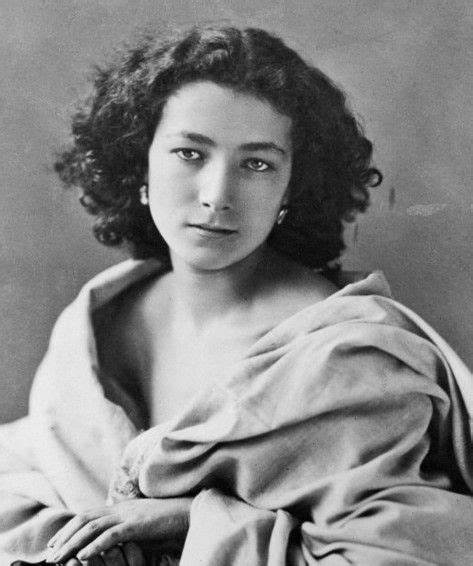
Because stage plays generally have no requirements for vocal range, they do not usually contain breeches roles. But Sarah Bernhardt (below) once played Hamlet as a breeches role.
Some critics thought these roles were just a trick to allow audiences to see women’s legs on stage. (I wouldn’t put it past us.) Here’s a verse suggesting that regarding the famous breeches actress Susanna Mountfort:
You’ll hear with patience a dull scene, to see,
In a contented lazy waggery,
The female Mountford bare above the knee.Here’s Sarah B. (Not a leg shot, though. Sorry fellas.) I couldn’t find Susanna.
Life in the age of Alzheimers. Here’s a piece from Met Diary today by Patricia Fernandes.
Dear Diary:
We were on a trip to New York and got a restaurant recommendation at the hotel where we were staying. Small, we were told, but the food is good.
When we arrived, we wiggled our way to our table. We were careful not to knock over glasses or bruise our elbows as we settled in after a day of adventures in the city.
After we finished our meal, our waitress returned to the table. “Sorry,” she said to my husband, “I don’t remember what you ordered for dessert.”
He looked at her blankly as he often does in such situations.
“I’m sorry,” he said, “I don’t remember either.”
A woman at the neighboring table piped up.
“He ordered apple pie with ice cream,” she said.
-
Roll Out The Bbl, We’ll Have A Bbl Of Fun!
There’s a less-than-great Steven Wright joke in Saturday’s puzzle: “I spilled spot remover on my dog and now he’s gone. ” (A better line of his is “I’m having amnesia and deja vu at the same time: I think I’ve forgotten this before.”)
The clue for 10D was “Crude meas.” and the answer was BBL — the abbreviation for “barrel” of crude oil. The question arose among the commentariat as to why the second “B” is part of it. This was posted on the issue first:
“In the early 1860’s, when oil production began, there was no standard container for oil, so oil and petroleum products were stored and transported in barrels of all different shapes and sizes (beer barrels, fish barrels, molasses barrels, turpentine barrels, etc.). By the early 1870’s, the 42-gallon barrel had been adopted as the standard for oil trade. This was 2 gallons per barrel more than the 40-gallon standard used by many other industries at the time. The extra 2 gallons was to allow for evaporation and leaking during transport (most barrels were made of wood). Standard Oil began manufacturing 42 gallon barrels that were blue to be used for transporting petroleum. The use of a blue barrel, abbreviated ‘bbl’” guaranteed a buyer that this was a 42-gallon barrel.”However, serious doubt was cast on this via Wikipedia, with proof:
“The ‘b’ may have been doubled originally to indicate the plural (1 bl, 2 bbl), or possibly it was doubled to eliminate any confusion with bl as a symbol for the bale. Some sources assert that ‘bbl’ originated as a symbol for “blue barrels” delivered by Standard Oil in its early days. However, while Ida Tarbell’s 1904 Standard Oil Company history acknowledged the ‘holy blue barrel’, the abbreviation ‘bbl’ had been in use well before the 1859 birth of the U.S. petroleum industry.”
And here are two cites pre-dating 1859:
Niles Weekly Register, June 15, 1816. Supplement.
Page 369.“23,650 bbls. tar”; “6,015 bbls. flour”; etc
William Cobbett, Porcupine’s Works, Vol. VIII, May 1801. Page 462
“The schooner Columbus, Mason, from St. Vincent’s, for Kennebunk, was boarded by a French privateer, which detained her six hours, and took out of her 60 gallons of rum, a bbl. of sugar, &c.”
So it’s a bit of a mystery, as far as we can tell at the moment. And, of course, who cares anyway?

The Writer’s Almanac informs us that on this date in 1989 the first episode of The Simpsons aired. Yikes! — Sam, who is a big fan, – had just turned one year old. We spent many happy family hours watching that show together.
TWA states:
It has become a point of pride to appear as a guest voice on The Simpsons. The usual pop culture suspects are well represented, but creator Matt Groening often draws from a deep pool of literary glitterati as well. Alumni include David Mamet, James Patterson, Michael Chabon, and Jonathan Franzen. Even the notoriously reclusive Thomas Pynchon has “appeared” twice, but his animated counterpart always wears a paper bag over his head.

Groening has described the Simpsons characters as “creatures of consumption and envy, laziness and opportunity, stubbornness and redemption. Just like the rest of us. Only exaggerated.”
Here’s playwright David Mamet:

There was a funny New Yorker cartoon about a month ago. It was a funeral scene. It was called “Death of a Prankster.” The widow was addressing the people in attendance with her children by her side. She was reading somberly from a card, and saying: In lieu of flowers, please send two dozen anchovy pizzas to Robert Anderson, 19 Foxview Lane . . .
We had cirrus clouds the other day, and today we had STRATI (“overcast clouds”). These are low-level clouds characterized by horizontal layering with a uniform base. More specifically, the term stratus is used to describe flat, hazy, featureless clouds at low altitudes varying in color from dark gray to nearly white.

Here’s another poem by Ted Kooser, from Winter Morning Walks.
All feathered out in clouds,
the wind’s a mockingbird this morning.
Out of its mouth
the piercing whistle of a red-tailed hawk,
the caw of a crow.
No hawk or crow to be seen
from one downy gray side of the sky
to the other.
Ted Kooser won the Pulitzer Prize for poetry in 2005 and served as the Poet Laureate Consultant in Poetry to the Library of Congress for several years. He was diagnosed with cancer in 1998 and started taking a two-mile walk from his home in Nebraska each morning during his recovery from surgery and radiation. He had to stay out of the sun due to skin sensitivity, so he took the walks before dawn.
He grew depressed during the ordeal, and stopped reading and writing. But he started pulling out of it as winter came on and he found himself trying his hand at a poem after one of his walks. He then got into the habit of writing a poem after each walk, pasting it on a postcard, and sending it to a poet-friend Jim Harrison. His book Winter Morning Walks are 100 of those poems.
Several of the poems were put to music by composer Maria Schneider and performed by Dawn Upshaw with the New Jersey Symphony. That’s how I learned about him — I was at one of the performances. Schneider and Upshaw were also recovering from cancer during the project.
I lack the capacity to appreciate any poetry more complex than “Roses are red,” but these seem simple enough even for me.
Thanks for stopping by! Happy Puzzling!
-
Subscribe
Subscribed
Have a WordPress.com account? Log in now.

