-
Milk Bust
On this date 82 years ago, Woody Guthrie wrote the lyrics to This Land is Your Land. He had grown tired of hearing Kate Smith’s God Bless America, having traveled the country and seen the struggles of the (unblessed) poor, so he wrote it as a counter song. It was sung by Bruce Springsteen, Pete Seeger, and Pete Seeger’s grandson at Obama’s 2009 inaugural celebration.
Arlo Guthrie tells a story on occasion, of his mother returning from a dance tour of China, and reporting around the Guthrie family dinner table that at one point in the tour she was serenaded by Chinese children singing the song. Arlo says Woody was incredulous: “The Chinese? Singing ‘This land is your land, this land is my land? From California to the New York island?’”
Here is one of the verses:
This land is my land; this land is your land,
From the Rupununi, to the Corentyne.
From the green heart forest, to the Atlantic waters;
This land was made for you and me.Wait, what? No, that’s the Guyanese version. It’s included in the list of national folk songs of Guyana. It’s been adopted by many countries.

Who comes after Tuesday Weld? Wednesday Addams, of course, of the Addams family, played by the eerily adorable 11-year-old Christina RICCI, who popped into the puzzle today at 55A, with her Sotomayor-red nails.

At 17, she shifted to grown-up movies including The Opposite of Sex (1998). (What’s the opposite of sex? — law school?) Ricci was born in Santa Monica in 1980, but raised in Montclair NJ where her family moved when she was young.
Her first marriage was a disaster — abuse, calls to the police, restraining orders, the whole nine yards. She has full custody of their son. She remarried in 2021 and has a daughter now too. Ricci is the national spokesperson for the Rape, Abuse & Incest National Network (RAINN). Don’t mess with Jersey girls.
Ricci starred opposite Charlize Theron who won the Best Actress Oscar for Monster. Theron acknowledged Ricci during her acceptance speech, calling her the film’s “unsung hero.” Roger Ebert said, “Ricci finds the correct note for Selby [her character], — so correct that some critics have mistaken it for bad acting, when in fact it is sublime acting in its portrayal of a bad actor. She plays Selby as clueless, dim, in over her head, picking up cues from moment to moment, cobbling her behavior out of notions borrowed from bad movies, old songs, and barroom romances.” A. O. Scott of The Times described Ricci playing her role in Woody Allen’s Anything Else with “feral, neurotic glee.”
The Owl Chatter photographers caught her relaxing at home. Sorry RC! Probably should have knocked.

At 52A, “Colorful garment” was DASHIKI. The original dashiki is a brightly colored pullover shirt of African origin. Here’s a stylish, modern, full-dress version. How do you walk in it?

Today’s puzzle had a dark lining to it, like a Christina Ricci character. SATAN himself appeared at 58A, clued pretty mildly as “Dark force.” And terrorism! — 42D “Navy vessel in 2000 headlines,” was the USS COLE. Do we really need all that unpleasantness in our puzzle, constructor Joe Deeney?
On the other hand, there was yet another ANA de Armas sighting (at 51A), said Tom droolingly. Did her parents know what they were getting her into, naming her ANA?

In his nice article about Dianne Feinstein in his newsletter today, Frank Bruni, noting her passionate fighting for gun control, observed: “In 1978, she saw, up close, what firearms can do, kneeling beside the gay rights pioneer Harvey Milk to check for a pulse after he was fatally shot and feeling her finger slip into a bullet hole.”
At the unveiling of a bust honoring Milk in 2008, Feinstein said hearing the shots and finding Milk dead were the hardest moments of her life. She couldn’t talk about it for years. She said Milk was a real character: very funny, very intense, very loud. He was shot by Dan White, a friend of his, who felt betrayed when he wasn’t allowed to reclaim his position after resigning. Milk’s being gay had nothing to do with the killing.

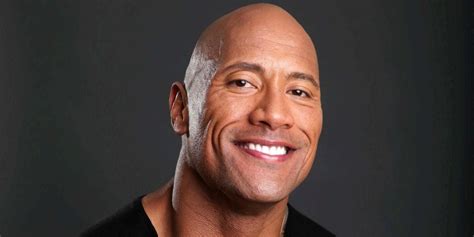
DWAYNE (The Rock) Johnson went a few rounds in the puzzle today too. Before making movies he was considered one of the all-time great pro wrestlers. His grandfather (via adoption) was a Samoan-American wrestler, and his dad was a pro wrestler too — as is his daughter, Simone! His ambition was to play pro football, and he went to U. of Miami with that in mind, but he couldn’t make the first team and went undrafted upon graduating. He tried Canadian ball for a while and then turned to wrestling.
His first marriage lasted about ten years, produced Simone, and ended amicably. He seems like a mensch. He remarried and had two more daughters with his second wife. He voted for Obama twice, sat out 2016, and endorsed Biden in 2020. He’s considering entering politics himself. He’s only 50 and knows how to smile.
Thanks for wasting some time on our chatter. See you tomorrow!
-
Bronx Girls
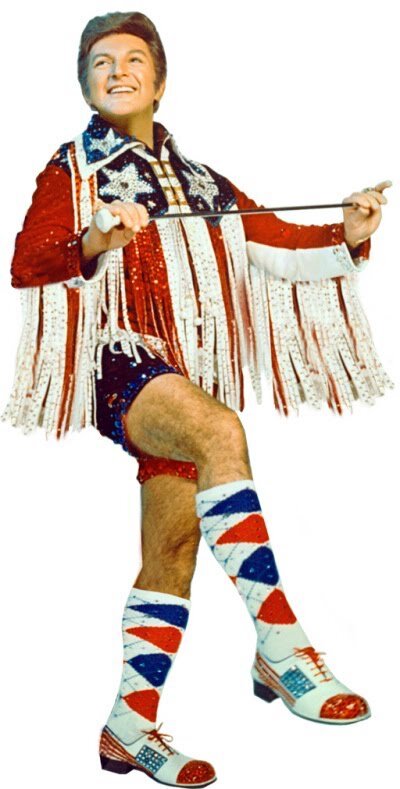
After closing down Owl Chatter yesterday, I was noodling around a bit more on Liberace and came up with this wonderful July 4th shot of him. How could anyone not love the guy? The hairy legs. The baton. God bless America.
Welcome to the Owl Chatter Hall of Fame, sir. No question. Unanimous. First ballot.
Way fewer names in the puzzle today, but what a delight to see Amy Adams. Amy was born in Vicenza, Italy on August 20, 1974, which makes her 48. She is married to actor and painter Darren Le Gallo, and they have a 12-year-old daughter Aviana. She was born in Italy because her dad was stationed there in the military, but from age 8 and on she grew up with 6 siblings in Colorado (amid the orange groves). She was raised a Mormon until her parents divorced when she was 11, but is not religious. She did not go to college, and worked for a time as a greeter in a Gap store and as a waitress at Hooters.
Adams finds little value in being a celebrity and maintains that the “more that people know about me, the less they’ll believe me and my characters.” Carl Swanson of Vulture found her “suspiciously unnarcissistic for a Hollywood star, gracious, hardworking, and decent to the point of almost not being a celebrity.” Anthony Lane in The New Yorker wrote: “The spry benevolence that carried her through a film like Enchanted (2007) has been cross-grained, in recent years, by the stern resolve of The Master (2012) and the snap of American Hustle (2013), and now, in Arrival, her gift for sorrow, her strength, and her instinctive sweetness of temper are rolled into one.”
Adams has received 5 Oscar nominations for Best Supporting Actress and one for Best Actress (for American Hustle (2013)). She is beautiful in a way that doesn’t hit you over the head.

Amy Adams (Photo by Robin Holland/Corbis via Getty Images)
Here’s the clue for 24A: “‘Next time someone tells Bronx girls to take off their ___, they can just say they’re dressing like a Congresswoman:’ A.O.C.”
The answer is HOOPS (as in earrings), and there’s a bit of a story behind it. It was a nod to Justice Sotomayor who refused to tone down her red nails for her confirmation hearings, as she had been advised to.
AOC tweeted: “Lip+hoops [at AOC’s swearing in] were inspired by Sonia Sotomayor, who was advised to wear neutral-colored nail polish to her confirmation hearings to avoid scrutiny. She kept her red,” Ocasio-Cortez tweeted about the Supreme Court Justice, who is also of Puerto Rican descent, referring to her choice to express herself the way she saw fit and not capitulate to outdated perceptions and arbitrary standards. “Next time someone tells Bronx girls to take off their hoops, they can just say they’re dressing like a Congresswoman.”
Don’t you love thinking of the Justice and the Congresswoman as “Bronx girls?”
AOC has been vilified on the right and lauded on the left, but Owl Chatter may be the first to note how pretty she is. We are so shallow.

Looks like the puzzle turned from tuchases to boobs for a change, with 10D’s “Liquid that may be pumped,” being BREAST MILK. Cutely, it wasn’t too far from KID’S MENU at 34D.
On the topic, Camilita noted:
“One branch of mammals doesn’t suckle: the egg-laying monotremes, which include today’s platypus and echidna, or spiny anteater. These animals lack nipples. Their babies instead lap or slurp milk from patches on their mother’s skin. I guess they drink …..drum roll please….Skin Milk!!!”
A group of platypuses is called a “paddle” of platypuses, and that’s the plural, not platypi. Here are some cute young ‘uns.

And here’s a poem by Kooser, from his collection Delights and Shadows. Softy that I am, it is sending me off to my tax class near tears.
At the Cancer Clinic
She is being helped toward the open door
that leads to the examining rooms
by two young women I take to be her sisters.
Each bends to the weight of an arm
and steps with the straight, tough bearing
of courage. At what must seem to be
a great distance, a nurse holds the door,
smiling and calling encouragement.
How patient she is in the crisp white sails
of her clothes. The sick woman
peers from under her funny knit cap
to watch each foot swing scuffing forward
and take its turn under her weight.
There is no restlessness or impatience
or anger anywhere in sight. Grace
fills the clean mold of this moment
and all the shuffling magazines grow still.
-
Penn’s Aunts
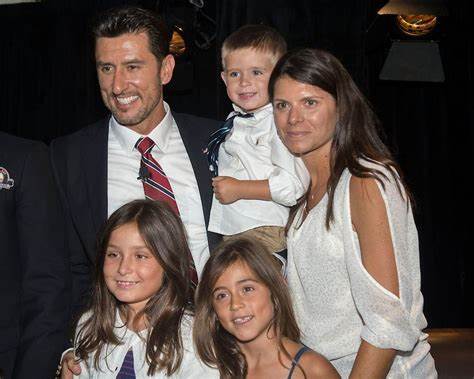
I had forgotten (if I ever knew) that Mia Hamm was married to ex-Boston shortstop Nomar Garciaparra. They have twin girls who will be 16 next month, Grace Isabella and Ava Caroline, and a son, Garrett Anthony, who just turned 11. Mia is 50 now and was born in Selma, Alabama. Nice to see her in the puzzle today. The clue was: “Sports star inducted into the National Women’s Hall of Fame in 2021.”
Hamm is regarded as one of the greatest woman soccer players of all time, and has been called the most marketable female athlete of her generation. She signed endorsement deals with Gatorade, Nike, Dreyer’s Ice Cream, Pepsi, Nabisco, Fleet Bank, Earthgrains, and Powerbar. She starred in a commercial for Pert Plus, was featured on a Wheaties box, and endorsed the first Soccer Barbie by Mattel. She retired at age 32 in 2004, having scored a record 158 international goals. Her #9 jersey was “inherited” by midfielder Heather O’Reilly.
Hamm was mentioned in an episode of Friends. When Rachel had Joey put his hand on her belly, she says, “Aw, it’s unbelievable! Wow! She is kicking so much! Oh, she’s like, um, who’s that kind of annoying girl soccer player?” Joey asks, “Mia Hamm?” Rachel says, “Mia Hamm!”
Here she is, en famille.
It felt like women athletes’ day in the puzzle, because Mia was accompanied by soccer great Abby Wambach, and figure skater Irina Slutskaya.
Abby was named female U.S. Soccer Athlete of the Year six times and is in the National Soccer Hall of Fame. She’s the highest all-time goal scorer for the U.S. team. She was born on June 2, 1980 in Rochester, NY, the youngest of seven. She credits her siblings with “toughening her up.” She played college ball for the Florida Gators. She is gay and was married to soccer player Sarah Huffman from 2013 to 2016, and is married to writer Glennon Doyle now. In 2016, Mattel unveiled a Barbie doll in her likeness, but it was part of a series that was not intended to be marketed to the public. Abby posed nude for The Body Issue of ESPN The Magazine. She wanted to send the message that no matter what shape you are, you’re beautiful. That Barbie doll looks a little creepy to me.

Irina Slutskaya, world-champion figure skater, was born on February 9,1979 in Moscow. Her dad was Jewish, but she was raised in the Russian Orthodox Church. She has three children, two from her first marriage and the third from her current marriage. She was a brilliant and groundbreaking (icebreaking?) skater. She invented the double Biellmann spin with foot change, was the first woman to land a triple lutz-triple loop combination in competition, and the first woman to land a triple salchow-triple loop-double toe loop combination. It’s hard to even type those.
Here she is, blowing Owl-Chatter readers a kiss. Love you too, Irina!

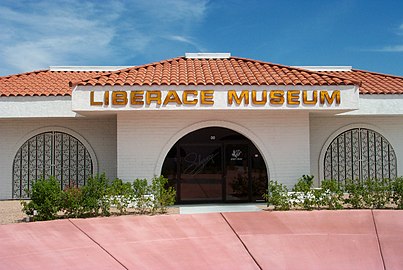
Owl Chatter readers who were planning to visit the Liberace Museum in Las Vegas are about 12 years too late: It closed in 2010 after a 31-year run. But in the “Liberace Garage” you can still see all 8 vehicles from the Liberace Museum, housed in the Hollywood Cars Museum. Also in the “garage” are the rhinestone-encrusted Radio City Baldwin piano, and stage costumes worn by Liberace.
Wladzio Valentino Liberace was born in Wisconsin on May 16, 1919, and died in 1987 at age 67 in Palm Springs. Sadly, he had an identical twin who died at birth. I remember his flamboyant piano-playing with the outrageous outfits, wild pianos, and his signature candelabra. [Note how the e in “candle” shifts to go in front of the l for “candelabra” — an example of a vowel movement.] At the height of his fame (from the 50s to the 70s) he was the highest paid entertainer in the world. He was in the puzzle today, clued with “Subject of HBO’s 2013 biopic ‘Behind the Candelabra.’”
Music critics were harsh in their assessment of his piano playing. Lewis Funke wrote, Liberace’s music “must be served with all the available tricks, as loud as possible, as soft as possible, and as sentimental as possible. It’s almost all showmanship topped by whipped cream and cherries.” Liberace himself said, “I don’t give concerts, I put on a show.” His favorite response to the critics was to note that he cried all the way to the bank. My mom got a kick out of him.
His TV show drew 30 million viewers, and he received 10,000 fan letters a week. It was broadcast in England and he became young Elton John’s hero. He denied being gay his whole life and even sued (and won) several defamation cases against publications stating he was gay. But there is no question that he was gay (not that there’s anything wrong with that, of course). In a 2011 interview, actress and close friend Betty White confirmed that he was gay and that she was often used as a “beard” by his managers to counter rumors of his homosexuality.
As flamboyant as Liberace was on stage, a lover of his stated that he was boring in his private life, mostly preferred to spend his free time cooking, decorating, and playing with his dogs, and that he never played the piano outside of his public performances.

A little known historical fact: William Penn’s mother had two sisters who ran a pie shop. Their pies were delicious and they charged very little for them. You could safely say “the pie rates of Penn’s aunts” were the talk of the colony. [That dreadful comment comes to us from egsforbreakfast on the occasion of 8D being PENZANCE, as in “The Pirates of.”]
And 13D was Double ENTENDRE, which led Lewis to share these actual headlines:
Kids Make Nutritious Snacks
Milk Drinkers Are Turning To Powder
Grandmother Of Eight Makes Hole In One
It’s only getting worse. Better stop now. See you tomorrow!
-
The Inverted Jenny and the Penny Black
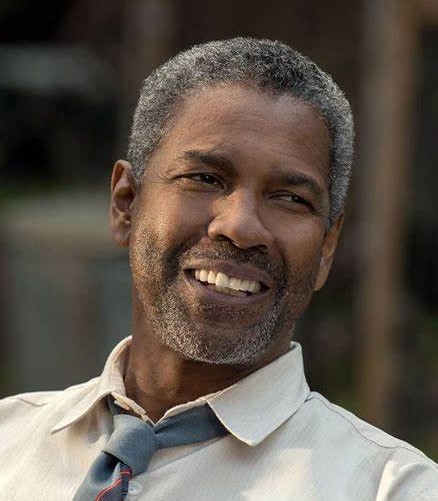
Denzel! What a surprise — welcome to Owl Chatter — we are big fans (who isn’t?)! Didn’t think we’d see you in the puzzle, with that Z and all. And clued so simply – “Oscar winning Washington.” What did they expect us to put down: George? Loved you in Philadelphia — “Innocuous.” Ha!
So, let’s see — you’re 68 now — ouch! Born in Mt. Vernon, NY, married to actress Pauletta Pearson for 40 years this June — yikes! Renewed your vows in 1995 in South Africa, with Desmond Tutu officiating. Classy.
Four kids, including pro footballer and actor John David, Yale grad Katia, and the twins Olivia and Malcolm. Malcolm a U. Penn grad — the Red and Blue! Excellent!
Presidential Medal of Freedom last July — that must’ve been a kick. Listen, settle in — get comfortable. Can we get you a beer? You’re always welcome here at Owl Chatter.
Well, we made it back from DC. It was a very nice visit. Tipped off by Bob to a baseball-themed exhibit at the National Postal Museum, we checked it out and it was pretty neat. Lots of non-baseball stuff too — the place is enormous. Did you know they only started using stamps in 1847? And they only became mandatory in 1855. Before that a fee was collected from the person to whom an item was delivered. And there was no glue to lick on the back — you had to use a little gum to affix it to the envelope. Here’s the first stamp ever (it’s from 1840 in England). The Penny Black.

Do you guys know about the “inverted Jenny?” It may be the most famous error stamp. It was issued in May, 1918 to celebrate the start of air mail, but the plane was printed upside down on the stamp. It was a Curtiss JN-4, known as the “Jenny,” so the error was called the “inverted Jenny.”
William T. Robey, a collector, went to his local Post Office early to buy a sheet, hoping for an error, since the earlier printings were most likely to have flaws. He got lucky when he noticed the error, but when he tried to buy more, he was turned down and the Post Office immediately stopped all sales. Robey’s sheet was the only one that reached the public. The Post Office sent inspectors out to try to convince him to give it back but he refused. He came under intense pressure, but held fast, eventually selling the sheet to a dealer for $15,000, which was a whopping sum back then. It enabled him to buy a house for his family in an upscale neighborhood and, years later, he still had enough left to pay for his daughter’s wedding. Needless to say, the value has skyrocketed since then. A single stamp goes for roughly $1.5 million at auction these days. There were 100 on the sheet. The whereabouts of four of them are currently unknown. Hey, Denzel — you got one?

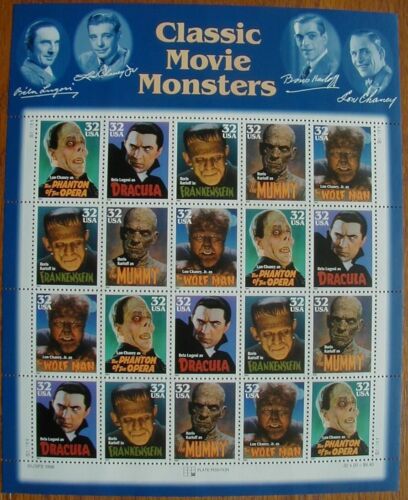
Denzel wasn’t the only actor in the puzzle today — Lon Cheney of the old horror films came by as well. He was a master of disguise as evidenced in The Hunchback of Notre Dame and The Phantom of the Opera. The studios didn’t know from makeup back then. He did all of his own makeup. His son was a horror movie actor too, Lon Cheney, Jr. He was the Wolfman. They were both honored with postage stamps, in a set with Bela Lugosi and Boris Karloff.
Gotta get some sleep. See you tomorrow.
-
Globophobia
Well, I was about to offer special Owl Chatter greetings from Maryland, the something state, and realized, to my shame, that I didn’t know the state nickname for Maryland. You know, like Florida is the Sunshine State and New York is the Empire State. So it turns out Maryland has much to be proud of, nickname-wise. Its primary nickname is the Old Line State and it was bestowed by George Washington, in lauding the state’s regular line troops for serving so courageously in the Revolutionary War. Bravo, Marylanders! And its secondary nickname is the Free State, relating to its abolishing slavery in its state constitution on Nov. 1, 1864, in celebration of which, under the direction of the Baltimore City Council, 500 guns were fired, bells were rung, and flags displayed.
Unrelatedly, here’s the view from my Best Western window.

Today’s puzzle was easy, after yesterday’s debacle. Actress Sela Ward was in it, not to be confused with Salma Hayek, as I usually do. Sela was an Alabama cheerleader a while back, and, of course, still roots for the Tide. She’s in the middle, below.
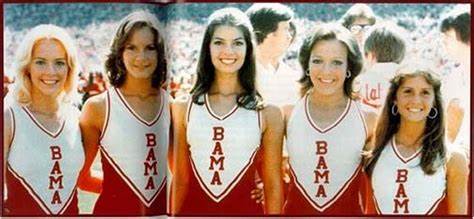
After hours of painstaking research on your behalf, Owl Chatter concludes that the Bama uniform has evolved over the years. This group was kind enough to pose for the Owl Chatter photographers. Hi Ladies!

117A was “Wear white to a chili cookoff, you might say,” and the answer was TEMPT FATE. It led Barbara S. to note: “The constructor must know me. Not that I’d ever be foolish enough to do such a thing, but I’m the champion spiller of staining foods on my clothing. I could rival any kid in a highchair. I remember the time in a restaurant that my cousin, who was sitting beside me, spilled red wine all over my white sweater. She felt awful but I just wanted to hug her because, for once, I hadn’t done it.”
It led me to post: On spilling wine, I forget which Rabbi said this, but the lesson was if you are the host of a Passover Seder and one of your guests accidentally spills red wine on your white tablecloth, you should “accidentally” do the same so that he or she doesn’t feel too bad. (Probably also best to avoid screaming “WHAT THE F**K, MURRAY?” if possible.)
Getting back to “tempting fate,” however, commenter Pete made my brain hurt a little with this point: “FATE, should it exist, exists on its own. You can’t tempt it. If something is alterable by someone’s actions, it isn’t inexorable, as is FATE.”
On the issue that arose yesterday: trans rights, triggered by a Harry Potter clue in the puzzle (JK Rowling has raised the ire of the trans community), Rex expounded today on why he always calls her out when that happens. Here’s what he wrote.
“A NYT article from yesterday that provides some context for my (recent, ongoing) intolerance of all anti-trans rhetoric; it details the politically popular and morally abhorrent legislative war on trans kids and their parents, a war which seeks to deny trans kids the gender-affirming care that keeps them healthy and in many cases saves their lives. Importantly, maddeningly, the medical care in question is unequivocally called for by medical science and supported by major medical associations (“When Parents Hear That Their Child ‘Is Not Normal and Should Not Exist’”). This is care that keeps trans kids from depression and suicide. The consequences of dehumanizing trans people are real, material, measurable, and widespread. Seems like people ought to be speaking out a hell of a lot more about this rather than (say) fear-mongering and lying about the alleged threat that trans women pose to “real” women. Lastly, there’s this article from The Onion, which gets to the heart of the matter better than I ever could (“It Is Journalism’s Sacred Duty To Endanger The Lives Of As Many Trans People As Possible”).”
***********
Here’s a picture of Debi Jackson, a self-described “army brat” who came to Kansas City, Mo., from Alabama — a faithful Southern Baptist, Rush Limbaugh devotee, straight-ticket Republican voter. She became a crusader for trans rights on behalf of her child. She’s fighting against anti-trans legislation in Missouri that would ban the medical treatment that saved her child.

“I’ve been ready for four years to walk up to those legislators with my hands out and say, ‘Just put the handcuffs on me now and throw me in jail,’” she said. “Because I will do anything I have to do to take care of my child.”
I read both articles Rex referenced and found them to be helpful on the topic.
I’m glad Rex, the commentariat, and my puzzling reached me under my rock to raise my awareness of the issue.
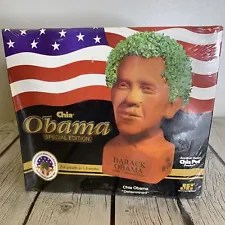
19A: “Presidential ‘pet’ that sprouts an Afro,” was CHIA OBAMA. It is a chia pet with an Obama base and you spread the little seeds on his head and a green Afro grows. The owner of the chia pet company, Joseph Pedott, is a Republican, but he came up with the idea sincerely to support Obama whom he felt entered office with an unusually full and difficult plate. But the minute it hit the stores it was viewed as racist and pulled from the shelves. Jesse Jackson approved of it, and Obama got a kick out of it when given one himself. “I’ve got green hair,” he laughed.
You can get one on eBay for about $25.
39D ruffled a lot of feathers. The clue was “Evidence derived from personal experience and observation rather than systematic research and analysis.” The answer was ANECDATA, like, from anecdotal. Some felt it was giving unscientific anecdotal evidence a scientific sheen. I think it’s just short for anecdotal evidence and have no trouble with it. But, as the commentariat likes to say — “Your mileage may vary.”
Second Sunday in a row with a whole bunch of tuchases in the grid, from the overt ASSES at 17D (clued as “Tushies”), to HIND at 38D (“Posterior”), and BUMS at 106D (clued, again, as “Tushies”). Plus a pair of hidden tuchases in GREEN AS GRASS and SMOOTH AS SILK.
Picked Nits: 34D “Big Ben hrs.” ANS: GMT
Comment: Big Ben does not reflect GMT (Greenwich Mean Time) per se. It reflects the city of London’s time. London recognizes daylight savings, therefore Big Ben’s clock changes when this occurs….thus differing from GMT by an hour. While it is true that during ‘standard’ time Ben equals GMT, it does not equal it in total.
Thank you. Noted.
Are you a fan of Kristen WIIG from SNL? Her breakthrough movie was “Bridesmaids,” though she was clued today as “Kristen of ‘Barb and Star Go to Vista Del Mar.’” If you’re wigging out over that seemingly extra “i” in her name, it’s because she’s of Norwegian descent and “Wiig” comes from the area of Vik in Sogn og Fjordane in Norway. Get this, her grandfather emigrated to the U.S. as a child, grew up in Rochester NY, and was a broadcaster for the Rochester Red Wings minor league baseball team. She’s married and has three-year-old twins, one of each flavor.
Here’s a nice shot of her.

One thing I enjoy in a puzzle is finding a fresh way to clue a simple “filler” word that’s appeared a zillion times. So I liked the clue for SAT today: “Succeeded at musical chairs.” I always sort of liked musical chairs. LMS, not so much. Here’s her take:
Ok. So about those musical chairs. I’m a lifelong sufferer of globophobia – a fear of balloons. But over the years I’ve come to realize that it’s a broader fear, the fear of being startled. The extreme anxiety when I know something is about to happen, I just don’t know when. The anticipation of that music stopping during musical chairs is as scary as waiting for a balloon to pop. I. DETEST. Musical. Chairs.
OK, Teach — sorry it came up.
Thanks for stopping by. See you tomorrow.
-
Maria
Owl Chatter is broadcasting from our nation’s capital tonight. Well, at least not too far into its outskirts in a Best Western in Maryland. Just a little getaway for the long weekend.
Special thanks to friend Bob for the head’s up on a terrific art exhibit in the Smithsonian:
“We Are Made of Stories: Self-Taught Artists in the Robson Family Collection”
https://americanart.si.edu/exhibition/we-are-made-stories-robson
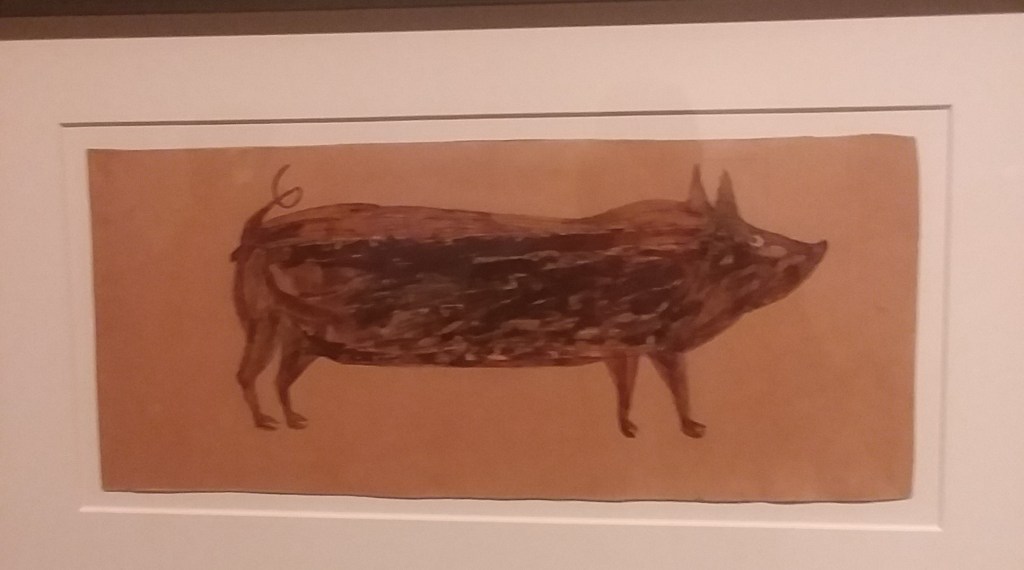
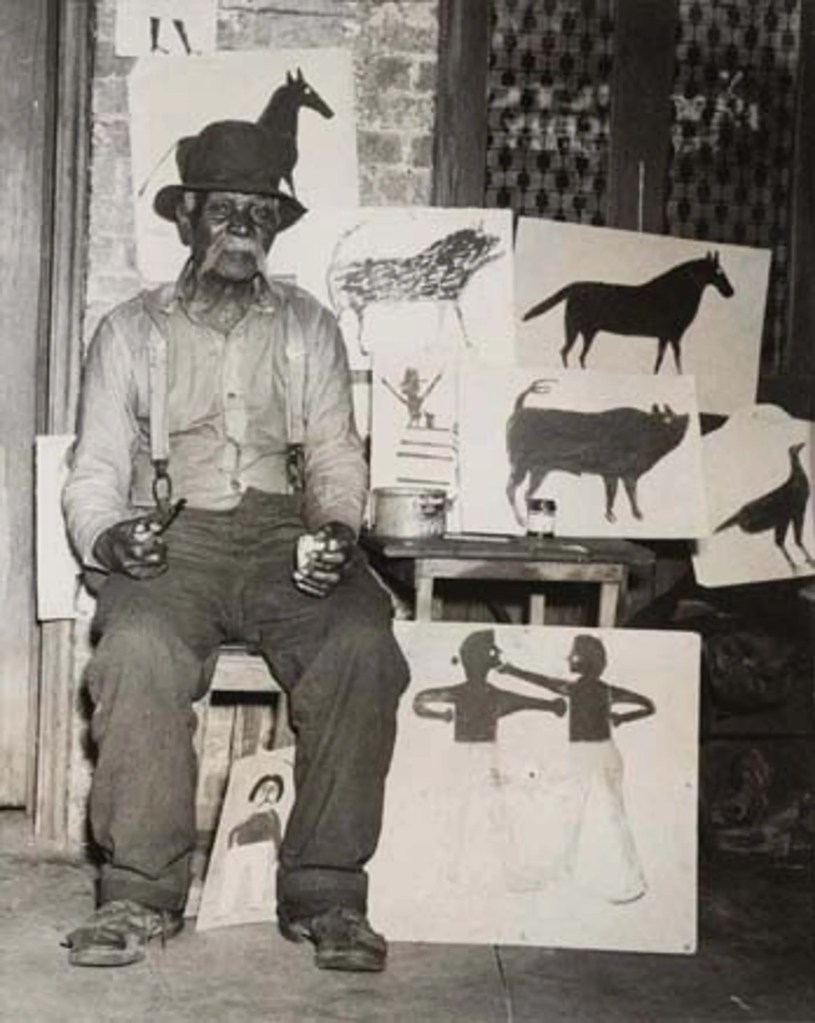
Here is one of the featured artists: Bill Traylor was born into slavery in 1853 and worked as a sharecropper after emancipation. He only began drawing when he was 85, to document his memories. He produced close to 1,500 pieces of art, including this neat pig I photographed. He died in 1949 at the age of 96.
Watching a tight Michigan vs. Michigan State basketball game now. The game’s in Annie Arbor and the Michigan band, as a goodwill gesture in the wake of the Michigan State shootings this week, played the Michigan State fight song before the game. The ‘Rines held on for an 84-72 win. Go Blue!
I couldn’t finish the damn puzzle today! The Northeast corner did me in. I’ll spare you the details (too painful), except somehow the answer for “Mares, e.g.,” was SEAS. That’s a WOE in my book: What on earth? It turns out “mare” is the term for a lunar sea, i.e., a large dark plain on the moon. Galileo thought they were seas when he first saw them through a telescope. The plural is usually “Maria,” however, not mares. Oh, well. All’s fair on Saturday.
In this photo of the moon, the dark regions are the maria.

Remember the early James Bond films? Loved ’em! Sean Connery starred in six of them, and Goldfinger was the third (1964). Remember the hot blonde he seduced into betraying Goldfinger? He took his revenge by painting her entire body in gold so she died of “skin suffocation.” That’s how Bond explained her death in the film, but in reality, skin doesn’t breathe. The filmmakers didn’t take a chance, though, and left a small patch on the lovely lady unpainted. But painting someone completely can prevent sweating and cooling, and thus bring on heatstroke and death. Or the toxic chemicals in the gold or paint might prove fatal.
Anyway, back to that blonde, the actress was Shirley EATON, who dropped in on the puzzle today at 45D as “Shirley of ‘Goldfinger.’” This might jar your memory.
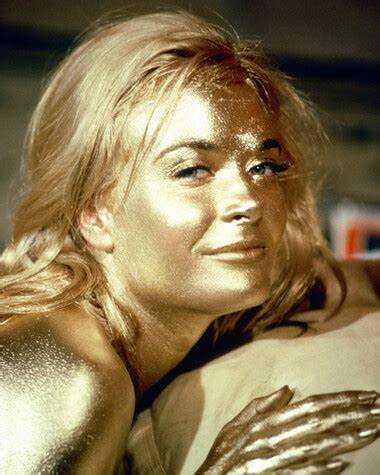
She is still living and is 86. She retired from acting way back in 1969 because she wanted to devote herself to her two children.
See you tomorrow!
-
Latkes!
This note on blackbirds comes from Frank Bruni’s “For the Love of Sentences:”
In the BBC Countryfile Magazine, Nicola Chester examined an industrious specimen of nature: “Blackbirds are ostensibly a woodland bird, and can be heard loudly and furiously flinging leaves about to find insects, eggs and grubs beneath hedges and shrubs, like a teenager who has lost something on the bedroom ‘floor-drobe.’”
And this one:
In The Times, Annie Karni followed up on the visibly tense exchange between Senator Mitt Romney and Representative George Santos: “After the speech, Mr. Romney, a devout member of the Church of Jesus Christ of Latter-day Saints, told reporters that Mr. Santos is ‘a sick puppy, he shouldn’t have been there,’ in what could be construed as the Mormon equivalent of an eviscerating, curse-filled diatribe.”
Baseball’s Tim McCarver died yesterday in Memphis at age 81, after a lifetime in the sport, first as an All-Star catcher, mostly for the Cards and Phils, and then as a groundbreaking Hall of Fame announcer. He was the favorite catcher of Hall of Famers Bob Gibson and Steve Carlton. He once quipped that when he and Carlton died they’d be buried 60 feet 6 inches apart from each other. (Carlton is still living.)
McCarver was born on October 16, 1941 in Memphis. He married his high school sweetheart, Anne, on December 29, 1964. They had two daughters, Kelly and Kathy, and two grandchildren, and stayed married until death did them part.
McCarver won the World Series twice with St. Louis (’64 and ’67), and came in second in the MVP voting in 1967 to teammate Orlando Cepeda. His 10th-inning game-winning HR against the Yankees in Game 5 of the 1964 World Series was pivotal. On July 4, 1976, McCarver hit what is known as a “Grand Slam Single” when, after hitting a grand slam, he passed his teammate Garry Maddox on the base path (a no-no). McCarver later claimed to have said to the umpire, “I didn’t pass him, he lapped me.” Asked how Maddox could have done that, McCarver replied, “Sheer speed.”
He revolutionized announcing by analyzing the “why” of plays rather then just the “what.” In that fashion he brought a lot of “inside baseball” out to fans. He was criticized in Sports Illustrated (unfairly, IMO), by being described as someone who “when you ask him the time, will tell you how a watch works.” But even my Zoey can tell you the time. What’s special about that?
Here’s a famous example. With one out in the bottom of the ninth of the seventh game of the 2001 World Series, the Arizona Diamondbacks had the bases loaded with the score tied against the Yankees’ Mariano Rivera. McCarver noted that Rivera pitched inside to left-handed hitters, often giving up broken bat hits to shallow outfield, and that it was dangerous to bring the infield in in such circumstances, as the Yankees had. On the very next pitch, the Diamondbacks’ Luis Gonzalez hit a blooper just a few feet into the outfield grass behind the drawn-in infielders, winning the Series for ‘Zona. [Wow.]
I was watching a game he was announcing once and the pitcher threw over to first four or five times to keep the speedy runner close. “Speed slows down the game,” McCarver noted, channeling Yogi.
He was very close with the daunting Bob Gibson. In all the years he caught Gibson, McCarver always acceded to Gibson on what to pitch (fastball, curve, etc.). He said he was afraid to ever disagree with him. He went out to the mound once to talk with him, and Gibson just said “Get back behind the plate where you belong — the only thing you know about pitching is that you can’t hit it.”
McCarver was from Memphis and occasionally would come out with some verbiage from his past that was racist. Gibson would explain to McCarver why that was hurtful and worked with him to get him “cleaned up,” so to speak. When Martin Luther King, Jr., was killed (in Memphis, of all places), Gibson was devastated. He told McCarver to leave him alone — that as a white man McCarver could never comprehend Gibson’s feelings. But McCarver wouldn’t let go — he said he was going to stick with it until Gibson made him understand what it meant to him. (Gibson died just shy of his 85th birthday in 2020.)


Thanks for all of your honest and good work. Rest in peace McCarver.
POSTAL codes popped up today, which led Joaquin to post this funny bit:
Are you guys following the JK Rowling controversy? I’m not, except as it pops up on Rex’s blog. She’s accused of being anti-trans and is receiving a lot of grief over it. There was a huge op-ed in the NYT today that comes to her defense. For some history, I read this timeline by Yahoo on how things got this far: https://news.yahoo.com/j-k-rowlings-transphobia-controversy-102506549.html?fr=sycsrp_catchall.
Rex was not at all convinced by the defense, to say the least, and continues to complain when a Harry Potter clue sullies the puzzle. Some commenters came to JK’s defense, e.g., this post:
“Oh Rex, we know that in your heart you mean well. Have you ever contemplated that issues, like human sexuality, may not be BINARY – that perhaps not every issue is black and white, has a right or wrong – but there is an entire rainbow of hues and colors in between. Consider for example, that one may be a member of the LBGTQ++ community and still believe that individuals born with male genitals may have an unfair advantage competing against others not similarly characterized in certain sports ? Oh, Rex, you preach tolerance of the gender fluid, yet you have such little tolerance for those with opinions contrary to your own. In any event, the hatred and venom don’t become you very well.”
[Ouch!]
Later, this appeared:

“‘I’m not racist, but I think there should be arenas where Whites should not have to be exposed to or compete with Blacks. I mean seriously, why should white people have to compete in sports with Blacks? Use the same bathroom as blacks.’ That sounds racist, because it is. Change Black/White to Trans/Cis, and it’s transphobic, and that’s what JKR has said. JKR is factually transphobic, and she goes out of her way to announce that.
“My niece is trans. She was bullied mercilessly as a youth for being exceptionally effeminate, then bullied mercilessly as a young adult for being trans. She is nothing but a lovely young lady who now suffers from PTSD from all of the past abuse. Every time some bigot goes on some pointless rant about random instances where maybe, some time, some where, a cis-gendered person might be inconvenienced by a transgender person, proposed new laws putting her back in some closet, she gets triggered again, in that the rich and powerful really are out to get her.
“It’s easy to not present yourself as obviously bigoted – Just don’t say things like ‘it’s just that there are places/times/situations where [people in category x] don’t belong.’ If you can’t stop yourself from saying such things, or spending hours dreaming up places/times/situations which you think confirm your claim, that’s your problem. Just don’t say so out loud, or if you do, don’t whine when people call you bigoted. Ok JKR?”Owl Chatter says: Why can’t we all just get along and go back to hating the Jews?
Here’s Tom Lehrer on it (he’s still alive, at 94):
Since you are all so well-educated (and all know what a logarithm is), you have heard of, and probably heard, Chopin’s MINUTE WALTZ, which was in the puzzle today at 31A. But did you know what inspired it? According to constructor Jem Burch, it was inspired by Chopin observing a dog chasing its tail. (Woof!)
In connection with the Rowling business, someone noted that Chopin had been involved in some controversy in his time as well. But I couldn’t discover what it was after a short search, and someone else posted this:
“So I was wondering in what way Frederic Chopin was flawed so I googled ‘Frederic Chopin cancelled.’ Turns out it’s the name of the international airport in Warsaw and there have been quite a few flight cancellations lately.”
Here are some neat clue/answers in the puzzle today:
57A: “Lowlife” — SLEAZEBALL
17A: “Place subject to food stains” — SHIRTFRONT.
Here’s what Rex said about that: Not sure why that last one makes me happy. There’s something apt and almost quaint about it. I just like the idea that at some point, someone was like “ugh, saying ‘front of my shirt’ is too long, too taxing, I need something shorter … [snap] … I’ve got it! We’ll move the FRONT to the back and make it one word! SHIRTFRONT!
6D: “Ennui + wealth =?” ANS: AFFLUENZA
38A: “Whom the Irish may call a gossoon” — LAD
How about 54A? — “Real-life sucker.” It’s a VAMPIRE BAT.
They are creepy little buggers. True to their name, they hunt only when it’s fully dark and they live off the blood of mammals, including humans, when one is on the menu.

Yuck, can we please go back to looking for photos of Ana de Armas?
Here — this’ll get the bad taste out of your mouth —
42A: “Some Hanukkah servings,” — LATKES!
Here are some nice-looking ones with apple sauce. BYOSC (bring your own sour cream)

See you tomorrow!
-
Pleistocene Era Cave Woman Dies
Although she was born Jo Raquel Tejada in Chicago, Raquel Welch was about as far from your average Jo as you can get. She died a peaceful death in LA yesterday at age 82. Raquel’s nickname in high school was Rocky. Her dad was Bolivian and an aeronautical engineer. Her parents met when they were students at the U. of Illinois. Her cousin was the first female President of Bolivia.
This write up in Wikipedia seems on target to me: “Welch helped transform America’s feminine ideal into its current state. Her beautiful looks and eroticism made her the definitive 1960s and 1970s sex icon, replacing the blonde bombshell of the late 1950s as typified by Marilyn Monroe and Jayne Mansfield. Welch became a star in the mid-1960s and was exotic, brunette, and smolderingly sexual.”
You’ve all seen the poster of her as the cave woman in the movie “One Million Years B.C.,” so you don’t need Owl Chatter to reproduce it. But look how young, beautiful, and sexy she is here. Could you plotz?

Describing her cave woman poster, the obit in The Times said she “grabbed the spotlight by the throat with her defiant, alert-to-everything, take-no-prisoners stance and her dancer’s body. She was 26.”
She posed for Playboy, but not nude, and she would not appear nude in her films. Hugh Hefner remarked that the photos showed she could be the sexiest woman in the world without taking her clothes off. Playboy named her third on their list of the “100 Sexiest Stars of the 20th Century,” behind Monroe and Mansfield. In an omission that can only be attributed to anti-Semitism, Golda Meir did not make the list.
Apparently originally taking the position “I’m going to keep doing it until I get it right,” Welch married four times, but finally swore off the institution when the last one tanked. Her first marriage was to her high school sweetheart, James Welch, and she kept his name her whole life. They separated after only three years, but she had her two children with him. Husband #3 was Jewish: Andre Weinfeld, a French filmmaker. No doubt he fell for that shayna punim. Despite his success in cinema and marriage to the sexiest woman alive, Weinfeld’s mother never got over the disappointment of his not becoming a doctor and she died complaining to her mah jong group.
Welch’s last marriage was to Richard Palmer, owner of the Mulberry Street Pizzeria. OMG, how great is that!! But they couldn’t agree on toppings, and split up after four years. Then she decided enough with the marriages already and stayed single the last twenty years of her life.
Raquel’s kids are also good-looking. Her son Damon is 63, and went into acting for a while, but left for the quieter life of a computer guy. Her daughter Tahnee, 61, is an actress/model who appeared on the cover of Playboy and had a nude pictorial in November, 1995. She also appeared in quite a few films, including Ron Howard’s Cocoon movies. Here’s Tahnee.

So long Rocky. Thanks for making our lives a little brighter with your glamour and grace — rest in peace.
From the sublime to the unbelievable. This next story goes beyond “you can’t make this stuff up” to “WTF?” I’m just going to reproduce the first few paragraphs from yesterday’s NYT verbatim.
“On Saturday night, Wiebke Hüster, a German dance critic, was taking a break from watching a ballet program at Hanover’s main opera house when the choreographer Marco Goecke appeared in front of her.
“That morning, Ms. Hüster, 57, had published a review of Mr. Goecke’s latest work, and it wasn’t positive. Watching his new dance, ‘In the Dutch Mountains,’ audiences would feel like they’re either ‘going insane’ or ‘being killed by boredom,’ she wrote in the Frankfurter Allgemeine Zeitung, a major German newspaper.
“So it was perhaps unsurprising when Mr. Goecke, 50, the ballet director at the Hanover State Opera, confronted her, asking why she wrote so negatively about him.
“What was a surprise was that Mr. Goecke — who is known for his pet dachshund, Gustav, as well as for his work — then pulled a bag filled with dog excrement out of his pocket and rubbed the feces on Ms. Hüster’s face.”
Amirite? WTF Marco!
Hüster filed charges with the police, and Goecke, who has been a star in Europe for over a decade and has been called the most important ballet choreographer in Germany, was suspended by the Hanover State Opera.
Ms. Hüster stated she will attend a ballet performance again as soon as she can. “I’m a professional,” she said. “I will go back to my work.” But, she added, she would not see Mr. Goecke’s work again. Yup, that’s probably for the best.
Here he is, without Gustav (woof, woof), dancing his way down the Opera House stairs. The caption under the photo quotes him as saying “I’m still not free of this anger.” Apparently, he’s not feeling any morse, let alone remorse.

Have any of you heard of Avicii? I haven’t. He was an answer in the puzzle today, clued with “‘Levels’ D.J., 2011.” Pretty obscure for a Thursday, it seemed to me. Born Tim Bergling in Sweden, he was very big in electronic music internationally. Once he became successful, he was active philanthropically in anti-hunger campaigns. Sadly, he killed himself at the age of 28 in Oman.
The puzzle today was brilliant, and was a nod to Eagles’ fans since the theme was “Take an L,” as in loss. In five places in the grid L’s were formed by black squares and were cleverly used in the construction of answers. Even curmudgeon Rex was impressed. Kudos Kevin Patterson.
“Multihued bird” at 52A was MACAW. Here’s a cute couple. They remind me a little of our Welly and Wilma.

I checked An Exaltation of Larks to see what a group of macaws is called but there is no entry. For parrots, I found a “company” of parrots, and a “prattle” of parrots. How about a “variegation” of macaws?
There are nineteen species of macaws, the majority of which are endangered in the wild, and several of which are extinct. The greatest dangers they face are deforestation and illegal trapping. Get this — they are zygodactyl, i.e., of their four toes, the first and fourth point backwards. In North America they are native only to Mexico, although they sometimes appear in the U.S. in crossword puzzles.
Clue/answer of the day: “Ones who don’t want to hear that you’re laying down on the job?” ANS: GRAMMAR POLICE. (Get it?)
Second best: “Word that retains its meaning when its third letter is removed.” ANS: ROTUND.
For “Nonbasic characteristic, the answer was LOW PH. Joe Dipinto noted: “Halph a lowph is better than naan.” Ha!
I was today old when I learned that the French capitalize much less than we do. For example, they do not capitalize months or days of the week. They also do not capitalize religions. So in French “Two Jews and a Muslim walked into a bar on Monday, July 8th,” would be (in French) “Two jews and a muslim walked into a bar on monday, july 8th.”
How come I didn’t know this? When I was in high school, I took high school French for two years in high school.
If you can stand even more beauty, Owl Chatter’s favorite palindromic actress ANA de Armas was in the puzzle again yesterday. Nice to see you, Ms. A. Always welcome.

In a nod to Black History Month, yesterday’s puzzle honored several African-Americans, including U.S. Army Private GEORGE WATSON, to whom Bill Clinton awarded the Medal of Honor posthumously on Jan. 13, 1997. It’s the nation’s highest military decoration for valor. On March 8, 1943, near Porlock Harbor, New Guinea, Watson gave his life rescuing fellow soldiers from drowning. He was two weeks shy of his 29th birthday. Watson was a graduate of Colorado State University, and was married with one daughter.
Watson’s ship was attacked by nine Japanese bombers. With fires raging, the order was given to abandon ship. Once he was in the water, instead of saving himself, Watson assisted soldiers who could not swim get into life rafts. Exhausted by his efforts, he was dragged down by the suction of the sinking ship. On June 13, 1943, he was awarded posthumously the Army’s second-highest medal for valor, the Distinguished Service Cross for extraordinary heroism. He was the first Black American serviceman in World War II to receive this decoration.
By Ted Kooser, from Winter Morning Walks
A cold wind out of the west all night.
Where our row of Norwegian pines
lines the road, there were lots of joined pairs
of needles this morning, blown over the grass
and onto the shoulder, every pair
an elongated V, coated with frost,
and each pointing east southeast,
where, sure enough, the sun was rising.
Thanks for dropping by — see you tomorrow!
-
Cutie Pie
No chatter today — I need a nap!
Here’s Michigan Mo:

-
Heartthrobs
I learned a new word from a puzzle clue today, and it inspired me to write this limerick:
A lumberjack’s quota to fill
Left him achy and feeling quite ill
But on Valentine’s Day
Lady Luck came his way
In the guise of a cute lumberjill.
Back in 1986, the Poet Laureate of Owl Chatter, Ted Kooser, stole an idea from a family friend and wrote a poem and mailed it on Valentine’s Day to about fifty women, many of them wives of his friends. (His own wife tolerated this foolishness, he said.) It became an annual tradition, and the list grew and grew. He printed them on standard-sized postcards and if the timing worked out he sent them up to Valentine, Nebraska, to be postmarked from there. He added a small red heart to each card.
He did poetry readings around the country over the years, and took the names and addresses of women in the audience who wanted to get on the list. By 2007, the list had grown to 2,600 women, and the printing and postage costs grew prohibitive. So he included a note that year saying that it would be his last.
The poems are collected in a very attractive volume called “Valentines.” They are accompanied by illustrations by Robert Hanna, who added this “Illustrator’s note.”
“The illustrations created to accompany the poems in this book are not meant to represent the poems themselves, but rather give a glimpse of the world where they were written. The art is meant to reflect the aesthetic temper of Ted’s writing space–which includes his home, his work shed, and the rolling landscape of Nebraska’s Bohemian Alps–and reveal the heartland that provides his inspiration.”

Here is the poem that started things off, the one he wrote and sent in 1986, called “Pocket Poem.”
If this comes creased and creased again and soiled
as if I’d opened it a thousand times
to see if what I’d written here was right,
it’s all because I looked too long for you
to put it in your pocket. Midnight says
the little gifts of loneliness come wrapped
by nervous fingers. What I wanted this
to say was that I want to be so close
that when you find it, it is warm from me.

In the NYT today, Bret Stephens referenced the obit of Holocaust survivor Solly Perel featured in Owl Chatter yesterday. He homed in on a particular make-or-break moment Perel faced, which we left out of our discussion. When confronted with having to deny his Judaism to the Nazis, he was faced with conflicting messages from his parents. His dad told him: “Always remain a Jew.” His mom told him, “You must live.” (Thanks, Mom!)
Stephens added: It seems like contradictory advice, since he had to pretend to be a Nazi in order to survive. But from a Jewish perspective, the advice was actually the same. From Deuteronomy: “I have put before you life and death, blessing and curse — therefore choose life.”
I lifted this verbatim from The Writer’s Almanac today: Chaucer gets credit for establishing St. Valentine’s Day as a romantic occasion, when in the 14th-century he wrote in The Parlement of Foules of a spring landscape “on seynt Valentynes day” where the goddess Nature watched as every kind of bird came before her to choose and seduce their mates.
Since that includes owls, here is a message from Welly (on the left) and his bride Wilma, the owls behind Owl Chatter:
Happy Valentine’s Day! Thanks for listening to all of our nonsense!! This is Post #120 for Owl Chatter and it’s been a real hoot! We love you all very much!! And a special shout out to our special friend and Valentine Jenny, our honorary mom — we love you Jenny!

Robert Hanna’s mention of the Bohemian Alps of Nebraska got me wondering, What the hell are they? Who associates the Alps with Nebraska? So it turns out it is a region in Southeastern Nebraska, 25 miles north of Lincoln, and 25 miles west of Omaha, marked by rolling hills that reminded the Czech immigrants who settled in the area of their homeland. The settlements have great names: Abie, Bruno, Brainard, Dwight, Garland, Linwood, Loma, Malmo, Morse Bluff, Prague, Tuohy, Valparaiso, and Weston. Here’s a shot of downtown Brainard: Go Tigers!

The puzzle’s musical guest today is the British band THE CURE, clued with “‘Friday I’m in Love’ band, 1992.” Amazingly, The Cure has been in existence since 1978, although only songwriter, guitarist, and lead vocalist Robert Smith has been in it the entire time. The founding members were friends in middle school. The band was inducted into the Rock and Roll Hall of Fame in 2019. Here’s a wild version of the song from the clue. Give it 45 seconds and you’ll be hooked. (Is that Oliver Hardy in there?) Turn up your hearing aids!
Monday, you can hold your head
Tuesday, Wednesday, stay in bed
On Thursday, watch the walls instead
It’s Friday, I’m in love
How about 29D for the ladies out there? “Dudes showing off duds” — MALE MODELS. Let’s dig one up to go with our lumberjill.

Yikes! Remind me never to google that again — I feel so out of shape now. Ouch.
The clue for 56A was “One who’s barely existing?,” and, of course, the answer was NUDIST. So I googled “nudist jokes” to see what I’d come up with. Did you hear someone punched a hole in the nudist colony fence? The police are looking into it.
But I did run into this oldie I had forgotten. It’s about centipedes, not nudists:
A man walks into a pet shop and says to the owner. “Ok I want to buy a pet, but I don’t want a boring normal pet, no cats, or dogs or budgies. I want something different.” [Budgies? Seriously?]
The pet shop owner informs him that he has a talking centipede. “Really?” says the man “How much?” The owner says $50. Happy with the unusual offering the man pays the money and takes his new pet home.
On getting home he lays the match box with the centipede in it on the table, opens it and says, “Hello Mr. Centipede, fancy going to the pub for a few drinks?” The centipede says nothing.
Figuring it must be tired from the journey he decides to leave it for a bit and try again later. A bit later he opens the match box and says “Hello Mr. Centipede, fancy going to the pub for a few drinks?” The centipede again says nothing.
Starting to get suspicious the man decides he will give it one more try a bit later, and if the centipede still doesn’t talk he will take it back to the shop for a refund. After a while the man opens the match box and says “Hello Mr. centipede, fancy going to the pub for a few drinks?” And the centipede says: “I heard you the first time you moron! I’m putting my shoes on!”
Here’s a Valentine’s Day observation on the difference between men and women:
If it came down to a choice between catching a fly ball or saving the life of an infant, a woman would go for the baby without even considering if there are men on base.
Valentine’s Day is a little less fervent when you get up in years. Remember these days?

I said to my wife Linda, Remember when sex was so fresh and exciting? And she said, Yeah, but all those men meant nothing to me.
D’oh!
See you tomorrow!
-
Subscribe
Subscribed
Have a WordPress.com account? Log in now.

