-
Hail to the Chiefs
Mazel Tov to the Super Bowl winners! Nice job guys! I’ll be honest, it didn’t look too good at halftime!
Owl Chatter was able to get into the winning locker room right after the game for this exclusive celebration footage. It’s a little wild!
Hi CRAIG Ferguson! Welcome to the puzzle and owl chatter! I’m not too familiar with your work, but this quote of yours is spot on:
“Alcohol ruined me financially and morally, broke my heart and the hearts of too many others. Even though it did this to me and it almost killed me and I haven’t touched a drop of it in seventeen years, sometimes I wonder if I could get away with drinking some now. I totally subscribe to the notion that alcoholism is a mental illness because thinking like that is clearly insane.”
Craig is Scottish, born in Glasgow on May 17, 1962. He was the host of The Late Late Show on CBS from ’05 to ’14.

If the army ever needs to form a brigade of nitpickers, Crossworld is at the ready. The clue at 21D was “Sounds during a dental exam,” and the answer was AHS. So an anonymous commenter carped: I’ve never had a dentist ask me to say “ah.” Doctors do it all the time to check for swelling or discoloration in your mouth and throat. But dentists don’t need “ahs” to determine if there’s a problem with teeth or gums.
But my favorite nit picked today was on the clue at 27D: “Alternative to a Ho Ho.” The answer was TWINKIE. Commenter Son Volt conceded that a Twinkie is “technically” an alternative, but it’s not chocolate. So Yodels are a more fitting alternative. Duly noted.
Here are some Ho Hos.

If you saw the film Europa, Europa, which came out in the U.S. in 1991 and won the Golden Globe for best foreign-language film, you know the story of Solomon “Solly” Perel, who died on Feb. 2, at age 97. I remember seeing it, but only vaguely. Perel himself attended the film’s premiere in Lodz, Poland.
Many Jews hid their Jewish identity to escape the Nazis, but Perel was unique in that he actually went so far as to join the Hitler Youth. He fled the Nazis with his brother from Lodz, Poland, and then fled from an orphanage in what is now Belarus. When he was captured in an open field near Minsk, he told the Germans he was an ethnic German and they believed him. He was welcomed into their unit and later sent to join the Hitler Youth. He recounted being relieved to discover the showers were in separate stalls so no one would notice he was circumcised. He said he wasn’t suspected because it was impossible to think a Jewish boy could penetrate so deeply into Nazi society.
He received a holiday pass for Christmas in 1943 and took a train back to Lodz in his Nazi uniform and walked the streets of the ghetto searching without success for his parents and sister. He saw men rolling carts piled with Jewish corpses. He never saw his parents or sister again, but his two brothers survived the war, and he was reunited with them.
Eerily, the Nazi indoctrination had a deep effect on him. “My mental faculties were so befogged that no ray of reality could penetrate. I felt just like one of them.” Towards the war’s end, his unit was captured by the Americans and he ended his charade. He eventually emigrated to Palestine and fought in the Israeli war of independence and settled in Israel, where he managed a zipper factory in civilian life. He gave lectures about his experiences, stressing the dangers of racism.
Perel died in his home near Tel Aviv, survived by a son and three grandchildren. Another son died in 2019. Perel said he never fully purged the Nazi identity that he adopted. “I love him [his Nazi self] because he saved my life.”

We’re honored to welcome Sir Elton John, in the grid today at 65A, with a clue that notes his AIDS charity work. I remember when his first album was released. We were at Brandeis. It feels like yesterday.
Here he is, performing his beautiful paean to Marilyn Monroe.
Here’s a poem by Kooser to send us on our way today. It’s from Winter Morning Walks.
Just as a dancer, turning and turning,
may fill the dusty light with the soft swirl
of her flying skirts, our weeping willow—-
now old and broken, creaking in the breeze—-
turns slowly, slowly in the winter sun,
sweeping the rusty roof of the barn
with the pale blue lacework of her shadow.
Thanks for stopping in. See you tomorrow!
-
Colorado Oranges
Happy Super Sunday, everybody! I hope it’s a good game. I also hope not to make a MINIPIG of myself from the snacking (fat chance of that). MINIPIG was an answer in the puzzle today (“Little squealer”) and it started a ruckus over whether they exist or not. But a quick check shows that they do exist: miniature or pygmy pigs. Adults weigh between 70 and 300 pounds and are described as follows: “They have a pot belly, a swayed back, a chubby figure, a rounded head, a short snout, short legs, a short neck, and a tail with thick hair at the end.” You probably had a high school teacher like that, no? Here’s a cute one.
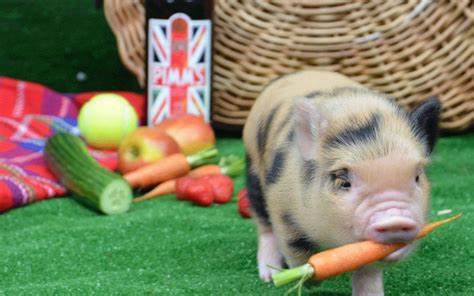
The name of the puzzle was “Cheap Thrills” and it had a whole bunch of neat tricks having to do with “economizing.” For example, there were no squares in two of the corners, to represent “Cutting corners.” And the word SINGLE had to be entered as SSIINNGGLLEE to represent “Stretching a buck.” In BICENTENTIAL CENTER, the two times “cent” appears it gets squeezed into one square to represent “Pinching pennies.”
But the best of all was a tuchas extravaganza right smack dab in the center of the grid! I’ll try to replicate it.
          I
          N
          C
          A
          N
A L B U M   A S S E T
          B
          U
          T
          T
          E
If you look closely, you will see CAN, BUM, ASS, and BUTT, all meeting in the center square. It represents “Making ends meet.” (“Economizing,” right?) Yes, this crapload of tuchases is in the staid NY Times. As Bob Dylan noted long ago: “The Times they are a changin’.” At least the puzzle standards are. There used to be a “breakfast test,” under which the puzzle should not contain any words that might discomfort a reader sitting down with it over his or her breakfast and coffee. I can’t imagine this buttfest would pass. But I’m not complaining. To the contrary, I love a good tuchas in my puzzles. Can’t get enough of ’em.
The clue at 11D was “Tranquil discipline,” and the answer was YOGISM. Many complained that it should just be YOGA, and one fellow said the clue should have been “It gets late early out here, e.g.,” — i.e. a YOGI-ISM. I added one of my favorites of Yogi’s — “I’d give my right arm to be ambidextrous.”
The clue at 47A was “Offering from Dr. Mom, in brief,” and it was TLC. And 64A was “Scrapbooker’s project,” for ALBUM. It led LMS to post:
“The clue for TLC and ALBUM made me feel mildly regretful for the kind of mom I was. If one of my kids came in crying from some fall, I’d look at the injured area, tell them they were fine, and send’em back out. No frantic assembling of ice, no Neosporin, no TLC. And I did briefly try my hand at scrapbooking but lost interest and patience after about 2 pages. I remember visiting a high school friend who had shelves of gorgeous scrapbooks. Gorgeous. I bet she had oodles of ready-to-go ice packs and Neosporin, too. On the way home, I did a frantic mental inventory of anything right I was doing as a mom:
1. I’d take them out in the woods after a rain to turn over rocks and logs looking for interesting bugs.
2. I packed them epic April Fool’s Day lunches.
3. I would have them point to the area of whatever to ask exactly where they wanted me to squirt the whipped cream, and then I’d start at that spot and continue squirting right up the length of their arm.That’s all I could come up with. AH ME.”
Hey, let’s class up the joint a little with some art. Jan van EYCK was in the puzzle today, the Flemish painter, born in 1390. The Ghent Altarpiece (below) is attributed to Jan and his brother Hubert and marks the transition from Middle Age to Renaissance art. An inscription that has been lost stated that it was started by Hubert, “greater than anyone” in art, and completed by Jan, identified as “second best.” (I’m not kidding: they sound like a hoot.)
Jan is considered by some to have invented oil painting; he at least was an early and significant user of it.
He was a punster, as noted in this Wikipedia entry: “Ten of his paintings are dated and signed with a variation of his motto ALS ICH KAN (As I (Eyck) can), a pun on his name, which he typically painted in Greek characters.”
LOL, van Eyck!
The altarpiece was seized by Hitler during the war and suffered some damage while stored in the Austrian salt mines. But it has been restored.
A great way to see his work is to click on: closertovaneyck. (That was shared by a commenter, and owl chatter concurs.)

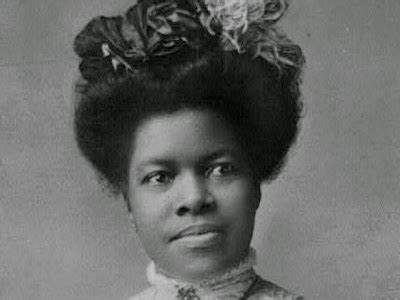
Let’s also welcome “Civil rights icon, NANNIE Helen Burroughs.” Born May 2, 1879 in Virginia, she was an educator and orator who fought for civil rights and women’s rights until her death in 1961. She founded the National Training School for Women and Girls, in Washington DC, renamed in 1964 as the Nannie Helen Burroughs School. Born to former slaves who prospered in freedom, Burroughs was devoted to her work and never married. The Library of Congress manuscript division holds 110,000 items of hers.
On a lighter note, here’s LMS on “economizing:”
“It’s interesting how we all have our ways of cutting back. Mom will eat pretty much any kind of leftover in the fridge, regardless of its age or state. (Once she burned the crap out of some Eggo waffles but insisted on eating them anyway in the waste-not-want-not spirit. She insisted they tasted fine.) For me, I buy these little ROC retinol capsules – you’re supposed to use one capsule every night all over your face, but they’re too expensive. So I cut a little opening to squeeze out a tiny amount for around my eyes. So one capsule lasts several days.”
That’s all fine and well. But it was this video she posted of her mom with the Eggos that literally had me roaring in laughter. You must give it a few (32) seconds! Turn the sound up — there is no talking, but the chomping noises are good.
Vermont Lizzie tells me there’s a small brunch in honor of Susan’s memory up there today, so here’s a small Susan and Robert story I’ve always enjoyed. I was up for a visit and Robert offered me an orange, “A Colorado orange,” he said, and he and Susan both chuckled. I did not chuckle because I had no idea what was going on, so they explained.
Susan was going out to do some grocery shopping a few days before, and she asked Robert if there was anything special she should get. He said, “Yes, get some more oranges — they’re delicious. And make sure they are Colorado oranges, I checked to see what they are.” Susan said OK, and went out to the car. But she came back a moment later and said “I thought oranges only come from Florida or California.” And Bob said, “Well, I checked, but let’s check again.” So he rooted through the trash to find the orange peel and dug it out. It said on it: Color added.
Ever since then, I refer to all oranges as Colorado oranges. And that also goes into the “makes life worth living” file, along with Zoey’s smile.
We’re doing our best, S. Miss you.
-
Vibe Check
Let’s open with a poem today. It’s from tomorrow’s Met Diary, and it’s by Danny Klecko.
45 Minutes in Central Park
Between the hours of 9 and 10
On a bench adjacent to mine
Sat a man who was not put together
A man in the grip of some battle
Big drops of rain began to fall
Raindrops by the tablespoon
The man refused to move
A woman with a terrier
Stopped as if she knew him
Offering dry comfort
Underneath her umbrella
The man began to cry
What determines luck?, who makes up the rules?
Why is value attached to everything but me?
The woman sat by his side
Put her arm around his shoulder
In silence, the umbrella twirled
Until she offered explanation
Everything will be fine, she said
Just not today
Today’s puzzle was by Sam Ezersky whom some of you may know as the dude who runs the Spelling Bee in the daily NYT online. (I don’t do that one; I only do Sunday’s.) Anyway, so it was neat to see his clue at 2D: “Unlikely trait for a beekeeper” (my italics). The answer was APIPHOBIA.
Right next to it at 3D, we got a sweet treat. “Snickers alternative” was MR. GOODBAR. And if your tastes run more to the hematologic, 1A was VAMPIRES, clued by “Those out for blood?” Rounding out that excellent corner, 1D was “Emotional assessment of one’s surroundings, in lingo,” with the answer VIBE CHECK. I can see using that phrase. Some party’s going on that you feel iffy about, so you send in your buddy to do a vibe check before committing.
Do you know what a pipit looks like? I sure don’t. I don’t even know what a pipit is. The clue was “Pipit lookalikes,” at 66A, and the answer was SKYLARKS. Here’s one!

According to Wikipedia, the female skylark builds an open nest in a shallow depression on open ground well away from trees, bushes and hedges. She lays three to five eggs which she incubates for around 11 days. The chicks are fed by both parents but leave the nest after eight to ten days. They scatter and hide in the vegetation but continue to be fed by the parents until they can fly at 18 to 20 days of age. Unless they try to make a living in the arts, in which case they are fed by the parents until their thirties. The skylark is known for the song of the male, which is delivered in hovering flight from heights of 50 to 100 meters, when the singing bird may appear as just a dot in the sky from the ground.
The toughest clue for me, was at 32A: “K, for Kay.” WTF? It turns out to be referring to Kay Jewelers. And for a jeweler, K stands for KARAT, which was the answer.
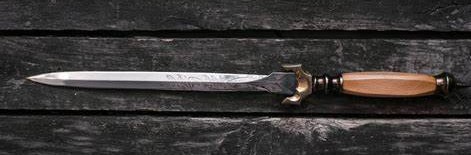
Hands up if you would say “Stiletto feature,” four letters, starting with H is “heel.” Well, it was HAFT, stiletto referring to the thin knife, as opposed to the sexy shoe most of us lunged for. Here’s a shot of the knife, so you can notice the haft (handle). Followed by one of my tax students, in her stiletto heels.

Let’s take a puzzle break. Wanna hear a joke? So these two Jewish guys are walking down the street and they come to a church with a sign out front that says: “Come in, convert, and we’ll pay you $50.” So one of them says, “I’m going to check it out; wait here.” He goes in and after about 45 minutes he comes back out. His friend says, “Well, what happened?,” and he says, “I converted.” His friend says, “Wow. Really?” He says “Yeah.” His friend says, “Did you get the money?” And he says, “Is that all you people care about?”
[I heard that joke told by someone on a panel of Jewish comedians discussing the old Sid Caesar Show. The subject of production costs came up and one of them said it cost $10,000 to produce an episode. And another one said, “For you, $9,500.”]
Sadly, a special Owl Chatter farewell to Ron Labinski, who died on New Year’s Day, at age 85, in Prairie Village, Kansas. If you’ve ever sat in a wonderful ballpark and couldn’t quite understand why you felt so happy, it may have been Labinski’s work. The Times described him as a “visionary” architect, and he specialized in ballpark design.
Labinski designed Orioles Park at Camden Yards, with that gorgeous warehouse wall beyond the right field fence. I’ve been down there for games 3 or 4 times. If you look around you notice that everyone is happy just to be there. It’s magical. The game is secondary. It has all the charm the new Yankee Stadium lacks. I’ve been there once and plan never to return. Labinski also designed Oracle Park in SF. Here’s a shot from Baltimore.

Spring training starts soon! Let’s play ball!
-
Cheap Thrills
There is a whole crapload of words the NYT allows in its puzzles now that it didn’t used to allow. CRAPLOAD, for example. The clue for 32D was “Crazy amount,” and I filled in “cartload” first (when I had the C and LOAD), but it was CRAPLOAD, for sure.
Here’s how Rex started off today: “Look, it’s a SHIT-LOAD and a CRAP-TON and I will die on this (filthy) hill! Actually I don’t care that much, but those are the expressions that feel right to me, and they both google better than their oppositely-suffixed counterparts (well, ‘crap-ton’ does … there are issues with whether you do or don’t include a hyphen in your search term). I think ‘shit-ton’ (hyphenated) is probably what I’d say soonest, of the whole lot, followed by ‘shitload’ (unhyphenated) … I think I have largely phased ‘crap’ (and its assorted variations) out of my life, as it feels like a euphemism that has somehow over time come to sound more vulgar than the thing it’s a euphemism for (namely shit).”
Surprisingly, I had not heard of the -ton ending for either of them. But I do love the idea of a euphemism becoming worse than whatever it’s euphemizing. (Spellcheck is accepting euphemizing, BTW.)
I shared the following joke with the gang, and have received no response yet (which may be for the best):
This guy’s wife dies and he’s depressed, so a friend suggests he get a pet for companionship. He goes to a pet store and explains his situation to the store-owner. The owner says, “Sure, take a look around, I’m sure you’ll find something. And check out the dog in the backyard. He’s very unusual – he can talk.”
So the guy looks around the store and finds a couple of possibilities, and then he glances out the window and sees the dog in the yard. So he goes up to him and says, “I feel funny about this, but the owner said you can talk. Is this true?”
And the dog says, “Yes, I can talk. When I was born I was a regular dog like my brothers and sisters, but around my first birthday I suddenly became able to talk. When word got out, the CIA took me on for special projects. For example, I’d slip into meetings and listen to what was said and report back to my handlers. But after a few years they started worrying I’d be caught, so I got transferred to the State Dept. I’d go on goodwill trips, you know, if a head of state was a dog lover, they’d bring me along and introduce me. I did that for a few years, but now I’m perfectly happy just relaxing out here in the yard.”
The guy goes back into the store, and the owner says, “Did you find anything?” And he says, “Yes, a few, but let me ask you — Is that dog out back for sale?” The owner says, “That dog in the back? — Yeah, you can have him for $10.” The guy says, “Just $10 for that amazing dog?” And the owner says – “Aw, he’s full of crap — he didn’t do any of those things.
The clue at 6D was “Something simple done for pleasure,” and the answer was CHEAP THRILL.
Here are some examples of what LMS said qualify for her:
-Sliding down a staircase banister on my fanny
-Spotting the local weatherman out in the wild
-Throwing up a helicopter leaf and watching its descent
-Petting a Newfoundland, any Newfoundland
-Pogo sticking
-Getting a student to bite on the old “henway” joke (see below)
-Blowing every single white fluff thingy off the dandelion so my wish will come trueMs. Smith, what’s a vestibule?
Well, hmm. It’s a lot like a henway.
What’s a henway?
A little over 3 pounds.
[Pause] Ms. Smith, you cringey.
I’m trying to think of what a cheap thrill for me would be. I do get a kick out of it when the conductor fails to ask for my ticket. Now that I’m a senior, though, it just saves me $4.90. It used to be around $10. Finding money on the street is always good. If it’s a penny, I adhere to the goodluck/badluck rule and only pick it up if it’s heads-up.
When I was teaching CPA Review classes I saved up all the lucky pennies I found and gave them out to the students to bring with them when they took the test. I also encouraged them to email me if any questions arose after our classes ended. And I remember once a young lady sent me an email saying she was taking the test in a week and she had a few questions for me. I answered them and wished her luck, and she wrote back to thank me and she said “I have the lucky penny.”
Other cheap thrills I can think of off the top of my head:
Zoey’s smile
Leon’s knock-knock jokes
When I get back to the car after the meter has run out but have not gotten a ticket.
When the pint of beer I ordered comes perfectly filled all the way up to the top of the glass.
When I tell a joke in class and it gets a good laugh.
When Taylor Smith is in the puzzle so I can search through photos and videos of her again. (Ana de Armas works for this too.)
When a train I am waiting for comes — the subway, NJ Transit — any train.
When anything I have ordered online is delivered.
When Karen the dental hygienist says, OK, we’re done, you can rinse now.
At 8D, “Annual competition that starts on the first Saturday in March,” was not Rabbi Heskel’s kishka-eating contest, which, seriously, you should stay away from (don’t ask). It was the IDITAROD. LMS shared this note on it (on the iditarod, not the kishka contest).
“Dad and I volunteered once at the IDITAROD, and it was a hoot. We did all kinds of stuff to help – erected a fence downtown Anchorage for the ceremonial start, took a dog-handler course so we could help a musher at the start, got to check the microchips on the dogs the morning of the race to make sure all the dogs were who they said they were.
“Our last job was to wait at the hotel headquarters for the small planes bringing back dogs who’d been disqualified by a vet for some injury, some reason it wasn’t healthy for them to continue. We’d stand out on this frozen lake (I think it was) and watch the planes materialize. As they got closer, we could see the little dog faces staring out the window, dejected. We’d get them off the plane, set them up on some straw with water and food, and then try to comfort them ‘cause every single one of them wanted to still be running with their buddies.”
Remember the “Big Dogs” t-shirts that were popular for a time? I had one that said: “If you can’t run with the big dogs, stay on the porch.” On the other side it just said “Big Dogs.” Looks like they’re still in business at bigdogs.com.

Wow, 3D really got me. The clue was “Praise for a queen,” and the answer was YAS. You hear of that? I hadn’t. It turns out it has nothing to do with, like, the Queen of England (aleha hashalom). It’s slang in the LGBTQ community, used for encouragement during the performances of drag queens. Hence, “queen” in the clue.
And how about “Pinched pasta” at 41A? Unrelated to shoplifted fusilli. The answer was FARFALLE. It’s pasta sometimes known as bowties or butterflies. It’s “pinched” in the center to form its shape. (In the puzzle, it was crossed by NERVES, clued with “Butterflies!” Well done!)

In Yiddish, farfel is small pellet- or flake-shaped pasta made of egg noodle dough and used in soups or as a side dish. The Baal Shem Tov, founder of the Hasidic movement, is said to have eaten farfel every Friday night because the word was similar to the word farfaln which means “wiped out, over and finished.” He considered the noodles symbolic of the end of the old week. It’s sort of a Yiddish food-based TGIF.
I’m more familiar with matzoh farfel at Passover, which is just matzoh broken up into little pieces mostly to be used in soup or baked into kugels.

And then there’s Farfel the Dog who was created by ventriloquist Jimmy Nelson and used in Nestle’s Quik ads from ’53 to ’65. Quite a run! An original talking Farfel can be seen at the Chocolate Experience Museum, located in Burlington, Wisconsin. Woof woof! Until you get out there, you can enjoy this funny ad.
14A was “Jumble of speech,” and the answer was WORD SALAD. So I’m thinking we’ll start with a word salad, followed by alphabet soup, but what else is on the menu? Synonym rolls would be good. And maybe whip up an omelet with a few items from the verb garden. We’ll manage.
1D was “Who reinvented the wheel in 1893?” Did you know the FERRIS wheel was invented by George Ferris, Jr. What are the odds? (That was a Robin Williams line. When he heard that Lou Gehrig died of Lou Gehrig’s disease, he said “Wow — what are the odds?”)
It was designed and built by Ferris for the 1893 World Expo in Chicago. It was meant to rival the Eiffel Tower that took the world by storm in the Paris Expo of 1889. It wasn’t the first wheel of its type, but they are all known as Ferris Wheels now. That one was 264 feet tall. The tallest today is in the United Arab Emirates and is 820 feet tall.
The one in Chicago was quite a feat of engineering and was very popular. There were 36 cars, each fitted with 40 revolving chairs and able to accommodate up to 60 people, giving a total capacity of 2,160. The wheel carried some 38,000 passengers daily and took 20 minutes to complete two revolutions, the first involving six stops to allow passengers to exit and enter and the second a nine-minute non-stop rotation, for which the ticket holder paid 50 cents.

Let’s close today with a pretty majorette, in honor of Super Bowl Weekend.
See you tomorrow!

ATLANTA, GA – DECEMBER 31: An Alabama majorette performs at halftime of the College Football Playoff Semifinal at the Chick-fil-A Peach Bowl between the Washington Huskies and the Alabama Crimson Tide on December 31, 2016. Alabama defeated Washington by the score of 24-7 at the Georgia Dome in Atlanta, Georgia. (Photo by Michael Wade/Icon Sportswire via Getty Images) -
Zeke Midas Wolf
Did you know that the Big Bad Wolf had a name? I guess that’s good, so his buddies didn’t have to call him “Big” or “Biggie” or “Big Bad,” as in “Hey Big Bad — What’s up with the Grandma suit?” He pops up all over the place, most notably in his ridiculous Grandma disguise in Little Red Riding Hood, and tormenting the Three Little Pigs. He also drops in at the end of The Boy Who Cried Wolf, and in the Russian Peter and the Wolf.
Disney’s version was introduced in 1933 in the cartoon short The Three Little Pigs, and it was in the comic strip incarnation that he was named: First name Zeke (1946), and middle name Midas (1949). Full name: Zeke Midas Wolf. I learned about this because today’s puzzle asked for ZEKE (Midas Wolf), described as the “Three Little Pigs” antagonist.
BTW, Zeke had a son, L’il Bad Wolf, who disappointed his dad by wanting to do good. (I’m not kidding.)

While we’re on the topic of names, Alex Rosen, today’s constructor, apparently expects us to know the names of the Magi, even though they are not named in the Bible. Tradition has them as Melchior, Caspar, and Balthazar. Caspar is the one in the puzzle, and one fellow noted he was the “friendly” one. Owl Chatter was able to snare a shot of him for you.

It was a great puzzle. The trick was that every two-word clue had to be reversed in order to get the correct answer. And they were clever. So, e.g., for the clue “Pan Asian,” you had to think Asian pan, and come up with WOK. For “Water buffalo,” you had to think “Buffalo water,” and the answer was ERIE (i.e., Lake Erie in Buffalo NY). My favorite was “Does not.” So reverse it to get “Not does.” The answer was BUCKS. Get it? “Doe” as in female deer. Deer that are not does are bucks (male deer).
The clue at 8D was very good. It was “Only human, briefly.” The answer was ADAM, who for a short time (briefly) was the only human. And at 16D “Went to third, say,” was SHIFTED. You had to think of shifting gears, not baseball.
One of the switcheroos was “Young musician.” You had to go with Musician Young, and the answer was NEIL, as in NEIL Young, one of Owl Chatters’ favorites. Here’s a little-known tune of his: “Falling Off the Face of the Earth.”
Neil Young is 77 now. He’s Canadian, and became a U.S. citizen in 2020. Welcome, Old Timer!
OMG, I had forgotten he’s been married to Daryl Hannah since 2018. Daryl is 62 in real life, which is about 40 years older than she is in my head. Young’s first marriage, to a restaurant owner, Susan Acevedo, lasted less than two years. He then had a five-year relationship with actress Carrie Snodgrass, who was nominated for an Oscar for her role in Diary of a Mad Housewife in 1970. They have a son Zeke who is 50 now (no relation to the Big Bad Wolf, see above), and who has cerebral palsy.
Young next married Pegi Young in 1978. He first met her in 1974 when she a waitress. They divorced in 2014 after 36 years of marriage, and she died in 2019. They had two children together, Ben and Amber. Ben has cerebral palsy, and Amber is epileptic. I don’t mean to define the kids by their conditions, only to note that parenting for Neil Young must not have been easy.
He’s a model train freak. He was part owner, and is now on the Board of Directors, of Lionel trains, and is named as co-inventor on seven patents related to model trains. Here’s a great “get off my lawn” shot of him. Then the missus, after a rough night.


This sentence is from Frank Bruni’s “For the Love of Sentences” feature this week. It was written by Sophie Gilbert in The Atlantic in an article about Pamela Anderson:
“In the ’90s, Anderson was one of the most famous women in the world, the highest-paid actress on the most-watched television show (that would be ‘Baywatch’), her scarlet swimsuit and box-blond curls covering more bedroom walls than Sherwin Williams.”
The story of Caresse Crosby, born Mary Phelps Jacob, is pretty amazing. I’m not sure Owl Chatter will be able to do it justice. She was known as Polly Jacob when she married Dick Peabody in 1915. The ceremony was conducted by Endicott Peabody, founder of the Groton School. The Peabodies, some said, had by then supplanted the Cabots and the Lodges as the most distinguished family in the Northeast. Still Dick was a loser — he drank and was a bad dad to their two children. He spent as much time away as possible, mostly on military assignments.
Into the story steps Harry Crosby, a war hero who, after completing his studies at Harvard, met Polly on July 4, 1920 at a picnic. Polly was 28 with two small children and Harry was 22, but KABOOM! Within two hours he confessed his love for her, appropriately, in the tunnel of love at an amusement park. He pursued her like Zelensky going after a shipment of rocket launchers. Polly said, “Harry was utterly ruthless. To know Harry was a devastating experience.” By July 20th, they were sleeping together, and after a night in NY’s Belmont Hotel she said, “For the first time in my life, I knew myself to be a person.” It was a massive scandal for the families involved.
Eventually, Polly and Dick divorced, and she married Harry, but it devolved into an open marriage with many affairs and much drugs and drinking. At the end of 1924, Harry persuaded Polly to formally change her first name. They briefly considered Clytoris before deciding on Caresse. [You cannot make this stuff up.] Her Wikipedia entry is “Caresse Crosby.”
When he was 30, Harry met 20-year-old Josephine Noyes Rotch and fell in love with her, despite her funny-sounding last name. They had an affair that ended after about a year when she married, but it was soon rekindled, with deadly consequences. On December 9, 1929 Harry was found in bed in New York’s Hotel des Artistes with a bullet in his head. He was in an affectionate embrace with Josephine who also had died of a gunshot to the temple. In case this is all not striking you as unusual enough: Both were dressed but had bare feet. Harry sported red-painted toenails and tattoos on the bottom of his feet. [I guess he wasn’t ticklish.]
The coroner determined that Josephine died two hours before Harry. It was never determined whether it was a murder-suicide or a double suicide. No suicide note was found. (As Larry David remarked when someone he knew committed suicide without leaving a note: “No note? Would it have killed him to leave a note?”) Harry left Caresse the equivalent of $1.5 million, but his parents had the will invalidated.
Owl Chatter fell down this rabbit hole because the clue in the puzzle today, smack in the middle at 38A, was “Garment patented in 1914 by Mary Phelps Jacob.” The answer was BRA. She wasn’t the first to come up with the concept, but she was first to go for a patent. I might have clued it with “What men have been desperately fumbling with since 1914.” Here’s Caresse.

That will do it for today. See you tomorrow!
-
Fred Terna
We continue to be surprised that China’s spy pinata is still wafting across the states. Here it is, sighted by Owl Chatter in the sky above New Mexico.

Maybe Biden was too busy with his big important speech to take a swing at it? Anyway, I can’t recall anything like this happening since the Israelis released their spy knishes over Lebanon back in 1982. Here’s one just before launching.

Fred Terna’s last name at birth was Taussig, but his parents adopted the name Terna and assumed false identities to hide from the Nazis in the Czech countryside. It worked for awhile but they were discovered in the fall of 1941 and sent to concentration camps. In Theresienstadt, Fred began to draw, using any materials he could find. He drew scenes of everyday life in the camp, like people lining up for soup. He buried his drawings in a tin box under the barracks floor. Before he was transferred to Auschwitz he turned the drawings over to another prisoner. He had not signed them in case they were found by the guards. After only two months, he was transferred again, to Dachau and was liberated by U.S. troops on April 27, 1945. He was ill and weighed 70 pounds but was alive. No one else in his family survived.
Terna said the prisoners made a promise to each other — if they lived they would “tell what it was like.” Terna honored the promise through his art. He studied art in Paris after the war, “informally,” he said, and eventually moved to NY where he supported himself with his artwork. Whenever possible, he also searched libraries and archives for the drawings he left behind. You can see his paintings and read about him on his website: fredterna.com, and a book was written about his work and life by Julia Mayer, “Painting Resilience.” His work is in the Holocaust Museum in DC, Yad Vashem, and other sites devoted to the Holocaust.
Below is one of his works, many of which portray the flames of the incinerators.
He died last December 8, at age 99, survived by his son Daniel, and his second wife Rebecca, a child of survivors. They married in 1982 and honeymooned in Israel. They visited a kibbutz that had a museum dedicated to the memory of the victims of Theresienstadt. The curator allowed them to look through boxes of material from the camp. One box contained a file of unidentified art, in the middle of which they found six of Fred’s drawings from the camp.


This poem by Ted Kooser is from Winter Morning Walks.
The long, December shadows
of bare trees
run far away from the woods.At sunrise, they cross a red pasture
and, though softened and torn
by stones and weeds,
strike out into the trees
on the opposite side,
leaving dark trails through the forest.
-
Bang Bang
China explained today that their spy balloon was inadvertently set adrift over the U.S. when they bent over to tie their shoe and let go of the string momentarily. Their Minister of Defense added: “C’mon fellas, you’ve all been there.” Biden, who has seven grandchildren, noted: “He has a point.”
Yesterday’s puzzle included the dating app GRINDR. One comment noted that there are other new terms that drop the final E, e.g., TUMBLR. He said it’s called “disemvowelment.” I had heard separately that when an E or an A shifts position in a word, it’s a VOWEL MOVEMENT.
Which reminds me of one of the funniest things our friend Carl ever worked on me. It was back during the era of “born agains,” during which many people wore pins that said things like “Ask me about the Good News.” I made the mistake of asking a young lady at our food coop about the Good News once while she was checking out my groceries at the register. She said the “good news” was that Jesus loved me. Good news, indeed. Hard to dispute. I thanked her, checked my change, and made a note never to ask anyone that again.
Anyway, so Carl was visiting a few weeks later and we were having a little brunch, and he excused himself at one point to use the rest room. When he returned I noticed he was wearing a little pin. It said “Ask me about my bowel movement.” Seriously, I had to be helped off the floor and back into my seat.

Today’s puzzle contained Scott Joplin’s “Maple Leaf Rag” at 6D. It led “Taylor Slow” to share a modern rag with us: William Bolcom’s “Graceful Ghost Rag.” It is lovely.
Harry Whittington died on Saturday in Austin TX. He was 95. He’s lucky he lasted that long — he’s the fellow Dick Cheney accidentally shot on a hunting trip back on Feb. 11, 2006. A little-known fact about that incident is that after shooting him, Cheney bent over and bit off part of his ear. [That last part is not true. I went for a cheap Tyson-Holyfield joke. Once it came to me, I had to go with it. Long-time readers of Owl Chatter will understand.]
Here’s how the NYT described the shooting in Whittington’s obit: “In the encroaching dusk, Mr. Cheney abruptly wheeled around to shoot a quail and instead shot Mr. Whittington in his face and upper body. He suffered scores of birdshot wounds.”
The two had met only briefly before the outing. Surprisingly, it was Whittington who apologized — for stepping into Cheney’s line of fire. At the time, Cheney acknowledged only that he was responsible for pulling the trigger. (Huh? Let me tell ya, folks — that’s one hell of an “only.” I don’t think I’ve ever seen an “only” stretched that far. “We only hit the iceberg, Captain.”))
Five years later, in his memoir, Cheney offered what The Times termed “an apology of sorts.” He wrote: “I, of course, was deeply sorry for what Harry and his family went through. [Of course.] The day of the accident was one of the saddest of my life.”
Whittington’s wounds were more serious than was revealed at the time. He had a mild heart attack after birdshot moved into his heart, and he suffered a collapsed lung. About 30 pieces of shot remained in his body, including one near his heart.
During his lifetime, Whittington was an effective prison reformer and worked to combat corruption in Texas. He was sensitive to the needs of the developmentally disabled, since his daughter Claire was in that condition, and he successfully pushed for the creation of a separate unit in prisons for them. He urged Gov. Rick Perry to sign a bill banning the execution of developmentally disabled people. Perry vetoed the bill, saying it would diminish the power of juries, and noting that Texas did not execute such people anyway. (The U.S. Supreme Court later banned the execution of the developmentally disabled. So, fuck you, Perry.)
Whittington is survived by his wife Mercedes whom he married in 1950, three daughters, six grandchildren, and six great-grandchildren. Sadly, his daughter Claire passed away last year.
Whittington kept the blood-stained vest he was wearing when he was shot, and used it to teach children the dangers of firearms. He hunted only infrequently after the shooting. He said “Some of my enthusiasm is gone.”
Ya think?
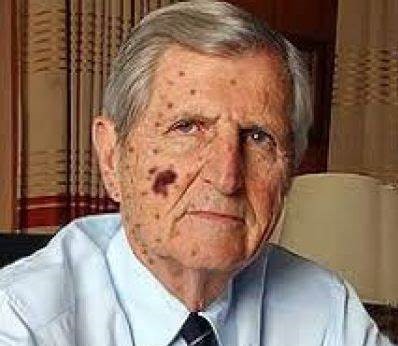
And Charlie Thomas died, at 85, last Tuesday. He was with The Drifters. They had some terrific hits and are in the Rock & Roll Hall of Fame. Who doesn’t recall Under the Boardwalk, There Goes My Baby, and This Magic Moment? Classics all. Their only song to reach #1 was Save the Last Dance for Me.
Oh, I know
Oh, I know
That the music’s fine
Like sparkling wine
Go and have your fun . . .But don’t forget who’s taking you home
And in whose arms you’re gonna be.
So, darlin’,
Save the last dance for me.I wonder how it would sound if Leonard Cohen sang it, don’t you?
Here’s a shot of Charlie Thomas, beltin’ it out — thanks for all the great tunes! — Rest in peace.

Sheldon “Shel” Silverstein was in the puzzle today. He was born in Chicago back in 1930. Has it really been over twenty years since he died? He was 68. He never married, and was quite a ladies man: a frequent guest at Playboy clubs and Hugh Heffner’s Playboy Mansion. He had two children, Shoshanna (which is Hebrew for Rose), who died of an aneurysm when only eleven, and Matthew, 38, a songwriter and producer in NYC. A Light in the Attic is dedicated to Shoshanna.
The Giving Tree was one of Caity’s favorite books when she was little. She knew it by heart. To say it’s a classic doesn’t say enough. He was a songwriter too. He wrote “A Boy Named Sue” which Johnny Cash turned into a huge hit.
Here are three samples of his writing:
Listen to the mustn’ts, child.
Listen to the don’ts.
Listen to the shouldn’ts, the impossibles, the won’ts.
Listen to the never haves, then listen close to me…
Anything can happen, child. Anything can be.How many slams in an old screen door?
Depends how loud you shut it.
How many slices in a bread?
Depends how thin you cut it.
How much good inside a day?
Depends how good you live ’em.
How much love inside a friend?
Depends how much you give him.If you are a dreamer, come in.
If you are a dreamer, a wisher, a liar,
A hoper, a pray-er, a magic-bean-buyer.
If you’re a pretender come sit by my fire
For we have some flax golden tales to spin.
Come in!
Come in!Silverstein also wrote this wrenching song, “Sylvia’s Mother,” nicely performed by Doctor Hook. Remember pay phones?
Whew. I’m pretty much wrung out now. See you tomorrow.
-
Earthrise
Take that, China! So much for their f**king balloon. We’re going to beat the crap out of their pinata next.
In a clear case of anti-Semitism, pitcher Max Fried lost his arbitration case against the Braves and will be pitching this year for an insulting $13.5 million, and not the $15 mil he demanded. Considering that he had a better year than the other Max, Max Scherzer (whom we also love), who is getting paid $43 million, this is clearly a shonda! Your day will come, Maxie — hang in there. We love you!
Max keeps his private life private. Owl Chatter was unable to confirm if he’s still dating USA soccer star Rose Lavelle. She’s lovely, as you can see, but Max has been complaining that, in bed, she doesn’t let him use his hands.

While we’re on the topic of star pitchers, supermodel/actress Kate Upton was in the puzzle today — wife of three-time Cy Young Award winner Justin Verlander, who will pitch for the Mets this year. They have a daughter Genevieve. Kate was born in Michigan, and her grandfather was co-founder of the Whirlpool Company. What in the world does Verlander see in her?

Born dead. Wait, what? You heard me — Bob Born is dead. He died at age 98 in Conshohocken PA and there won’t be another Peep out of him. He was a confectioner, head of Just Born Quality Confections, the candy company started by his dad in Brooklyn, but greatly expanded in Pennsylvania via automation by Bob. The company’s best seller is Mike and Ike, but the most loved items are Peeps, of which they make 5.5 million a day, and close to 2 billion a year. Most are sold around Easter, of course.
The record for Peeps consumption is held by Matt Stonie, a competitive eater from San Francisco, who ate 255 in five minutes. Stonie also won the Nathan’s hot-dog eating contest in 2015 and is ranked fifth among competitive eaters. Apparently, they are ranking eaters now.
How Peeps are eaten by the general public is a personal thing. Some folks pop them into their mouths right out of the package, but others let them age a few days, use them in s’mores, or even put them on pizza or infuse them into vodka. A company survey found that 30% of Peeps are not eaten at all — they are used in floral centerpieces, or as chess pieces or jewelry. Some are woven into clothing or wreaths.
In 2004, The St. Paul Pioneer Press sponsored a competition for “Peeps-based displays,” e.g., dioramas, and 80 papers around the country picked up the idea. The Washington Post runs the largest, often getting 600 or so entries. Past “themes” have included: “We Come in Peeps,” “The Ides of Marshmallow,” and “Sweety Todd: The Demon Barber of Peep Street.”
The company has fitted out two school buses with giant fiberglass Peeps that tour the country. “Peepsfest” is celebrated annually in Bethlehem, PA, where the company headquarters are. It culminates with the dropping of a giant Peep on New Year’s Eve.
Bob’s dad, Sam, was an innovator. He developed the process for attaching lollipop sticks to their candy tops, and invented chocolate that would harden quickly around ice cream, as in Klondike bars and pops. The company prospered even during the Depression.
Rest in Peeps, Bob Born.
Here’s a photo of Bob, on his way to work. That must be the Peepmobile, no?

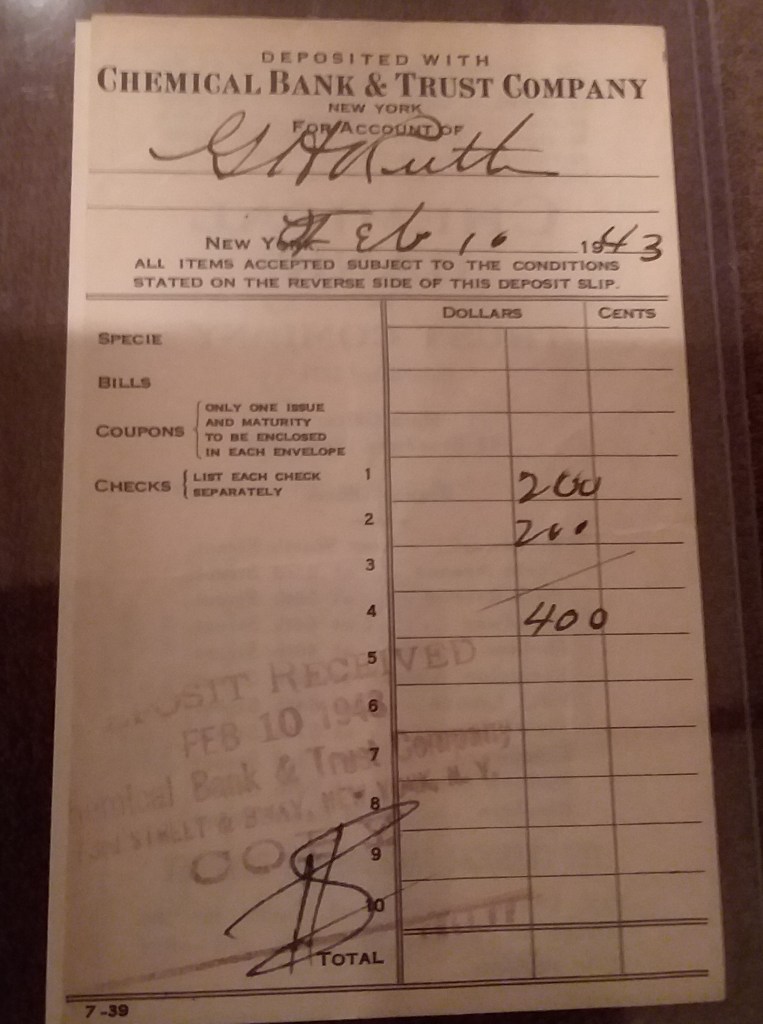
OMG, it’s Babe Ruth’s birthday today, born George Herman Ruth, Jr., in Baltimore in 1895. Only he and a sister survived out of eight children born to his mom. His parents struggled to eke a living out of a seedy neighborhood bar and he rarely saw them. I knew he grew up in an orphanage but I wrongly thought it was because he was an orphan. Not so — his father didn’t think he could raise the Babe so he signed custody over to the St. Mary’s Industrial School for Boys when he was seven and he spent twelve miserable years there.
On the other hand, one of the priests at St. Mary’s — Brother Matthias — taught him how to play baseball, and a scout for the then-minor-league Orioles saw him play one day, and signed him to a contract for a then-whopping $600. In training camp, the players referred to him as one of the scout’s “babes,” and it stuck.
I’m not going to throw stats at you (much), but I would like to note that in 1920, when Ruth led the majors with 54 home runs, that was more than the next three hitters combined: George Sisler (19), Tilly Walker (17), and Cy Williams (15). By contrast (not to diminish Aaron Judge’s impressive season), Judge’s 62 homers last year were less than half of the next three hitters combined: Schwarber (46), Trout (40), and Alonso (40).
I bought the item pictured below from another collector for $25 when I was in high school. It’s a deposit slip signed by Ruth. Good move.
In the puzzle today, the clue for IVANA at 17A was “The first Mrs. Donald Trump.” Here’s what Rex had to say: “Are there no other IVANAs in the world? Truly? And did the clue have to write out the entire full-ass name of that creep that used to be president?” I guess Rex isn’t a fan.
Nine down had me confused today. The clue was “Ancient tool for hunters or warriors,” and the answer was SPEAR THROWER. But isn’t the tool the spear, and the thrower the hunter who uses it? NO! I had not heard of a tool called atlatl (also known as a “spearthrower”) that enables the spear to be thrown at greater velocity and for a greater distance, by employing leverage. So the ancients did use such a spearthrower as a tool. Here’s a picture:

And commenter Joe Dipinto noted there are also mini-spearthrowers for when you have the urge to hurl asparagus at your enemies.
Rex has taken to solving Monday puzzles via the down clues alone. Others have too, feeling that the puzzle is too easy otherwise. And they sometimes seem a little too full of themselves when they crow to the rest of us mortals about it. There was a comment today spoofing them: “I solved using diagonals only. Backwards and reflected in a mirror. With the cyrillic alphabet.”
The theme of today’s puzzle by Taylor Johnson was “Earthrise,” the famous picture of the Earth taken by astronaut William Anders from lunar orbit during the Apollo 8 mission on Dec. 24, 1968. MOON was the answer in the lower left corner, and the word EARTH was contained within three long down answers (e.g., in HEART HEALTHY) in such a way that it “rose” across the grid. Here’s the famous photo.

CDilly52 shared the following on Rex’s blog:
We in the “older” category remember the “space race” that started in earnest in 1957 when, despite the US touting its plans to launch satellites in 1955, the USSR sent Sputnik up and followed that by being first to achieve manned space flight with Yuri Gagarin.
We cheered when Kennedy achieved Congressional backing for the goal of getting a man on the moon and safely home again by the end of the decade. Those were heady times indeed. We were awestruck as we followed the highs and lows and all of the excitement and gut wrenching fear of every flight. No internet or cell phones and three television stations – maybe four with public tv. And Walter Cronkite. And real news.
Until this Christmas, a stunning color print of EARTHRISE has hung in my husband’s office since Christmas 1986. Our daughter was hooked on space travel and all things “space” when Sally Ride became the first woman to “slip the surly bonds of earth” in 1983. Our Kate was only four.
My husband, ever a teacher and a lifelong student and aficionado of all things astronomy, aerospace and space exploration was thrilled when Kate showed interest. They made drawings of the solar system and went out to look at the stars. With every issue of Sky and Telescope magazine, he would distill the complex information for her and many bedtime stories were about our astronaut heroes and their adventures.
The Challenger tragedy of early 1986 was traumatic. Millions of us watched in real time as the day so many children were celebrating the “First Teacher in Space” ended in tragedy.
Still participating with her dad in their mutual interest, they spent extra time talking about the sacrifices made for progress and specifically about Challenger and the hope that things the scientists learned would help make the next mission that much better.
As their exploration continued, the Apollo program caught her interest. She loved thinking about walking on the moon. I only recently tossed her shoebox diorama of a toothpick and aluminum foil “LEM” on the mostly sand and spray painted styrofoam lunar surface.
The year came to an end and Christmas became the focus. The Smithsonian catalog landed in our mail box. One of the available items was a beautifully matted and framed color reprint of the iconic EARTHRISE photo from 1968. Kate showed it to me and said we “have to get this for Daddy.” We did, and it has been the focal point of his office ever since.
My daughter has since become a dedicated teacher of very challenged fourth through sixth graders. Her twelve students this year are all boys, and she says it is a completely new dynamic. At Thanksgiving, she said “All they want to talk about is evil aliens.” I asked her if they showed any interest in the factual side of space travel. She said she’d think about it.
I packed up EARTHRISE and sent it to her. She was thrilled and hung it in her classroom. None of her kiddos had ever seen anything like it. At first they didn’t believe it was taken from space. That was all she needed to get them wanting more. She started with the clip of the Apollo 8 crew seeing EARTHRISE for the first time and taking the pictures that became the photo on the wall.
We talked last weekend and she said they were demanding to see more actual “movies” from the NASA archives. She said she was so happy to be able to pass on all her Dad taught her about space.
If we’re lucky, we actually get glimpses of things that turned out well.
I’m in my office at Hunter today, waiting for my 4 pm tax class to start. I’m looking out my 15th-floor window, north up Lexington Avenue. Hey, there’s that goddamn Chinese pinata drifting across Northern Manhattan!! C’mon Biden, bang the crap out of it!! What the hell are you waiting for??

Good night, readers. See you tomorrow.
-
If You Say Run, I’ll Run With You.
OK if we start today with a poem?
It’s by Gail Mazur and it’s called Ice. It reminded me how much I love my incredible daughter Caitlin.
In the warming house, children lace their skates,
bending, choked, over their thick jackets.A Franklin stove keeps the place so cozy
it’s hard to imagine why anyone would leave,clumping across the frozen beach to the river.
December’s always the same at Ware’s Cove,the first sheer ice, black, then white
and deep until the city sends trucks of menwith wooden barriers to put up the boys’
hockey rink. An hour of skating after school,of trying wobbly figure-8’s, an hour
of distances moved backwards without falling,then—twilight, the warming house steamy
with girls pulling on boots, their chafed legsaching. Outside, the hockey players keep
playing, slamming the round black puckuntil it’s dark, until supper. At night,
a shy girl comes to the cove with her father.Although there isn’t music, they glide
arm in arm onto the blurred surface together,braced like dancers. She thinks she’ll never
be so happy, for who else will find her graceful,find her perfect, skate with her
in circles outside the emptied rink forever?
Today’s puzzle, by Jeremy Newton, was right up Owl Chatter’s alley. Bad puns! It took Oscar-winning (for sound) movie titles and played with their names. So one clue was: “Why the Devil was forced to pay ‘The Greatest’” was HELL OWED ALI. Say it out loud: Hello Dolly! My other fave was: Bronzed NY basketball player from Bangkok.” That was THAI TAN KNICK.
That last one led one commenter to share this SNL bit that was pretty good and new to me: an interview with the (very defensive) iceberg.
(“First of all, you hit me.”)Aside from the themers, some of the regular cluing was terrific. “Therein lies the rub” was the clue for SPA.
“End of a flight, in two senses,” was the clue for LANDING (plane and stairs).
“On display, as a painting,” was the clue for WALL HUNG. Several folks noted one small change in a crossing clue could have made it WELL HUNG. Darn! So close.
Curmudgeon Rex did not like the puzzle, which led LMS to refer to his negative writeup as a “Rexcoriation.”
The clue for ALOHA at 10D was “Greeting that means, literally, ‘love.’” LMS said she was jealous of the way other cultures greet each other. E.g., Konnichiwa (Japanese) – kinda like, “And what about today?” And Sawubona (Zulu) – “I see you and value you.”
She went on: “We get stuck with “How You Doin’?” And pray pray pray the person recognizes the question as the phatic communion that it is and not an actual inquiry into their well-being. This is especially true when running into one of Mom’s friends at the mailboxes. Safer to lead with Hey! Nice weather, huh? or How ‘bout them Panthers! than to ask how they’re doing ‘cause let me tell you, They. Will. Tell. You. After impatiently listening about their latest doctor visit, MRI, fall, rash, ache, I leave hating myself for being so indifferent to their loneliness.”
I didn’t know the word “phatic.” Here’s what the dictionary says: denoting or relating to language used for general purposes of social interaction, rather than to convey information or ask questions. Utterances such as hello, how are you? and nice morning, isn’t it? are phatic.
David Bowie’s 1983 hit LET’S DANCE was in the puzzle. Here’s a good video performance of it.
David Bowie was born David Robert Jones in London on Jan. 8, 1947 and died in NY two days after his 69th birthday in 2016. He shares his birthday with Elvis. By age 6, in nursery school, he developed a reputation as a gifted and single-minded child, and as a defiant brawler. When he was nine, his dad brought home a bunch of American 45’s, including Little Richard’s Tutti Fruitti, about which Bowie said it was like “hearing God.”
For the financiers among you, in 1997 “Bowie Bonds” were issued, the first modern example of celebrity bonds. By forfeiting 10 years worth of royalties on 287 songs, Bowie received $55 million up front from Prudential. The bonds liquidated in 2007 and the rights to the income from the songs reverted to Bowie.
In 2016, filmmaker Michael Moore wanted to use Bowie’s song Panic in Detroit for one of his films. Denied at first, Moore was given the rights after calling Bowie personally, recalling: “I’ve read stuff since his death saying that he wasn’t that political and he stayed away from politics. But that wasn’t the conversation that I had with him.”
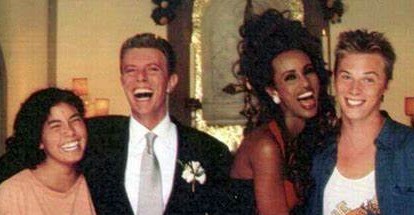
His sexuality was fluid. Bowie was married to his first wife, Mary Angela Bassett, for ten years, and they had a son, Duncan. Bowie said “living with her is like living with a blow torch.” He was married again twelve years later to Somali-American model Iman, and they had a daughter Lexi.
You don’t need Owl Chatter to tell you how successful he was artistically and commercially. Let’s put it this way: He has a spider and an astral constellation named after him. He’s on postage stamps and local currency. There is a statue of him in Aylesbury, where Ziggy Stardust debuted.
He was cremated in New Jersey, and his ashes were scattered in a Buddhist ceremony in Bali, Indonesia.
Here’s a shot of David, Iman, and the two kids.
Owl chatter took a rare outing to the movies yesterday, to see The Banshees of Inisherin. Loved it. Very beautiful and very unusual. Four members of the cast received Oscar nominations.
Against the backdrop of the 1922-1923 Irish Civil War, the film centers on the relationship between two men. The older of the two, Colm, decides to end their friendship, and, to say the least, the younger, Padraic, has trouble understanding or accepting that. Colm concedes Padraic is “nice,” but says he’s dull and would rather spend his time devoted to his music. As the old song says, “breaking up is hard to do.”
Colin Farrell’s sister was played by Kerry Condon, whom some of you may recall from Better Call Saul, where she plays Mike’s daughter. She’s up for Best Supporting Actress in Banshees.
Born on January 9, 1983 in Thurles, in County Tipperary, Condon is Irish through and through. She has a soulful, intelligent, haunting beauty that is hard to capture in a photograph. This is the best I could do.

Here are the last two paragraphs in today’s Modern Love column in The Times. If you haven’t read it yet, it won’t ruin it for you.
“But if you lose someone you love, as I may soon lose Kevin, you will kick yourself for missing out on the five minutes you could have spent standing outside of a hospital entrance in the freezing cold among the smokers and the security guards.
“So, find the people you want to be around and be around them. Invent a ridiculous excuse to spend an afternoon in their company: Go shopping for Scotch tape, watch them buy groceries, whatever. Call the person you love most, right now, and say: I have to buy ink cartridges for my printer. Would you like to come along?”

Or invite them to read Owl Chatter with you!
See you tomorrow. Thanks for stopping by.
-
Noisy Confidence
Yesterday’s puzzle answer OAST (Outbuilding that’s sometimes converted into a dwelling), inspired a few poets. A new one was just posted that earns the Owl-Chatter funny-poem hat today:
Kevorkian’s just-opened Oast
Is not for patrons milquetoast.
If thrombosed or sclerosed,
diagnosed tuberculosed,
they’ll be necrosed as a ghost by the host.I commented that I liked that one the moast. (Please see yesterday’s Owl Chatter for another oast limerick and a nice photo of an oast.)
Today’s puzzle had a lot of neat phrases and expressions. For “Line at the door of a bar,” the answer was LET ME SEE SOME ID. It was nicely crossed by BESOT (“inebriate”). It evoked the following note from our favorite commenter, LMS:
“OK – I have one LET’S SEE SOME ID story. When I was a cocktail waitress, I hated when people whose age looked iffy came in. If they ordered, say, Dewars on the rocks, I let it go. But order a strawberry daiquiri, buddy, and I have to see some ID. One early evening these two guys came in, and one looked iffy, so I approached bracing myself for the ID confrontation. Happily, the youngish one just ordered an OJ and then asked about the piano that was sitting there and could anyone play it. I shrugged and mumbled something about our having rented it for New Year’s Eve. I was at the bar getting their order when all hell broke loose – even the cooks came out of the kitchen to gape. I’ve never seen anyone assault a piano like that. Talk about your instant mood lifter. His name is Jason D. Williams, and we became friends. So I’m a bit of a big deal.”
Here’s Williams at the keyboard with a band. Watch it through til the end with the volume turned up. I guarantee it will knock your socks off — from inside your shoes. I’m just glad I didn’t lose any toes.
That reminds me of a Sam story. I was visiting him in Annie Arbor when he was an undergrad at UMich, and we had some plans for the day so I was picking him up in the morning. He told me not to ring the doorbell because his roomies would still be asleep. I was to call him when I got there and he’d come out. So I found a spot a few houses down, gave him a call, and he said he’d be out in a few minutes.
Glancing around, I noticed a single black sock sitting in the street by the side of the curb. It seemed odd because it was winter so what one usually found in the street was a single glove, or a knit cap. Socks are generally securely encased by shoes — how would a single sock get out? How drunk must this kid have been? — “Hold on a minute fellas, I have to tie my shoe. Oops it came off. And there goes my sock! Hold on guys. Where did it land? Oh, never mind,” and he goes staggering off down the street with one sockless foot. Was that what happened? Or was he just so drunk that he suddenly had to take one sock off and heave it into the street? In any event, I felt very lucky not to be the parent of that poor sot.
After a few more minutes, I saw the door to Sam’s house open and out popped Sam. He saw where I was parked, waved hello, and locked the door behind him. As he was walking to the car, he noticed the sock in the street. He bent over and picked it up. “I’ve been looking for this,” he said as he got into the car.
What?! That’s yours? You better have a good story on how it got there!
He did. It had fallen out of the pillowcase he was using as a laundry bag on his way back from the laundromat. We had a wonderful day, as we always did in that wonderful little city. Go Blue!

“Sanctuary for many couples,” was a nice clue for ARK. As was “Unconditional condition,” for TRUE LOVE. They prompted commenter Lewis to recall a terrific clue by this constructor (Kate Hawkins) in an earlier puzzle of hers: The answer was HOLE PUNCH, and the clue was “Inefficient confetti-making tool.” Ha!
Here’s a word for you that only exists in Crossworld, and, in fact, only in Rex Parker’s small corner of it. So Owl Chatter readers will be among the very few people in the world who know it. It was coined a while back by a Rex commenter. She noticed that it sometimes weirdly happens that you enter a wrong answer in one part of the puzzle and then find it to be the correct answer elsewhere in the grid. It happened to Rex today. The clue at 1A was “Smart,” and Rex wrongly filled in ACHE. (It turned out to be CHIC.) But ACHE was the correct answer at 32A for “Long.” When that happens, it’s called a “malapop.”
You’re going to need to know what a contrail is for the poem by Kooser I’ve reproduced below from Winter Morning Walks. A contrail is a trail of condensed water from an aircraft or rocket at high altitude, seen as a white streak against the sky.

Here’s the poem.
Walking in darkness, in awe,
beneath a billion indifferent stars
at quarter to six in the morning,
the moon already down
and gone, but keeping a pale lamp burning
at the edge of the west,
my shoes too loud in the gravel
that, faintly lit, looks to be little more
than a contrail of vapor,
so thin, so insubstantial it could,
on a whim, let me drop through it
and out of the day,
but I have taught myself
to place one foot ahead of the other
in noisy confidence
as if each morning might be trusted,
as if the sounds I make might buoy me up.
Thanks for stopping in. See you tomorrow.
-
Subscribe
Subscribed
Have a WordPress.com account? Log in now.

